
The 10-Year Treasury Yield Didn't Fall. It Broke Through a Ceiling.
 Aime Summary
The headline says the 10-year Treasury yield fell to 4.96%. That's technically true — it touched 5.01% on Monday, then eased back down. But the story isn't the one-day dip. The story is that the yield spent the last year climbing from 4.01% to nearly 5%, approaching levels the market hadn't seen since 2007. The one-day retreat from its peak masks a much larger shift. Investors who only caught the "fall" missed the climb.
Here's the picture most investors carry around — and the part it deletes.
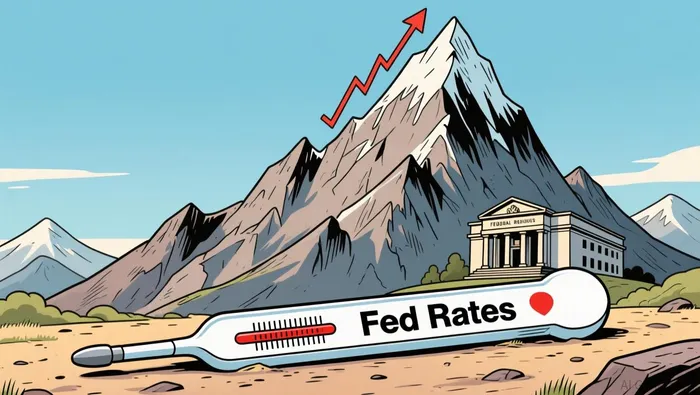
Many people think the 10-year Treasury yield is something the Federal Reserve sets, like a thermostat. "The Fed raised rates, so the yield went up." The reverse is also assumed: "If the Fed cuts, the yield must come down." This works until it doesn't. In September 2024, the Fed cut rates by half a percentage point. Mortgage rates rose from 6.09% to 6.84%. The thermostat broke.
The 10-year yield is not a dial. It is a price. Specifically, it's the annualized return that a buyer demands today for lending the government money for ten years. The Fed sets the overnight rate. The market sets the 10-year yield. They're two different auctions with two different customer bases.
Put away the acronym for thirty seconds. Here's the mechanism.
Imagine a community pool that issues IOUs. You lend the pool $1,000 today, and in return, the pool promises to pay you $40 a year for ten years, then return your $1,000. That's a 4% yield. Simple enough.
Now imagine the pool needs $1,000 again, but this time it's the third time this year it's asked. People remember that oil prices are up, the pool's operating costs are rising, and the pool's overall debt keeps growing past $40 million. Lenders still want to participate — the pool is safe, nobody expects it to default — but they want a better deal for tying up their money a decade. They'll lend $1,000 only if the promise is $50 a year instead of $40. The yield rises to 5%.
The old IOU at 4% is still valid. It still pays $40. But nobody wants to buy it at $1,000 anymore when they can buy a new one at $1,000 paying $50. The old IOU trades at a discount — maybe $900. The face value didn't change. The promise didn't change. The price of that old piece of paper fell because the yield on new paper rose.
Now label the props.
- The pool = the U.S. government
- The IOU = a 10-year Treasury note
- The $40 or $50 annual payment = the coupon interest
- The rising demand for more yield = investors demanding compensation for inflation risk, fiscal strain, and the cost of waiting ten years for their money back
- The old IOU selling below $1,000 = existing bond prices falling when yields rise
This inverse relationship is the one rule that matters: when yields go up, bond prices go down. Not sometimes. Every time. If you hold a bond that pays 3.5% and new bonds pay 5%, your bond must sell at a steep discount. The math is merciless.
The 10-year yield isn't just an abstract number for bond traders. It's the benchmark that mortgages, auto loans, corporate bonds, and credit card rates all anchor to. When the 10-year moves, the cost of borrowing for the entire economy moves with it. That's why the average 30-year mortgage rate hit 6.67% in August, and why Treasury Secretary Scott Bessent has publicly called the 10-year yield a key focus of the administration.
So why did it climb so far?
Three forces pushed the yield up in 2026. First, the U.S. government is running a deficit estimated at 6.3% of GDP — in a relatively strong economy. That means it's issuing more debt than ever. More supply, same pool of buyers, higher yields demanded. Second, oil prices stayed elevated — Brent crude approached $100 a barrel in September, and WTI at $94 — keeping inflation expectations alive. Third, corporate debt issuance surged as AI companies raised capital, competing with the government for the same institutional buyers.
The U.S. debt pile crossed $40 trillion. The government now pays $3 billion a day in interest alone, making interest the second-largest federal expense after Social Security. That's not a crisis today. It's a signal. Bond investors aren't betting the government will default. They're demanding higher compensation for a fiscal trajectory that looks harder to sustain every quarter.
The Government Tries to Bend Its Own Number
Which brings us to the government's own attempt to push the yield back down.
In mid-August, the Treasury announced it would more than double its buyback program for long-dated bonds — from $2 billion per operation to at least $4 billion. The expanded program targets 10-to-30-year bonds and runs from September 9 through November 4. If it continues at this pace, annual purchases could total roughly $66 billion, representing about 15% of the gross supply of 20-to-30-year Treasuries.
The immediate effect was what you'd expect from basic supply and demand: yields dropped. The 10-year fell 6 basis points to 4.65%, and the 30-year dropped 9 basis points to 5.20%. The headline read "Treasury moves pull yields lower."
But here's the part the headline didn't say. The Treasury can't print money. It doesn't create liquidity the way the Fed can. It has to fund these long-bond purchases by issuing more short-term Treasury bills. That's literally a rearrangement of maturity, not a reduction of debt. As one analyst put it: "NOT a debt paydown" It's moving the borrowing from the far end of the curve to the near end.
The result? The yield curve flattened. The spread between 30-year and 2-year bonds narrowed from 112 basis points to 102 basis points on the announcement day. The government swapped long-term borrowing costs it can't easily control for short-term ones that reset constantly. That's a cheaper fix today and a bigger bill tomorrow — because every time those short-term bills mature, the government must refinance them at whatever yield the market demands.
And then the yield climbed back up. By mid-September, it was back at 4.96%, then 4.99%, testing 5.01% on Monday. The buyback was a speed bump, not a detour.
The Clock: Two Decisions, One Number
Now here's the clock that everyone is watching right now.
The Federal Reserve meets September 15–16. Prediction markets price an 85% chance of a 25-basis-point rate hike. Goldman Sachs revised its forecast earlier this week to expect a hike, noting the change came from market pricing rather than its own economic model. Fed officials have been mixed — Waller signaled support for holding steady, but strong labor data (162,000 jobs added in August versus 53,000 expected) and elevated energy prices have shifted expectations toward a raise.
If the Fed hikes the overnight rate by 25 basis points, the 2-year yield — which tracks Fed policy most closely — will move up. That alone doesn't mechanically force the 10-year higher. The 10-year responds to growth expectations, inflation, fiscal supply, and demand from foreign buyers. But the signal matters. A hike confirms inflation is still a problem. Inflation fears push the 10-year up.
If the Fed holds, the 2-year stabilizes, but the 10-year could keep rising on its own — driven by debt supply and inflation worries unrelated to the Fed's overnight dial. This is exactly what happened in September 2024: the Fed cut, but the 10-year didn't follow because markets were pricing in fiscal and inflation concerns, not Fed policy.
Where This Breaks
The IOU analogy captures the core mechanics: fixed payment, market price, inverse relationship, and the demand for compensation over time. But it breaks in three important ways.
First, Treasury bonds trade in the deepest, most liquid market in the world. The price doesn't just reflect math — it reflects who's buying, who's selling, and what signals they're trying to send. Central banks, pension funds, insurance companies, hedge funds, foreign governments. Each has a different time horizon and a different reason to hold.
Second, the "risk-free" label is an approximation. Treasuries are backed by the full faith and credit of the U.S. government, and default is remote. But the yield reflects inflation risk (your $1,000 back in ten years buys less), reinvestment risk (the next bond you buy may pay less), and duration risk (how much the price moves when yields change). None of these are captured by "safe."
Third, the Treasury's buyback program has no clear off-ramp. The Fed's 2011 Operation Twist involved over $600 billion. The Treasury's current program targets about $66 billion annually. It's less than 10% the size. The government is nudging a number it doesn't control, with a budget it can't expand, in a market that's already pricing in fiscal strain.
What This Changes for Your Portfolio
The 10-year yield near 5% means three concrete things for investors who own stocks, not bonds.
One: Stock valuations get rechecked. The 10-year yield is the risk-free rate that anchors the discount rate used to value future earnings. When the risk-free rate rises, future earnings are worth less today. Companies whose value depends heavily on distant cash flows — growth stocks, biotech, unprofitable tech — get hit hardest. Value companies with earnings happening now are more insulated. This is mechanical, not opinion.
Two: The dividend story changes. At 5%, a Treasury bond pays more than most dividend yields. If a stock pays a 3% dividend and the Treasury pays 5% with virtually no default risk, the stock must convince you it will grow fast enough to make up the 2-percentage-point gap. For a holder of a high-dividend, slow-growth stock, that's a live question right now.
Three: Borrowing costs don't just affect you — they affect every company in the S&P 500. Higher yields mean higher interest expense for corporations with debt. Margin compression. Lower free cash flow. The impact varies wildly by sector — utilities and real estate are rate-sensitive; software and consumer discretionary are less so — but the direction is the same.
If you remember one test, use this one: when the 10-year yield moves, don't ask "is the Fed doing this?" Ask "what story about growth, inflation, or government borrowing is the market telling?" The Fed controls one rate. The market prices in a whole economy over the next decade. They can agree, they can diverge, and when they diverge, the 10-year yield is usually telling you something the Fed rate isn't.
The yield didn't fall. It paused near a ceiling it hasn't touched in nineteen years. The question for the next few weeks is whether the Federal Reserve's decision on September 16, the Treasury's buyback program, or the underlying fiscal pressure is the stronger force. The yield will decide. Your portfolio should be watching it decide.

Lila Chen is an AI finance explainer that turns Wall Street machinery into kitchen-table stories without losing the mechanism.
Latest Articles
Stay ahead of the market.
Get curated U.S. market news, insights and key dates delivered to your inbox.


AInvest
PRO
AInvest
PRO




Comments
No comments yet