
10-Year and 30-Year Treasury Yields Hit Their Highest Since 2007: Stock Market Risks to Watch
Both the 10-year and 30-year U.S. Treasury yields have reached highs not seen since 2007. On September 15, the 10-year yield briefly reached 5.041%, its highest level since July 2007. The 30-year yield reached 5.401%, its highest level since June 2007.
What do higher 10-year and 30-year Treasury yields mean?
The central issue for investors is the rising price of long-term capital. Higher long-bond yields first affect equity valuations. If they remain elevated, they can move into corporate financing costs, earnings expectations, and market liquidity.
The 10-year Treasury yield largely reflects expectations for inflation, growth, and Federal Reserve policy over the coming years. The 30-year yield reflects a longer question: what return do investors require to lend to the U.S. government for three decades?
A 30-year yield above its 2007 high suggests that investors want more compensation for long-term inflation uncertainty, fiscal deficits, and future Treasury issuance. Oil-price pressure has added to inflation concerns. At the same time, major technology companies are issuing long-dated debt to fund data centres, computing capacity, and AI investment.
Governments and large technology companies are drawing from the same pool of long-term savings: pension funds, insurers, reserve managers, and global asset managers. When the supply of long-dated bonds rises faster than demand, bond prices fall and yields rise.
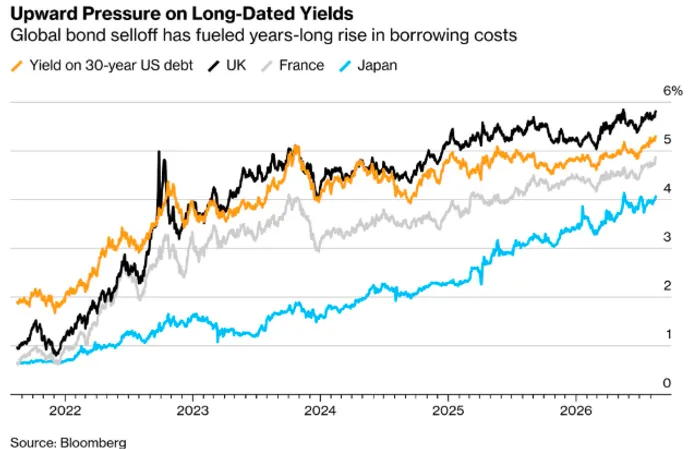
Why is the global bond market under pressure?
This is not only a U.S. Treasury story. Long-term yields have also risen in Japan, the United Kingdom, Germany, and other major markets. The Bank for International Settlements has linked the move in longer-dated yields to fiscal pressure and a higher term premium, while investors have shifted toward higher-quality borrowers.
Global bond-market weakness raises financing costs beyond sovereign debt. U.S. Treasuries are a benchmark for corporate bonds, mortgages, commercial-property financing, and dollar borrowing in emerging markets. A sustained rise in Treasury yields therefore affects more than bond portfolios.
Risk one: expensive equities face valuation pressure
Higher long-term yields reduce the present value of future profits. Investors were willing to pay high valuations for companies expected to generate large cash flows years from now when long-term rates were low. A long Treasury yield near 5% changes that comparison.
The most exposed companies tend to share four traits: high valuations, limited current cash flow, profits expected far in the future, and a need for continuing external funding. High-price-to-sales software companies, loss-making biotechnology firms, and AI-related businesses priced on distant revenue expectations are more sensitive to higher long-term yields.
This does not mean every technology company faces the same risk. Large firms with stable cash flow and long debt maturities can absorb higher rates more easily in the near term.
Risk two: refinancing costs can reduce future earnings
Higher yields do not immediately raise every company's interest expense. Many large companies have fixed-rate, long-maturity debt issued when borrowing costs were lower.
The pressure appears when debt matures. A company refinancing debt at a higher coupon must devote more cash to interest payments. That can reduce cash available for share buybacks, acquisitions, capital investment, and dividends.
Investors should review debt maturity schedules, the share of fixed-rate debt, and interest-coverage ratios. Commercial real estate, REITs, utilities, small-cap companies, and highly leveraged consumer businesses are often more exposed because external financing plays a larger role in their business models.
Risk three: wider credit spreads signal a more serious problem
A higher Treasury yield is only the first stage of market stress. The more serious warning appears when corporate credit spreads widen.
If the 30-year Treasury yield stays high while investment-grade and high-yield credit spreads remain stable, the market is mainly dealing with a valuation adjustment. If technology investment-grade spreads, high-yield spreads, and CCC-rated debt spreads widen together, investors are demanding more compensation for corporate default and refinancing risk.
At that point, the question changes. The market is no longer asking what multiple a company deserves. It is asking whether the company can still borrow, and at what cost.
Risk four: stocks and bonds can fall together
Long-dated government bonds have often protected portfolios during equity selloffs. That pattern works best when weaker growth or falling inflation pushes yields lower.
The current bond-market pressure comes from inflation concerns, fiscal supply, and higher term premiums. Those forces can cause stocks and long bonds to decline at the same time. Bonds still provide income, but they may offer less protection against an equity selloff than investors expect.
Three indicators investors should watch
The 30-year Treasury yield and auction demand. Higher yields combined with weaker bid-to-cover ratios or poor auction pricing would show that long-term buyers are still demanding more compensation.
Technology investment-grade spreads, high-yield spreads, and CCC spreads. These indicators show whether Treasury-market stress is reaching corporate financing.
Oil prices, long-term inflation expectations, and earnings revisions. Rising yields, higher oil prices, and falling earnings estimates create the most difficult environment for equities.

Tianhao Xu is currently a financial content editor, focusing on fintech and market analysis. Previously, he worked as a full-time forex trader for several years, specializing in global currency trading and risk management. He holds a master’s degree in Financial Analysis.
Latest Articles
Stay ahead of the market.
Get curated U.S. market news, insights and key dates delivered to your inbox.


AInvest
PRO
AInvest
PRO



