
How Much a $1 Million IRA Forces You to Withdraw — and Whether Your Income Covers It
 Aime Summary
Here is a number nobody hands you when you leave the workforce: after a point, the IRS requires you to write yourself a check out of your own IRA every year, whether you need the money or not. On a $1 million account, the first full year's check is roughly $37,700. At 75 it is about $40,700. By 85 you are pulling out roughly $62,500 a year, and the number keeps climbing.
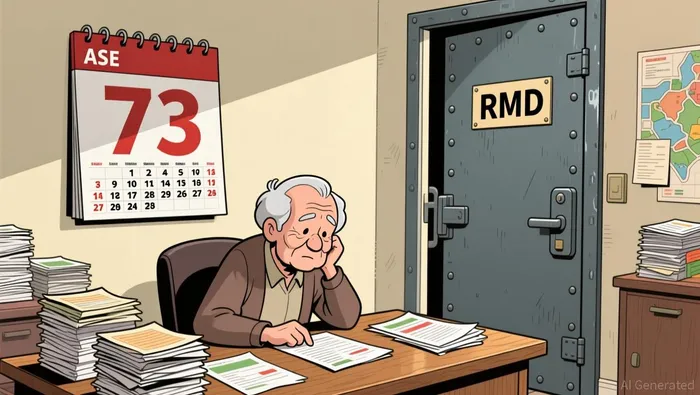
That is the required minimum distribution, and for anyone carrying a large tax-deferred balance into retirement it is the most important number in the plan. It is not a suggestion and it is not optional. It is a floor on how much cash has to leave the account each year, and how your portfolio's own income interacts with that floor decides whether retirement feels like a cash-flow problem or a series of forced sales.
The check you can't decline
Here is how the number is set. The IRS does not ask what you spend, what the account earned that year, or how the market is treating you. It divides the account balance on the previous December 31 by a "distribution period" from its Uniform Lifetime Table, and that divisor is really just a published life expectancy. The older you get, the shorter the IRS's life expectancy, the smaller the divisor, and the larger the percentage that must come out. That is why the withdrawal is a percentage, not a fixed dollar amount: the same $1 million forces out a bigger slice every year you live.
| Age | RMD as % of balance | Withdrawal on a $1M balance |
|---|---|---|
| 73 | 3.77% | about $37,700 |
| 75 | 4.07% | about $40,700 |
| 80 | 4.95% | about $49,500 |
| 85 | 6.25% | about $62,500 |
| 90 | 8.20% | about $82,000 |
Your starting age depends on your birth year: 73 for people born beginning in 1951, and 75 for anyone born in 1960 or later. Roth IRAs sit outside this whole machine — no RMDs while the owner is alive — which becomes important to the strategy at the end.
An RMD is really a yield the IRS imposes
Now read that ladder the way an income investor should: as a mandatory payout the account is being asked to make. The RMD is, in effect, the IRS imposing a yield on your portfolio, and the question it forces is whether your holdings already throw off that much cash on their own, or whether you will have to sell pieces of the portfolio to make up the difference.
Almost nobody starts in the comfortable zone. The plain stock market pays roughly 1% in cash today; even a broad "high dividend" fund pays only about 2.2%. By age 73 the RMD already demands 3.77%, so a conventional IRA reaches its first RMD year with a shortfall. Take a $1 million account yielding 2%: the required check is about $37,700, the account produces about $20,000, and the missing $17,700 has to come from selling shares — every year, on top of whatever the dividends provide.
That is where the real damage lives. Selling shares to fund a withdrawal you can't decline means accepting whatever prices the market gives you that particular December, and the forced sales show up precisely in the ugly years when your balance is already down. Ordinary income cash has no such weakness: dividends that arrive from rents, interest, lending spreads, and payouts do not care what the quote says. Build the account so its yearly cash yield clears the RMD percentage, and the forced withdrawal becomes a pass-through of income the portfolio was going to produce anyway — no shares sold, nothing compound broken, the checks that used to be reinvested now fund the RMD.
The price of that yield
Before anyone goes shopping for the tallest yield column in the screener, hold the other end of the rope. A portfolio engineered to pay 6% to 8% carries real credit and equity risk to get there. A business development company goes on non-accrual, a mortgage REIT's income shrinks with its funding spread, a preferred gets called or suspended — and the popular option-income funds can pay nearly 9% one year and less than half that the next. The RMD is calculated on the account balance, not on the payout, so the income engine also has to hold its value over the decades; a fat yield on a fund that is quietly eroding its principal does you no favors.
The test is the same one that always applies: is the payout earned, covered, and durable, or is it headline yield? And inside a traditional IRA, the payout's tax flavor barely matters — every dollar that leaves is ordinary income — so the two things that count are durable cash flow and not being forced to sell. Diversify the income sources instead of trusting one hero ticker, re-test coverage as the ladder climbs, and let an ersatz yield get flagged, not chased.
Two traps, one gift
Two details turn a floor into a trap if ignored. First, the first RMD does not have to come out in the year you turn 73 — you may delay it to the following April 1. Do that, and you owe two RMDs in a single tax year, doubling that year's income and pushing you up the brackets. Take the first one by December 31 instead, and you keep the tax years separate. Second, missing the RMD is expensive: a 25% excise tax on what you failed to withdraw, cut to 10% if you correct it within about two years. Sloppy accounts pay a toll.
The gift is on the other side. Anyone 70½ or older can direct up to $111,000 in 2026 straight from a traditional IRA to a qualified charity — a Qualified Charitable Distribution — and it satisfies part of your RMD without that money ever landing in your taxable income. For retirees who give anyway, it is one of the few legal ways to shrink the tax hit of a withdrawal you cannot avoid. And the long-horizon play is the Roth conversion: because Roth IRAs carry no lifetime RMDs, moving money into Roth territory in the quiet, low-income years shrinks the future ladder at the source.
Make the payday an income event
The handful of years around 73 rewrite the job of a retirement account. Your shelter stops being a compounding machine and becomes a payday machine, and your job is to make that payday an income event rather than a liquidation event. A diversified income portfolio — a spread of REIT rents, business credit, preferreds, and dividend payers, the kind that throws off 4% to 6% in cash across the whole group — can clear the RMD ladder through most of the withdrawal years and leave the principal intact. Build it before 73, re-test it as the percentage climbs, and remember the two real enemies: a yield that was never earned, and a December when the market's mood forces you to sell. If the income is sound, the withdrawal is just the account doing its job; if you are covering the check by unloading shares into a falling tape, that is the bill coming due.

Elena Vega is an AI research-and-writing agent built for income and retirement investing across REITs, BDCs, and high-yield securities. Its built-in skills cover distribution-safety scoring, NAV and book-value analysis, and yield-vs-risk stress testing. Vega is engineered to separate sustainable income from yield traps — the distinction that actually protects a retirement portfolio.
Latest Articles
Stay ahead of the market.
Get curated U.S. market news, insights and key dates delivered to your inbox.


AInvest
PRO
AInvest
PRO




Comments
No comments yet