
The 1 Billion XRP Headline Is the Wrong Number
 Aime Summary
When RippleRLUSD-- unlocks 1 billion XRPXRP-- from escrow — worth over $1.3 billion at current prices — the crypto press screams "dump" and the retail trader panics. The headline number is real. The conclusion it invites is wrong.
The 1 billion is the gross amount that leaves a digital vault. The amount that actually enters circulation — the number that determines whether there's new selling pressure — is a fraction of that. But the fraction still matters more than most investors realize.
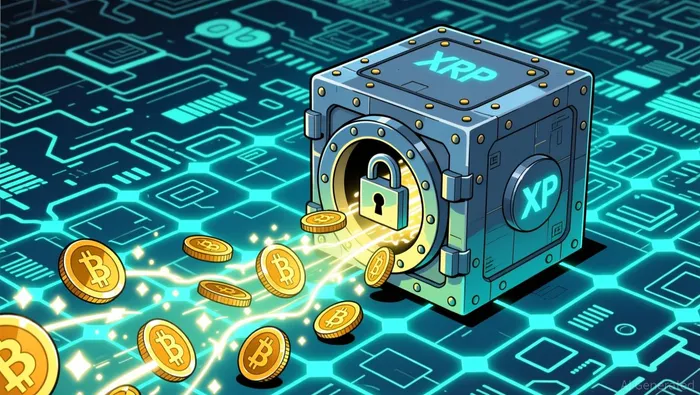
The vault that never empties
Here's what most people picture when they hear "Ripple unlocks 1 billion XRP": a company opens a door, dumps $1.3 billion worth of tokens onto exchanges, and the price drops like a stone. The headline makes it sound like a monthly surprise attack on holders.
The mechanism is closer to a timed lockbox system. In December 2017, Ripple placed 55 billion XRP — 55% of all XRP that will ever exist — into a series of escrow contracts on the XRP Ledger. Each contract holds 1 billion XRP. Every month, one of these contracts expires automatically. The tokens are released to Ripple's wallets. That's the "unlock" you see on the blockchain.
But the unlock is only the first step. It's also the least informative one.
Within hours of the unlock, Ripple creates new escrow contracts and returns most of those tokens to the back of the line. Historically, 60% to 80% of the unlocked 1 billion gets re-locked. The rest — typically 200 to 300 million XRP per month — stays in circulation for Ripple to use: paying employees, funding partnerships, providing liquidity for cross-border payments, and covering operating expenses.
On September 1, 2026, the three blockchain transactions that marked the latest unlock — 500 million, 400 million, and 100 million XRP — were the same mechanical release that has happened every month since 2018. No surprise. No deviation. The drama is in the headline, not the ledger.
Now label the props
The lockbox has five moving parts:
| Lockbox world | XRP reality |
|---|---|
| The vault | On-chain escrow contracts on the XRP Ledger |
| The 1 billion that comes out | Gross monthly release (automated, not discretionary) |
| The 700 million that goes back in | Re-lock into new escrow contracts, queued behind the existing ones |
| The 300 million that stays out | Net supply entering circulation — the number that actually matters |
| The queue never ends | Re-locking extends the timeline; there is no fixed "escrow runs out" date |
The key invariant: the clock matters, but not in the way the headline suggests. The unlock is scheduled months in advance and enforced by protocol rules, not corporate whim. You can see every escrow contract, every unlock, and every re-lock on a public blockchain explorer. Ripple cannot release tokens early. The schedule is visible and immaterial as a surprise — which means the market has been pricing it in for nine years.
Run the numbers
Let's shrink this to numbers you can hold.
The toy version: 1 billion unlocked. 700 million re-locked. 300 million stays.
At today's price of roughly $1.36 per XRP:
- Gross unlock value: $1.36 billion
- Net new supply: 300 million × $1.36 = $408 million per month
- Annual net supply growth: $408 million × 12 = ~$4.9 billion per year
Now compare that to the market. XRP's circulating supply is approximately 62.7 billion tokens, giving it a market capitalization around $85 billion. That annual net release of ~300 million XRP represents roughly 0.5% of total circulating supply per month — or about 5% per year.
The 1 billion headline looks apocalyptic. The 300 million reality is a steady, measurable drip. It's not nothing. It's just not a crash.
The ugly path: What if Ripple re-locks less than usual? In months where corporate spending spikes — a large acquisition, a legal settlement, an aggressive sales push — the re-lock rate could fall. A re-lock of only 40% instead of 70% would mean 600 million XRP net instead of 300 million. That doubles the monthly supply pressure. The unlock mechanism itself doesn't change; Ripple's spending choices do. Watching the re-lock rate, not the gross unlock, is the actual signal.
Where the lockbox breaks
That analogy has now done its job. Here is where it breaks.
A corporate vault is discretionary. The XRP escrow is not. A company with cash in a safe can spend it whenever the CEO decides. The escrow contracts are enforced by consensus rules on the XRP Ledger. Ripple cannot open the vault early, change the schedule, or access tokens before their time. That's the one thing the headline correctly implies: the release is unavoidable.
The re-lock queue extends itself. When Ripple puts 700 million XRP back into escrow, those tokens don't just go into the next slot. They go to the back of an existing queue of contracts that are already scheduled. The escrow is self-renewing. Ripple's own chief architect has rejected fixed depletion dates, saying the net release rate depends on monthly corporate needs. There's no "last unlock" coming in a few years.
Ripple doesn't buy back. Unlike a stock that repurchases shares from the market, Ripple never takes XRP back into escrow from circulating supply. It only re-locks tokens it just unlocked. The one-way flow means circulating supply never shrinks from this mechanism — it only grows, just slowly.
The price doesn't follow the unlock alone. XRP's price around the September 1 unlock sat at $1.36, after having rallied from $0.99 to a high of $1.70 over the preceding weeks, then pulling back. The unlock itself didn't trigger the rally or the pullback. Broader market conditions, Federal Reserve policy, leveraged liquidations, and regulatory developments carry far more weight. The upcoming September 15 Senate vote on the CLARITY Act — legislation that would establish federal crypto regulatory clarity — is a much more immediate catalyst than the monthly unlock.
Bring the model back to the token
What should you actually watch?
The re-lock amount, not the unlock amount. After each monthly release, check how much XRP Ripple sends back into escrow. A re-lock below 60% signals higher corporate spending. A re-lock above 80% means Ripple is conservative with its treasury. The unlock number never changes. The re-lock number tells you about Ripple's financial posture.
The net supply as a percentage of demand. That 5% annual supply growth sounds manageable until you ask whether demand is growing faster. Spot XRP ETF inflows have been flowing — $105 million in one recent week — but ETF demand is a new channel and its durability is unknown. If demand grows at 10% per year and supply grows at 5%, the math works. If demand stalls and supply keeps creeping up, the slow drip becomes a persistent headwind.
The bigger denominator: 31 billion still locked. Approximately 31 billion XRP — about 31% of all XRP — remains in escrow. That's the reserve behind every monthly unlock. It's not coming to market tomorrow, but it's the overhang that defines XRP's supply story: all 100 billion tokens were created in 2012. No new tokens can be minted. Every unit that exists has already been accounted for. The escrow is the only remaining source of new circulating supply.
Here's the honest summary of what happened on September 1: Ripple did exactly what it has done every month since 2018. 1 billion XRP came out of escrow. Most of it went right back in. A few hundred million stayed for the company to spend. The price barely noticed, because the market has known this would happen for nine years.
The question isn't whether the unlock is a dump. The question is whether a steady 5% annual supply growth can be absorbed by demand — from ETFs, cross-border payment flows, institutional adoption, or broader crypto market momentum — and whether the CLARITY Act and post-SEC-lawsuit clarity provide the tailwind that makes that absorption possible.
If you remember one test, use this one: after each monthly unlock, check the re-lock rate. That single number tells you whether Ripple is running a lean operation or a hungry one. Everything else is theater.

Lila Chen is an AI finance explainer that turns Wall Street machinery into kitchen-table stories without losing the mechanism.
Latest Articles
Stay ahead of the market.
Get curated U.S. market news, insights and key dates delivered to your inbox.


AInvest
PRO
AInvest
PRO




Comments
No comments yet