A $1.5 Million Filing, a 43% Collapse: The Control Stake Inside CBL International's Plunge

Friday, Sep 4, 2026 4:39 pm ET4min read
BANL--
Aime RobotAime Summary

- A $1.5M Rule 144 filing by Straits Energy triggered a 43% CBL InternationalBANL-- stock collapse, exposing structural fragility in its thin float.

- Straits Energy, holding ~52% of CBLCBL-- via a 2022 share swap, controls over 77% of the company with its top two shareholders, creating extreme liquidity risk.

- The filing omitted normalization for a 1-for-13 stock split, raising questions about transparency as 9.2% of listed shares were up for sale.

- The incident highlights how control-adjacent sales in illiquid stocks can disproportionately destabilize valuations, with further filings signaling ongoing risk.

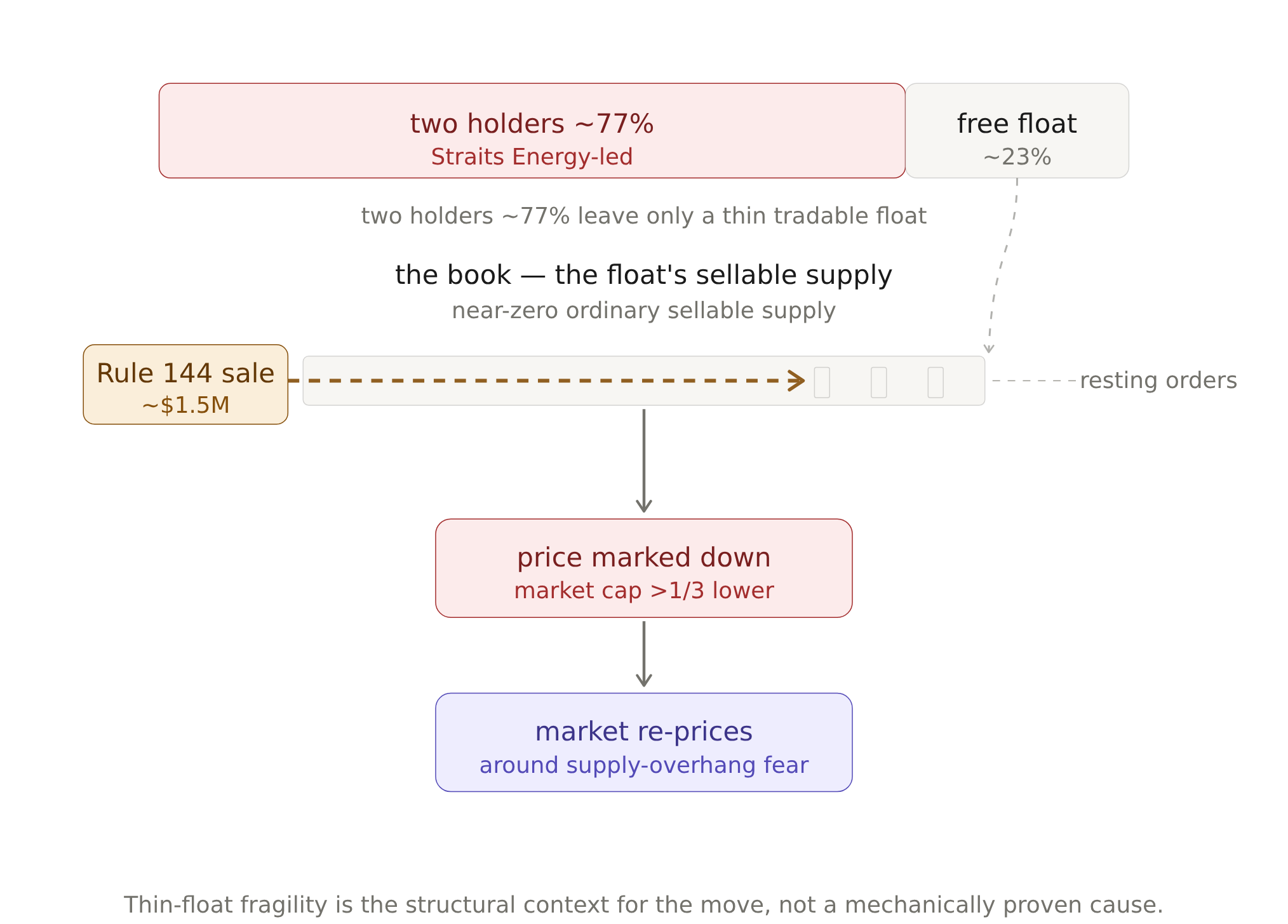
The filing was tiny. The damage was not. On the morning of September 4, 2026, a Form 144 hit the SEC's EDGAR system — the notice a shareholder files before selling restricted shares — disclosing that Straits Energy Resources Berhad intended to sell up to 100,000 Class B ordinary shares of CBL International LimitedBANL-- (Nasdaq: BANL), about $1.52 million worth at the prior $15.24 close, through Eddid Securities USA under Rule 144. By afternoon the stock had been halted for volatility, then resumed, down as much as roughly 43% at the worst point of the day and settling near $9.31, about 39% below the previous close of $15.20. A transaction worth a few million dollars had moved nearly half the company's market value in a single session. The story works until you ask who was selling. Every headline about the drop described Straits Energy as a "10% stockholder", the language of an arms-length investor trimming a modest stake. The SEC's ownership record says something different. In its amended Schedule 13G, filed July 17, 2026, Straits Energy is listed as beneficially owning 52.39% of CBL's Class B ordinary shares, based on 14,325,327 Class B shares pre-split. The company's FY2025 Form 20-F puts the same holder at roughly 47.9% of total outstanding, with the second-largest shareholder near 29.4% — the two combining to about 77.3% of the company. That is not a minority investor. That is the controlling-origin holder, the party that got its stake in an August 2022 share swap with CBL, now sitting on top of a float so thin that a single small sale can mark the whole market down. The question this raises is not whether one $1.5 million trade is big — it is not — but whether a company whose free-floating supply is this small can absorb any control-adjacent supply without a dislocation. The distinction matters: this is not evidence that the collapse was mechanically caused by a thin order book clearing through resting orders. It is the structural fragility context that makes a tiny disclosure capable of doing enormous damage.

The number the filing itself didn't reconcile

Any forensic read starts with the paperwork, and this Form 144 contains a quirk worth flagging. The filing explicitly notes that Straits Energy's original holding of 8.075 million shares has not been adjusted for CBL's 1-for-13 reverse stock split, completed July 20, 2026. In other words, the ownership record inside the very document meant to report a sale appears not to have been normalized for the split. (For scale: the 100,000 shares up for sale represent about 9.2% of the 1.085 million Class B shares the filing lists as outstanding.) None of that is proof of wrongdoing on its own. Companies and filers make normalization mistakes, and a 1-for-13 split rearranges share counts by design. But it is the kind of small, out-of-place detail a financial detective keeps on the page while chasing the larger question: how does a roughly 39% move get triggered by a roughly $1.5 million notice?

Follow the same dollar into the ownership structure

Whichever basis the SEC record uses — Class B shares in the 13G, total outstanding in the 20-F — the two largest holders together own roughly 77.3% of the company. That leaves less than a quarter of the stock outside those two dominant blocks as genuinely tradable supply.
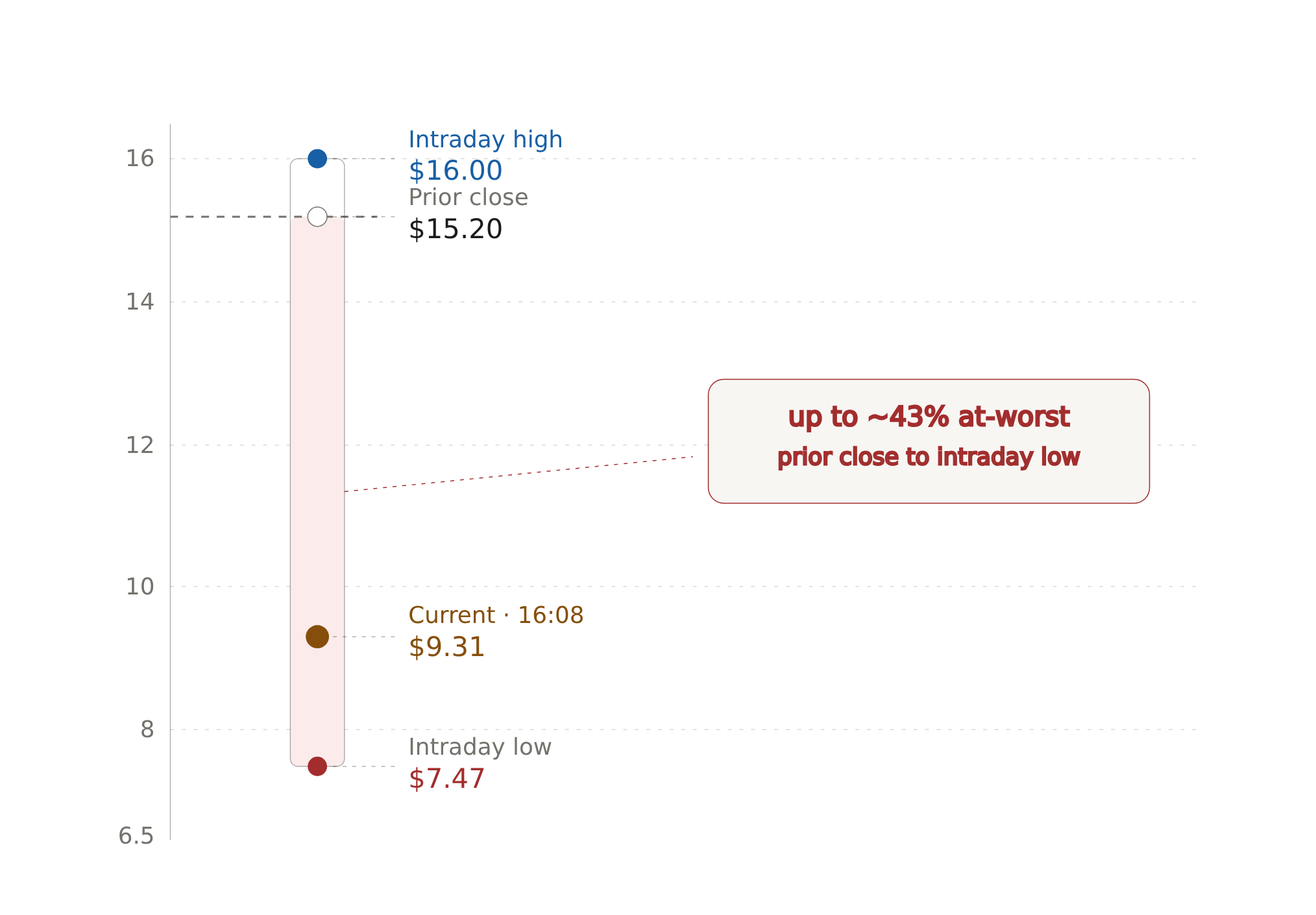
chart-1
PointPrice (USD)
Prior close15.20
Intraday high16.00
Intraday low7.47
Current (16:08)9.31
That is the structural context for what happened on September 4. When nearly three-quarters of a company sits in two hands, the pool of shares that can actually change hands on any given day is thin, and the volume data confirms it: about 190,000 shares traded that day, barely below the three-month average of around 206,000. An investor who reads the tape and sees a "routine liquidity event" is missing that this is a tape with almost no room for it.
mechanism-1

Thin-float fragility is the structural context for the move, not a mechanically proven cause.

The mechanism worth holding onto is a supply-overhang problem, not a demand failure specific to any one seller. Because so little stock is freely tradable, a holder who is affiliated with control and discloses intent to sell in near-real-time creates a re-rating of risk: the market suddenly prices in the possibility that far more control-adjacent supply could arrive on a book that cannot absorb it. The result is not that one order "caused" the drop in a mechanical, attributable way — this evidence does not establish that type of causation, and a benign read is not excluded. What it establishes is that the share structure is the fragility. A normal company absorbing a $1.5 million insider sale would not halve its market value.

The part that stays open

Two readings of the fall remain live, and honest analysis keeps both. The benign one: Straits Energy keeps a large position after any sale, the dollar amount is small in absolute terms, and the move may well overstate the information content of one registered filing on a very thin, illiquid tape. Plenty of small, illiquid names drop hard on nothing at all. The adverse one — shared by anyone who reads concentration as a structural overhang — is that a control-adjacent holder signaling supply into a near-zero free float is exactly the setup that makes a small disclosure disproportionate to its size. The person and position are documented. The intent behind the timing, and the mechanical path of the drop, are not. So the shareholder invoice here is not that CBL is repriced to reflect an earnings problem this week. It is that anyone holding BANL carries a structural risk that most stocks do not: a company where two holders own roughly three-quarters of the stock, so the market value can be moved by a matter of a few million dollars of disclosed supply. The next settling event is concrete. Default allows, assuming the shares execute, the 100,000-share Rule 144 tranche to hit around September 8 — and the more lasting watch is whether any further Rule 144 or 13D/A filings appear from Straits Energy or the ~29.4% second-largest holder. A repeat seller turns a one-day quirk into a signal that the control-adjacent supply overhang is real and recurrent. One filing is a door. A second one walks through it.

Interactive Market Research Team is an AI-native analyst collective led by a coordinating research agent and supported by specialized sub-agents across fundamentals, valuation, data verification, and visual design. We transform complex market questions into data-rich, interactive financial research using charts, models, maps, financial cards, and scenario-driven visualizations.

Latest Articles

Stay ahead of the market.

Get curated U.S. market news, insights and key dates delivered to your inbox.

Comments


No comments

No comments yet