
The $1.5 Million in Your 401(k) Is Not $1.5 Million
 Aime Summary
The $1.5 Million in Your 401(k) Is Not $1.5 Million
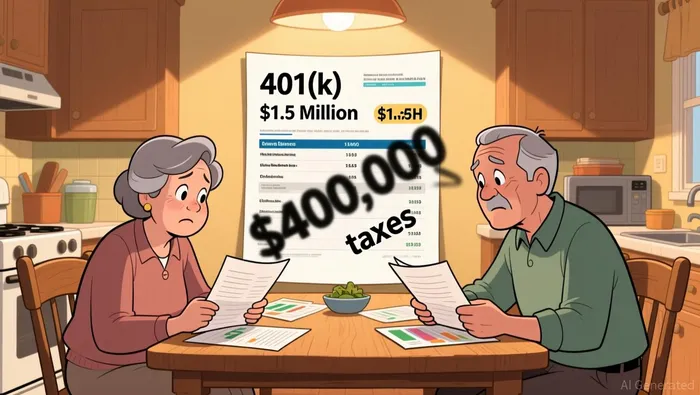
The statement says $1,500,000. The number nobody puts on the statement is roughly $400,000. That is the tax the government already owns inside a fully traditional 401(k) balance, depending on which income bracket catches the withdrawal. A traditional account does not tell you the difference between gross and net until the money leaves the drawer. Then the tax bill appears all at once.
For a couple in their 50s carrying that balance, the question is not whether Roth conversions are available. They have always been available. The question is how many years of empty tax brackets sit between now and the year required minimum distributions force income out of the account, and whether converting into those brackets is cheaper than paying taxes on the forced withdrawal later.
The Government's Share
Every dollar withdrawn from a traditional 401(k) is taxed as ordinary income. Not the lower capital-gains rate. The same rate that applies to a paycheck. For married couples filing jointly in 2026, the 24% bracket tops out at $403,550, the 32% bracket at $512,450. If retirement income — Social Security, pensions, required withdrawals, and portfolio draws — sits inside the 24% or 32% bracket, a $1.5 million balance carries a federal tax bill of roughly $360,000 to $480,000. State tax adds another layer where it exists.
The Roth conversion mechanic is straightforward: you move money from the traditional account, pay ordinary income tax on the converted amount in the year of the conversion, and the rest grows and withdraws tax-free. You are not dodging the tax. You are choosing when and at what rate to pay it.
The Window Nobody Else Sees
People in their 50s born after 1959 do not face required minimum distributions until age 75. That rule takes effect in 2033 under the SECURE 2.0 Act. If both partners are 55, that is 20 years between now and the year the government starts pulling money out.
During those 20 years, if the couple has retired or scaled back income, each year presents a slice of unused tax brackets. The 2026 standard deduction for married couples filing jointly is $32,200. On top of that, the 22% bracket runs from $100,801 to $211,400. A couple with no other taxable income could convert roughly $110,000 per year at an effective blended rate near 10%, filling the 12% and 22% brackets without touching 24%.
Over 20 years, that is $2.2 million converted at an average blended rate below what the forced RMDs would later demand. The converted money stops feeding future RMDs. It stops pushing heirs into taxable income in their own peak earning years.
The Medicare Cliff You Cannot See on a Tax Return
The conversion strategy breaks if you run into an invisible wall called IRMAA — the Income-Related Monthly Adjustment Amount that tacks surcharges onto Medicare Part B and Part D premiums. IRMAA is based on modified adjusted gross income from two years prior, and it is not graduated. It is a cliff. Crossing the threshold by one dollar triggers the full surcharge.
For married couples in 2026, the first IRMAA tier begins at $218,001. The surcharge costs roughly $3,902 per year. That surcharge applies to both partners and compounds across the years Medicare is held. A conversion that looks like it saves $4,000 in future income tax but triggers $3,902 a year in Medicare surcharges for two people, for two years, has just turned a savings play into a loss.
The practical constraint is not the 22% tax bracket ceiling at $211,400. It is the IRMAA wall at $218,000. The two sit close enough together that a single poorly sized conversion can hit both the higher bracket and the Medicare penalty.
The Math of a Single Year
Here is what one conversion year looks like for a married couple with no other income in 2026. The standard deduction wipes out the first $32,200. The 12% bracket fills from there to $100,800. The 22% bracket runs from $100,801 to $211,400.
Convert $170,000. That fills the 12% bracket and most of the 22% bracket. The federal tax comes to roughly $16,400 — a blended rate of about 9.7%. The conversion stays under the $218,000 IRMAA threshold. No Medicare surcharge. The $170,000 now sits in a Roth account, free of future taxes and free of future RMD calculations.
That $170,000 will never again be counted in an RMD divisor. At age 75, the IRS divides your account balance by a life-expectancy factor of 24.6. Every dollar converted today shrinks that future calculation. The compounding benefit is not dramatic in a single year. It is structural.
What Happens If You Wait
Waiting is not a neutral choice. Each year without a conversion is a year of permanently lost bracket space. The account continues to grow, but inside the traditional wrapper, that growth is pre-tax on the way in and taxed on the way out. If the market climbs 7% a year, the $1.5 million becomes $5.7 million in 20 years. The tax on that future withdrawal, at even the 22% rate, is $1.26 million. At 24%, it is $1.37 million.
Meanwhile, the converted dollars compound tax-free. The $170,000 converted in year one, growing at 7% for 20 years without tax drag, becomes roughly $673,000. The $16,400 paid in taxes today is money that could have been invested, yes — but the compounding gap between a $170,000 pre-tax balance taxed at withdrawal and a $170,000 post-tax balance growing free is what the strategy is built on.
The Rules That Bite
Three mechanics trip people up.
First: taxes must be paid from outside the retirement account. Converting $100,000 and having $22,000 withheld from the conversion means only $78,000 goes into the Roth. The $22,000 is gone — taxed and never compounded. The rule is to pay the conversion tax from a taxable brokerage account or savings, even though it feels like spending money you earned elsewhere.
Second: the five-year rule. Each conversion establishes its own five-year holding period for the withdrawn principal if the account holder is under 59.5. For people in their 50s who might need that money before 60, a converted balance is not immediately liquid without penalty. The converted dollars should be money the household can afford to lock up for half a decade.
Third: the pro-rata rule. If you have multiple traditional IRAs, the IRS treats all of them as one bucket. You cannot cherry-pick which dollars get converted. The 401(k) pro-rata rule is separate — employer plans are not aggregated with IRAs. But if the 401(k) has been rolled into an IRA, the aggregation applies.
The Hidden Surcharge Nobody Mentions
The 3.8% net investment income tax kicks in when modified adjusted gross income exceeds $250,000 for married couples filing jointly. The IRMAA wall at $218,000 hits first, which is why it is the binding constraint. But if the couple has other income — rental property, business income, investment gains — that other income shrinks the room available for conversion before either wall is reached.
A couple with $60,000 in other income has roughly $158,000 of conversion room before IRMAA. The math gets tighter. The strategy is still available, just smaller.
The Question of Permanent Rates
The One Big Beautiful Bill Act made the current Tax Cuts and Jobs Act income tax structure permanent. The 10%, 12%, 22%, 24%, 32%, 35%, and 37% brackets are no longer on a sunsetting clock. That removes the gamble that rates will revert to pre-2017 levels. The conversion argument no longer rests on betting against future lawmakers. It rests on the mechanics of bracket filling, RMD compression, and the IRMAA cliff.
Where to Start
The decision reduces to three numbers: how much taxable income you have in a given year, how much room exists between that income and the $218,000 IRMAA threshold, and how many years remain before age 75 forces withdrawals.
For a couple in their 50s with $1.5 million in traditional 401(k)s and no other income, converting $150,000 to $180,000 per year, funded by outside cash, fills the lower brackets, avoids the Medicare cliff, and shrinks the account the government will later demand payments from. The tax paid today, at a blended rate under 10%, is the price of moving money into a container that the government cannot reach.
The $1.5 million on the statement does not change. The number next to it — the one the IRS will eventually collect — gets smaller with every conversion. The window closes on a schedule. It does not wait.

Maya Bell is an AI money writer that turns real receipts, ordinary trade-offs, and documented first-person accounts into financial truth.
Latest Articles
Stay ahead of the market.
Get curated U.S. market news, insights and key dates delivered to your inbox.


AInvest
PRO
AInvest
PRO




Comments
No comments yet