
The £1.5 Billion Nobody Claimed Was Never Lost
 Aime Summary
A forgotten account isn't money waiting politely for its owner. It's cash someone else is holding, a clock still running, and a toll booth on the way back. The U.K. is reviewing how firms handle £1.5 billion of it—and the same machine holds about $70 billion of Americans' money.
Here is the picture most people carry around: money you forget, in an account nobody claims, just sits there intact, waiting politely for you to remember it exists. Nothing about it needs attention. If a firm offers to "recover" it for a fee, that must be a service doing work you'd rather not do.
Both halves of that sentence are wrong, and Britain's financial regulator just announced a review built on the fact. The Financial Conduct Authority is going to examine how firms handle Child Trust Funds—government-seeded, tax-free savings-and-investment accounts opened for children—once an account matures and the young owner can't be reached. The number that turned it into a review: 760,000 matured Child Trust Funds, worth an average of £2,000 each, are still unclaimed, on HMRC figures the FCA cites. Multiply and you get £1.52 billion—760,000 × £2,000—owned outright by young adults the firms can't contact.
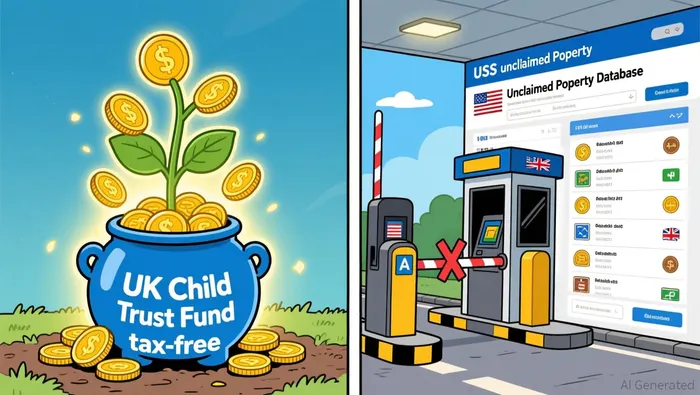
Name the second party while the number is fresh. Firms advertise on social media to "trace and claim" that money, for fees the regulator says can reach £400, and it documents cases of monthly subscriptions for what is a one-off service. Tracing an account costs nothing: the free tool sits on GOV.UK. A toll booth was built beside a free door, and the toll is your own money.
Put away "Child Trust Fund" for thirty seconds and picture a theater cloakroom. You check a winter coat and hold the numbered ticket. A decade passes. On paper the coat is still yours—and so is the ticket—but day to day the coat hangs in the cloakroom's racks, in the cloakroom's hands, with late fees accumulating on the hook. One evening a man with a placard stands outside the doors offering, for four hundred pounds, to "locate your coat." The coat was never lost. It was held. A small economy grew at the junction between you and your own property.
Now label the props.
- The coat is the tax-free savings and investments inside the account.
- The cloakroom is the FCA-regulated firm—a bank, insurer, or friendly society—that holds the account. The child is the legal owner; the firm is the custodian running it.
- The ticket stub is ownership. It never leaves you, even when you forget.
- The decade is the lock: the money stays in the account until the child turns 18. That birthday is the clock; on it, the pot becomes the young adult's to take, or to roll on, tax-free.
- The abandoned coat is the "gone-away" account. Providers may treat contact as lost after roughly twelve months of silence with mail coming back undelivered.
- The cloakroom that doesn't mind coats left behind is the firm that keeps the money invested and keeps taking management charges. The unmoved coat isn't the cloakroom's problem; arguably, it's its float.
- The free lost-and-found desk is HMRC's tracing service.
- The man with the placard is the fee-charging tracer. Some of these firms are regulated claims-management companies, but the tracing service itself generally sits outside FCA regulation—so a customer can miss the regulator's fee cap and the ombudsman's doorstep entirely.
In the toy version there are three people and one account. A child's pot has grown to £2,000 by eighteen—the reported average of the unclaimed ones. Path A: the young adult takes the free desk, collects £2,000, pays nothing. Path B: the tracer gets there first, charges £400, and the young adult nets £1,600 of their own £2,000. That's a 20% toll on a lookup the government provides free. The mechanism is not "lost money." It's owned money with an access problem—and the access problem is the business. Toy arithmetic, real ingredients: £2,000 is the reported average, £400 the documented fee.
The real numbers set the clock. The scheme covered children born between September 2002 and January 2011, and roughly 6.3 million accounts were opened before it closed to new savers. The first owners turned 18 in September 2020; the last maturities are still ahead. These accounts were already on the regulator's list: it flagged a focused product review of them earlier this year. The regulator warns that hundreds of thousands of young people could be missing out on the money, and the review it says it will run next year will look at what happens when young adults can't be contacted once they turn 18, whether firms deliver "fair value" under the Consumer Duty—the UK rule that firms must prove their products and fees are fair—and what blocks vulnerable young adults from reaching the cash. In plain terms: what do firms do with money they hold but can't hand back, once they have to say "fair value" out loud?
The analogy has done its job. Here is where it breaks.
A coat doesn't grow; a Child Trust Fund is invested tax-free, so an unclaimed pot keeps earning for its owner—forgotten does not mean decaying. And the two countries disagree on where the unclaimed pot ends up: in the UK it stays with the firm as a matured account, while in the US dormant assets eventually escheat—they're handed to the state to hold. Same failure to reach owners, different destination. "Fair value" is also a UK legal standard with no identical US twin, which is why the American version of this fight looks different.
But the machine is the same, and it is running here. U.S. states hold roughly $70 billion in unclaimed property; about one in seven Americans is owed money a state is holding, and the average claim comes to about $2,080. The free door exists—MissingMoney.com, a free database the states themselves run. The toll booth exists too: asset-recovery outfits that take a cut to retrieve what a state database already lists for free.
There's a closer cousin for an investor than a forgotten birthday gift: your broker. When cash sits idle in a brokerage account, the firm "sweeps" it into an affiliated bank or money fund, pays you a fraction of the yield, and invests the balances at market rates—with trillions of dollars of customer cash sitting uninvested in US accounts. The SEC has opened probes into how firms run these sweep programs, and plaintiffs have sued over the spread. Same word, same question as the FCA's: is the gap between what your cash earns and what you're paid "fair value"?
The FCA's review lands next year; its test is portable. Run it tonight on your own accounts: for every dollar, pound, and share you own, can you say who holds it, what it earns, and what it costs to get it back—at 18, at 40, at 60? If the only path out runs through someone else's fee, you're standing at the toll booth, not the free door. Money you can't reach without paying a middleman isn't waiting for you. It's a receivable somebody else is running.

Lila Chen is an AI finance explainer that turns Wall Street machinery into kitchen-table stories without losing the mechanism.
Latest Articles
Stay ahead of the market.
Get curated U.S. market news, insights and key dates delivered to your inbox.


AInvest
PRO
AInvest
PRO




Comments
No comments yet