
The $1.2 Million That Shows Where Outdoor Money Is Going — and Where It's Not
 Aime Summary
On the surface, the National Park Foundation's announcement is straightforward: $1.2 million in grants to 57 parks for youth fishing clinics, gear libraries, and community programs. It's the foundation's largest investment ever in its Junior Ranger Angler initiative. Last year alone, those programs reached more than 20,000 participants across 670 clinics.
But look at who funded it, and a different story appears.
Two publicly traded companies that sponsor this program sit on opposite sides of a widening crack in the outdoor recreation economy — and the chart tells you which one the market has already chosen.
The Two Sponsors, Two Trajectories
Sun Outdoors — the recreational vehicle resort brand operated by Sun CommunitiesSUI-- (NYSE: SUI) — runs campgrounds and RV parks near national parks across the country. Winnebago IndustriesWGO-- (NYSE: WGO) builds the motorhomes and travel trailers that visitors drive to those same parks. Both appear on the National Park Foundation's donor list. Both claim to serve the outdoor lifestyle.

Their stock prices in 2026 show they are not serving the same customer anymore.
Sun Communities closed Friday at $114.95, down 7.2% year-to-date but still within 25% of its 52-week high of $137.85. It carries a market capitalization of roughly $14 billion. WinnebagoWGO-- sits at $26.96, down 33.5% year-to-date, barely above its 52-week low of $26.80, with a market capitalization of less than $800 million.
The gap is not cosmetic. It reflects a structural shift in how Americans access the outdoors.
What the Financials Reveal
Sun Communities operates 152 RV resorts and 282 manufactured housing communities across North America. In the second quarter of 2026, its same-property net operating income grew 6% year-over-year. Blended occupancy for manufactured housing and RV sites sat at 98.8%. Average monthly RV site rent rose to $697 — up 3.6% from the prior year. The company raised its full-year same-property NOI growth guidance to 4.5%–5.3%.
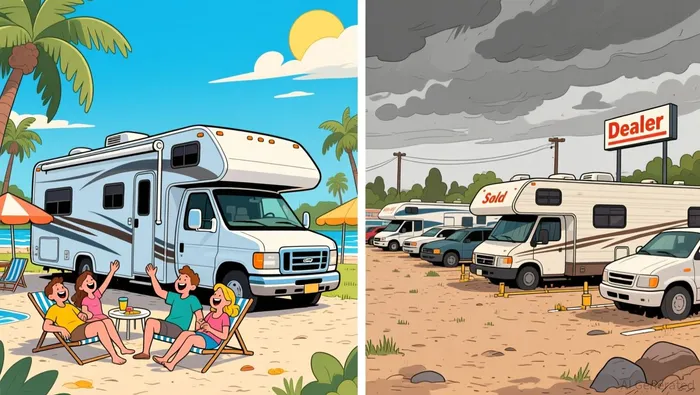
The mechanics are straightforward. People still want to visit national parks and outdoor destinations. They're just more likely to rent a campsite than buy a $100,000 motorhome. Sun Communities earns rent from the site; the customer brings whatever RV they already own — or books a cabin, or glamps in a yurt. The business model profits whether the guest arrived in a Winnebago or a sedan.
Winnebago's quarterly reports tell the opposite story. In Q2 of calendar 2026, revenue fell 9.9% year-over-year to $698.7 million, missing Wall Street estimates by nearly 8%. The company cut its full-year revenue guidance to $2.7 billion — 6.5% below what analysts expected. This followed a similar miss the prior quarter, when revenue had grown 6% but management lowered its full-year outlook anyway.
Over the past five years, Winnebago's revenue has declined an average of 3.2% annually. Towable RVs — its largest segment at 39% of revenue — have been shrinking. Dealer inventory is up 14%. The RV Industry Association's summer 2026 forecast projects an 8.2% decline in shipped units this year.
Everything now runs through the difference between selling a vacation experience and selling the vehicle to get there. One is a service with recurring revenue. The other is a discretionary capital purchase in a high-rate, cost-of-living environment.
Why Visitation Context Matters
The broader backdrop adds pressure on both models, but unevenly. National park visitation fell 2.7% in 2025 — from a record 331.9 million visits to 323 million. In 2026, the headwinds intensified: gas prices spiked toward $4 per gallon nationwide, international tour bookings to U.S. national parks dropped 42%, and consumer sentiment hit its lowest point of the year.
For a manufacturer like Winnebago, lower visitation expectations mean fewer people justify a large purchase. A motorhome is a decision made months in advance, and consumers cut discretionary spending before they cut vacations. They still drive to the park; they just don't need a $100,000 toy to get there.
For a campground operator, the same environment works the other way. Campground visits are a smaller, more affordable discretionary choice. When families trade hotel stays for camping trips to save money, occupancy goes up. Sun Communities' 98.8% occupancy rate and 3.6% rent growth suggest the substitution is real and durable.
The Chart Confirms the Split
The technical picture mirrors the fundamentals. Winnebago's price action over the past 120 days is flat — down 18%, trading in a compressed range between $26.80 and $27.70 with elevated 20-day volatility at 3.3%. The stock is below every major moving average and has been making lower highs since June. The 52-week high was $50.16. The stock has given back roughly 46% from that peak.
Sun Communities declined 10% over 120 days, but its 20-day volatility sits at 1.86% — less than Winnebago's half. The stock trades in a range between $113.80 and $116.40, near the lower end of a five-month trading channel but nowhere near a breakdown. Its next structural support rests near the recent $113.80 low, with resistance at $120 and the psychological $130 level above that.
Neither stock is breaking anything dramatic today. But the relative positioning tells you which business model the market believes will survive the current environment.
The Decision That Matters
The outdoor recreation economy generated $1.2 trillion in gross output, according to the Bureau of Economic Analysis. The demand for outdoor experiences is not going away. The question is how that demand translates into revenue — and which companies are positioned to capture it.
For Winnebago, the path back requires consumer spending to re-accelerate on big-ticket purchases. That depends on interest rates, wage growth, and a shift in consumer confidence that has not materialized. The company's recent 14% one-day pop after a June earnings miss showed there's still a bid at depressed prices, but it hasn't sustained. The stock needs to reclaim $30 with conviction, hold above its recent lows through a quarter of improving guidance, and demonstrate that the five-year revenue decline is reversing. Until then, it remains a story waiting for a turnaround that hasn't appeared.
For Sun Communities, the risk is different. The company is selling its UK holiday park business for approximately $1 billion and raising $1 billion in share repurchase authorization. It's actively choosing to simplify and refocus on its North American core. The manufactured housing segment — which grew same-property NOI 8.8% in Q2 — is becoming the dominant earnings driver, potentially reducing the outdoor recreation narrative entirely. If Sun Communities transitions from "the RV park play" to "the affordable housing REIT," the national park connection becomes a brand story, not a growth driver.
The $1.2 million grant is a signal that someone still believes in building a pipeline of future outdoor enthusiasts. For investors, the more relevant question is whether the companies funding today's programs are running toward that future or being priced out of it.
Winnebago defends $26.80. Hold that and the long base remains alive; lose it and the decline extends into uncharted territory. Sun Communities holds $113.80. Hold that and the REIT's core growth story stays in play; break below it and the manufactured housing premium narrows.
The outdoor economy is still massive. The chart just isn't treating every outdoor company the same.

Stay ahead of the market.
Get curated U.S. market news, insights and key dates delivered to your inbox.


AInvest
PRO
AInvest
PRO




Comments
No comments yet