
Solana (SOL) Gains Institutional Momentum Amid Regulatory Clarity and Network Upgrades
- Solana has been classified as a digital commodity by U.S. regulators, reducing legal risks for staking and airdrops and encouraging institutional participation according to reports.
- A broad sell-off in crypto assets, driven by expirations and geopolitical risks, has impacted SolanaSOL--, which fell 6-8% in a week.
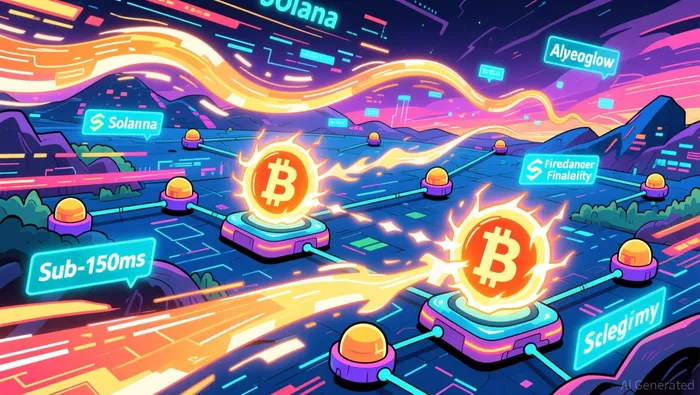
- The Firedancer and Alpenglow upgrades are seen as catalysts for Solana's scalability and performance, with long-term price targets as high as $277 cited by analysts.
Solana's recent regulatory classification under the U.S. SEC and CFTC has significantly reduced ambiguity around its staking and airdrop activities. This move has positioned the network as more attractive to institutional investors, who can now engage with the ecosystem with greater confidence. Over $6.4 billion in total value locked (TVL) has already demonstrated the network's growing appeal for staking.
However, the market has not been immune to broader crypto sector corrections. A combination of expiring options, geopolitical tensions such as Iran's oil threat, and macroeconomic pressures like high Treasury yields have pushed Solana down 6-8% in a week. On March 26, 2026, this was the first instance in 2026 where major crypto ETFs recorded simultaneous net outflows.
Solana is currently facing quarterly options expirations, which have added short-term volatility. Despite this, the Firedancer upgrade is already live, and Alpenglow is expected to further improve performance. Analysts have projected price recoveries into the $132.23–$277 range by the end of 2026, subject to macroeconomic conditions.
What Drives Short-Term Volatility in Solana?
The immediate price movementMOVE-- for Solana is influenced by quarterly options expirations and macroeconomic events. On March 29, 2026, Solana is trading at $83.19, which is 71.6% below its peak. Technical indicators show signs of hidden bearish divergence and weak on-chain demand, with $75 as a critical support level. A break below $80 is likely to push the price toward $48, while buyers holding at $75 could stabilize the price in the short term according to technical analysis.
The Fear and Greed Index currently stands at 23, indicating prolonged bearish sentiment in the broader market. This has contributed to ongoing ETF outflows and a cautious stance from institutional investors. However, despite these pressures, Solana's strong on-chain activity and Alpenglow upgrade continue to attract attention from AI-driven investment tools.
What Is the Long-Term Outlook for Solana?
Long-term price projections for Solana from 2026 to 2030 vary, with conservative to aggressive targets ranging from significantly below current levels to above $336. Analysts highlight infrastructure improvements such as Firedancer (1 million transactions per second) and Alpenglow (sub-150ms finality) as key enablers of scalability and performance.
Institutional interest remains a focal point for Solana's future. Projects like Taur0x IO and DeFi integration are being explored as alternative income-generation strategies for investors. Additionally, the platform's network fundamentals, including developer activity and ecosystem growth, are expected to drive demand over time.
Despite these positives, risks remain. Network reliability, regulatory uncertainty, and competition from other blockchains are factors that could affect Solana's trajectory. If sellers dominate at critical price levels, further downward movement is possible.
What Factors Could Accelerate Solana's Adoption?
Regulatory clarity has been a major enabler of institutional adoption in 2026. With legal risks for staking and airdrops reduced, more capital is expected to flow into the ecosystem, particularly from institutional players.
The Firedancer upgrade has already increased throughput, while Alpenglow is expected to reduce finality times and improve user experience according to upgrade reports. These upgrades are key to attracting more decentralized applications and users to the platform.
In addition, Solana's market cap of $38 billion currently limits the potential for a 100x return. However, growth in DeFi, NFTs, and global payment integration could provide new revenue streams and expand the platform's utility.
Alternative projects like AlphaPepe are also gaining attention for offering investors higher return potential in a different structure. This competition highlights the need for continued innovation and adoption in the Solana ecosystem.

Blending traditional trading wisdom with cutting-edge cryptocurrency insights.







댓글
아직 댓글이 없습니다