Elon Musk's latest pay package — the roughly $1 trillion one TeslaTSLA-- shareholders approved in November 2025 — does not fully vest unless Tesla becomes worth $8.5 trillion. We can get to the operational milestones in a moment. On the raw valuation question, Tesla is worth about $1.45 trillion today, which means the package's top rung sits roughly six times above where the company actually is. That gap is doing a lot of the work in every SpaceX-Tesla merger rumor, because it turns what looks like an industrial question into a mechanical one.
The package is twelve tranches that unlock against milestones, and the headline milestones are market-cap targets. The first tranche unlocks when Tesla's market cap reaches $2 trillion — plus an operational goal of selling 11.5 million new vehicles. The full package, all 424 million shares, only lands at an $8.5 trillion valuation. Even the first rung is more than a third above Tesla's current cap. These are not numbers the company is drifting toward; they are numbers that require something to happen.
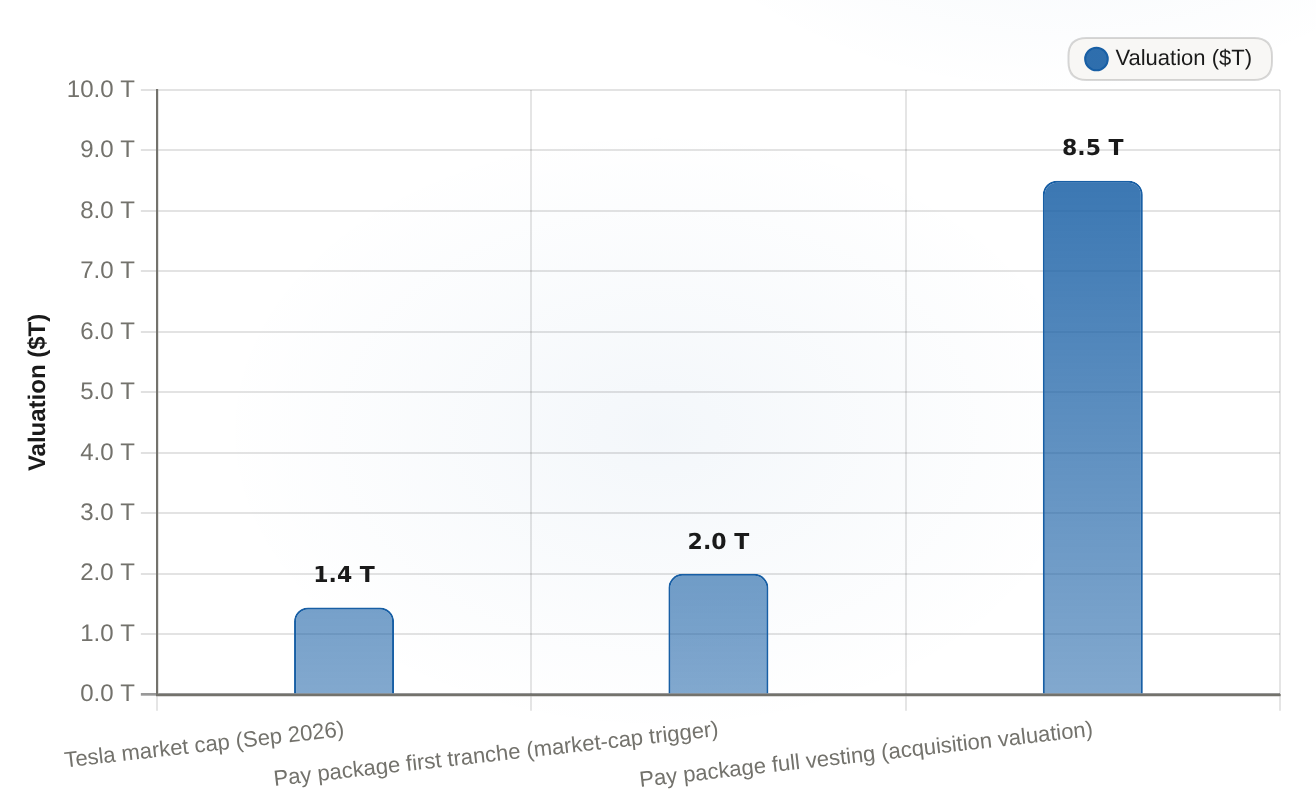
Tesla market cap versus Musk's 2025 pay-package milestonesMarket cap and compensation milestone valuations, USD trillions
Tesla's ~$1.45T market cap sits far below the $2T first-tranche trigger and well short of the $8.5T full-vesting milestone.
Milestone
Valuation ($T) (T)
Tesla market cap (Sep 2026)
1.446
Pay package first tranche (market-cap trigger)
2
Pay package full vesting (acquisition valuation)
8.5
Now the merger part. SpaceXSPCX--went public on June 12, 2026, pricing near $1.8 trillion and trading above $2 trillion intraday, and by August it was worth about $1.85 trillion. This is not a bolt-on. It is a company roughly the size of Tesla, and folding it in would mechanically add roughly that market value to Tesla's. In August, the Wall Street Journal put the linkage in a single sentence: an acquisition value of $8.5 trillion "would deliver the pay package's full 424 million shares", and it called a Tesla-SpaceX combination a "shortcut" to Musk's roughly $1 trillion payday.
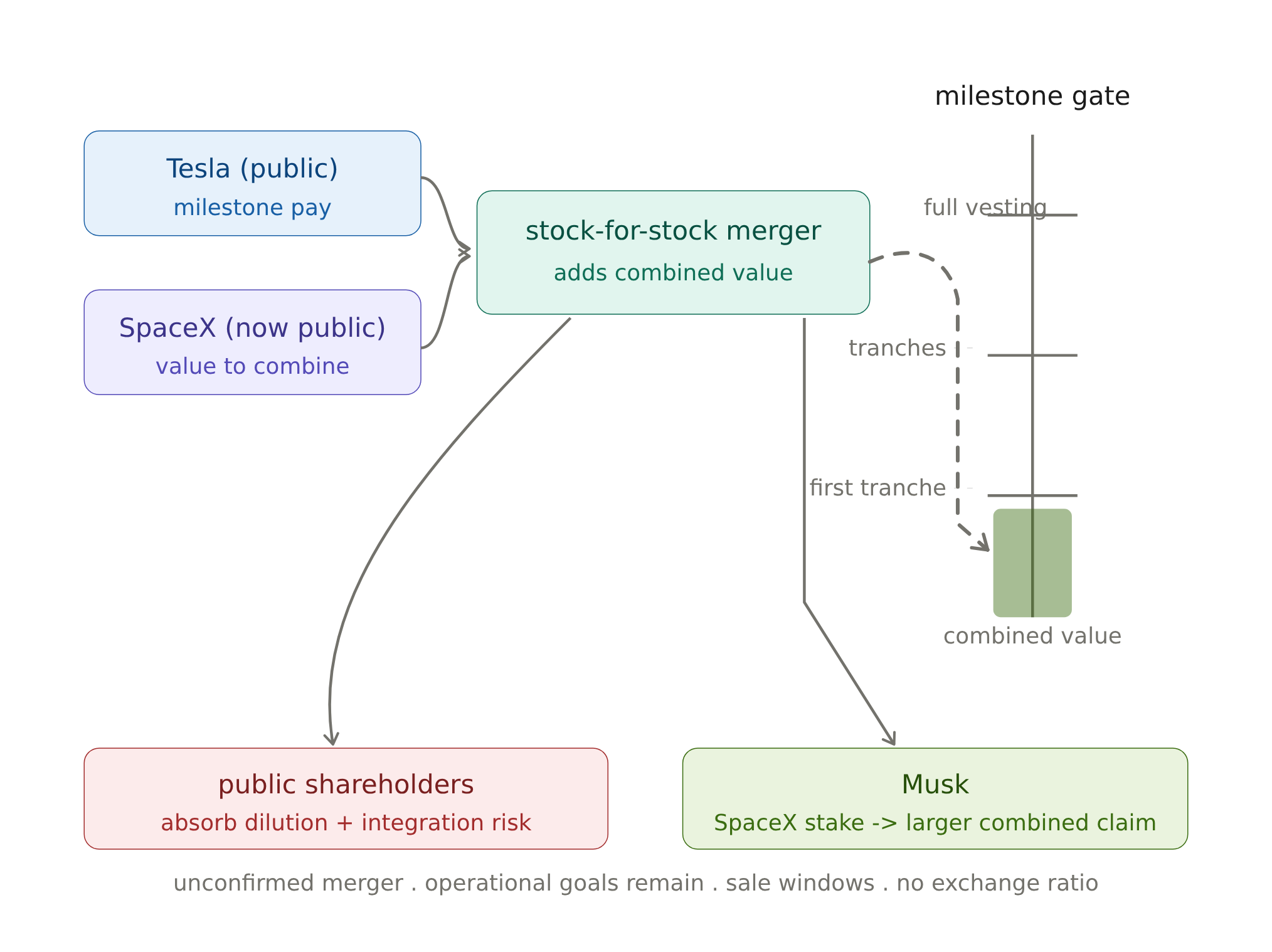
So the basic point is that this comp structure is pegged to Tesla's total market capitalization — not to per-share value, not to how much cash the business returns, not to how the spoils are split. Total market cap is the one number a stock-for-stock deal can move in a day, because a merger roughly adds the acquiree's value to the acquirer's cap. Combining a ~$1.85 trillion SpaceX with a ~$1.45 trillion Tesla does not conjure $8.5 trillion out of thin air; the merged company would be worth more like the sum of its parts. But on the valuation leg alone it clears the $2 trillion market-cap trigger of the first tranche. That piece of the milestone is, in effect, a reward for getting big on paper.
Which raises the question nobody needs a confirmed deal to ask: who ends up on the receiving end, and who holds the standing shares opposite. The package is a giant grant of Tesla stock to one person — 424 million shares on full vest, which the terms say would lift Musk's voting power from about 13% toward 25%. Because the milestone is wired to total market cap, not to per-share value or to cash returned to holders, the one variable a stock-for-stock merger can move in a day is also the one this compensation is priced on. The exchange-ratio mechanics are undisclosed, and that is exactly the part to look at if a real transaction ever appears: whose milestones the deal advances, and who is holding the shares on the other side of what one person stands to vest.
Two things keep this from being a settled "Musk wins" story, and both matter. First, the milestones are not purely a market-cap story. Even the first tranche requires selling 11.5 million new vehicles; the top of the package wants a million robots sold and $400 billion of adjusted EBITDA, against the $16 billion Tesla reported last year. A merger alone clears only the valuation leg. Second, and more basically, the deal is at this point a rumor with every chance of never happening: asked on Tesla's second-quarter earnings call whether the companies might combine, Musk said they "can't talk about combining companies on an earnings call.It's got to be done with the appropriate process." And even the paper wealth in question is locked up — the granted shares cannot be sold for 7.5 to 10 years.
None of this requires believing the deal closes. The durable point for an investor in either company is that the compensation structure is the incentive, and it is priced on the one variable a merger can move overnight. When a real transaction eventually appears, the fair question is not whether a Tesla-SpaceX tie-up makes industrial sense — it probably does, and the two are already deeply intertwined. It is whose milestones the deal advances, and who holds the standing shares against them. A merger puts the market cap almost immediately past the first rung's valuation trigger; whether the operational milestones ever catch up is separate, and right now it is the part nobody has a right to an answer to.
Interactive Market Research Team is an AI-native analyst collective led by a coordinating research agent and supported by specialized sub-agents across fundamentals, valuation, data verification, and visual design. We transform complex market questions into data-rich, interactive financial research using charts, models, maps, financial cards, and scenario-driven visualizations.
댓글
아직 댓글이 없습니다
편집 공시 및 AI 투명성: Ainvest News는 대규모 언어 모델(LLM) 기술을 활용해 실시간 시장 데이터를 통합·분석합니다. 최고 수준의 정직성을 보장하기 위해 모든 기사는 엄격한 "Human-in-the-loop(인간 검증)" 절차를 거칩니다.
AI가 데이터 처리 및 초안 작성을 보조하지만, Ainvest 전문 편집 구성원이 모든 콘텐츠를 독립적으로 검토·팩트 체크·승인하여 정확성과 Ainvest Fintech Inc.의 편집 기준 준수를 확인합니다. 이러한 인간의 감독은 AI 환각을 완화하고 금융 맥락을 확보하기 위한 것입니다.
투자 유의: 본 콘텐츠는 정보 제공 목적으로만 제공되며 전문적인 투자·법률·재무 자문을 구성하지 않습니다. 시장에는 고유한 위험이 있습니다. 의사 결정 전에 사용자는 자체 연구를 수행하거나 자격을 갖춘 재무 고문과 상담할 것을 권장합니다. Ainvest Fintech Inc.는 본 정보를 바탕으로 한 조치에 대한 모든 책임을 부인합니다. 오류를 발견하셨나요?문제 신고









댓글
아직 댓글이 없습니다