
Introduction:
In the stock market, trading with the trend is a golden rule for profitability. Trend Sight is a powerful trend-tracking tool that helps investors enter the market precisely at the beginning of a trend and exit safely when momentum fades. Whether you are a day trader, swing trader, or long-term investor, Trend Sight provides the data-driven insights you need to make confident, actionable decisions.
Step 1: Master the Core Trend Categories
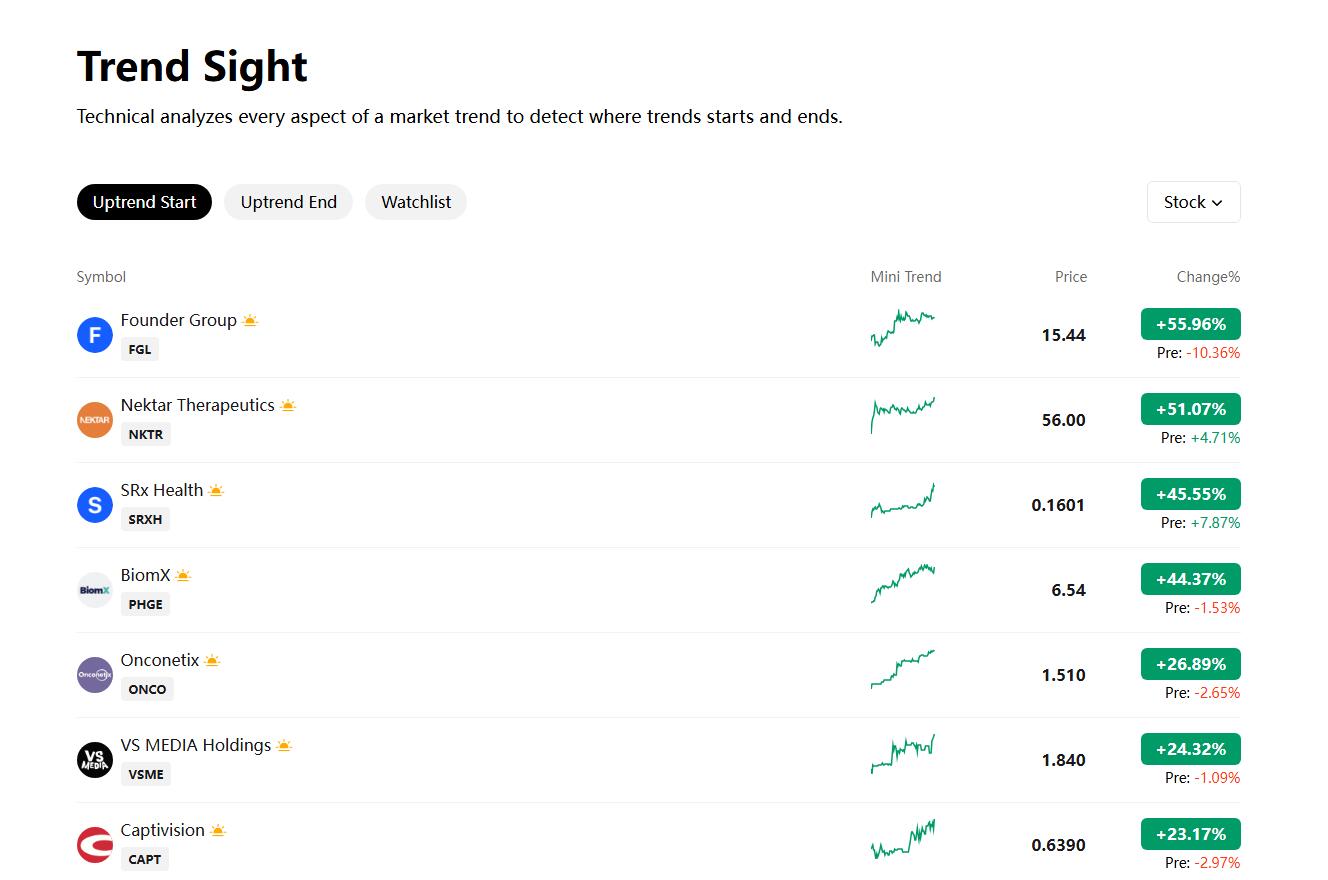
When you access Trend Sight, you will see a list of stocks clearly categorized under different trend statuses, helping you instantly filter your targets:
- Uptrend Start: Stocks beginning a new bullish trend. This is your prime pool for finding buying opportunities.
- Uptrend End: Stocks that are losing momentum after an uptrend, signaling potential profit-taking or reversal risks.
- Watchlist: A personalized list where you can continuously track the trend changes of stocks you are interested in.
(Trend Sight Interface Overview:)
Step 2: Deep Dive with Visual Analysis
When you tap on an individual stock (for example, Home Depot - HD) for deeper analysis, the system provides two core visual tools:
- Stock Chart with Moving Averages (MA): Clearly shows price trends over different time frames.
- Trend Sight Indicator (Subchart): Marks the trend strength and direction over time.
Step 3: Four Actionable Strategies for Different Timeframes
1. Swing Trading: Identifying Precise Entry and Exit Points
Swing traders look for short- to medium-term opportunities, typically holding positions for days to weeks.
- Case Study (HD): You see Home Depot (HD) in the "Uptrend Start" category. The stock has fallen from $426 to $368, and a green arrow appears in the Trend Sight indicator, signaling a possible reversal. You check the moving averages (MA5, MA10, MA20, MA30) and notice the price is nearing short-term support.
- Action Plan: You enter a long position at $370 and set a stop-loss at $365, targeting a move to $385.
- Pro Tip: Combine Trend Sight signals with volume analysis and momentum indicators (like RSI and MACD) for stronger confirmation.
2. Day Trading: Spotting Intraday Momentum Shifts
Day traders can use Trend Sight for real-time movement detection, allowing them to quickly capitalize on intraday volatility.
- Case Study (RTX): Raytheon Technologies (RTX) appears in the "Uptrend Start" category at the market open. The price moves above its MA5 and MA10, indicating short-term bullishness.
- Action Plan: You enter a trade at $128.50, setting a stop-loss at $127.80 and an exit target at $130. The stock rises quickly, and you lock in a consistent profit within hours.
- Pro Tip: For high-confidence intraday trades, check if Trend Sight's AI signals align with pre-market volume trends.
3. Long-Term Investing: Riding Multi-Month Trends
Investors looking for multi-month uptrends can use Trend Sight to filter stocks that have consistent growth momentum.
- Case Study (ENB): You see Enbridge (ENB) in an "Uptrend Start" and notice a 1.62% daily gain. The stock has broken above its MA20 and MA30, confirming an early uptrend.
- Action Plan: You check fundamentals like dividend yield and recent earnings reports, and decide to invest for the long haul.
- Key Takeaway: Trend Sight helps identify strong long-term performers without the hassle of manually screening dozens of stocks.
4. Risk Management: Avoiding False Trends
Every successful trading strategy requires strict risk control. Trend Sight helps filter out weak or misleading signals, reducing the chance of poor trade execution.
- Case Study (MMM): 3M (MMM) shows a 0.90% daily gain, but the Trend Sight indicator is flat with no clear uptrend.
- Action Plan: Instead of blindly entering the trade, you wait for additional confirmation from volume spikes or earnings reports. The next day, the stock falls back, proving the AI saved you from a false breakout.
- Pro Tip: If Trend Sight does not show strong trend activity, it's often better to stay on the sidelines.
Conclusion:
Trend Sight is more than just a screener; it is a comprehensive trading assistant. By transforming complex trend developments into clear categories and entry signals, it ensures that every trade you make is backed by solid data.




