
Introduction
The 5 core modules of the financial calendar (Economic Events, IPO, Dividends, Stock Splits & Mergers, Earings) help cryptocurrency, stock, and gold investors quickly obtain key information — one-click query of global economic indicators, real-time tracking of U.S. IPO dynamics, reminders of U.S. stock dividends/stock splits & mergers, and precise synchronization of U.S. corporate earnings reports. There is no need to collect information across multiple platforms, saving 80% of the time spent sorting out information, while avoiding investment misjudgments caused by delayed data and missing information. Against the background that the Federal Reserve maintains high interest rates in 2026 and only expects a single interest rate cut (March 19 FOMC meeting resolution), accurately mastering the use of the financial calendar allows investors to lay out policy-sensitive assets in advance, seize profit opportunities in market fluctuations, and stay away from the risk of losses caused by tight liquidity.
Step-by-Step Instructions
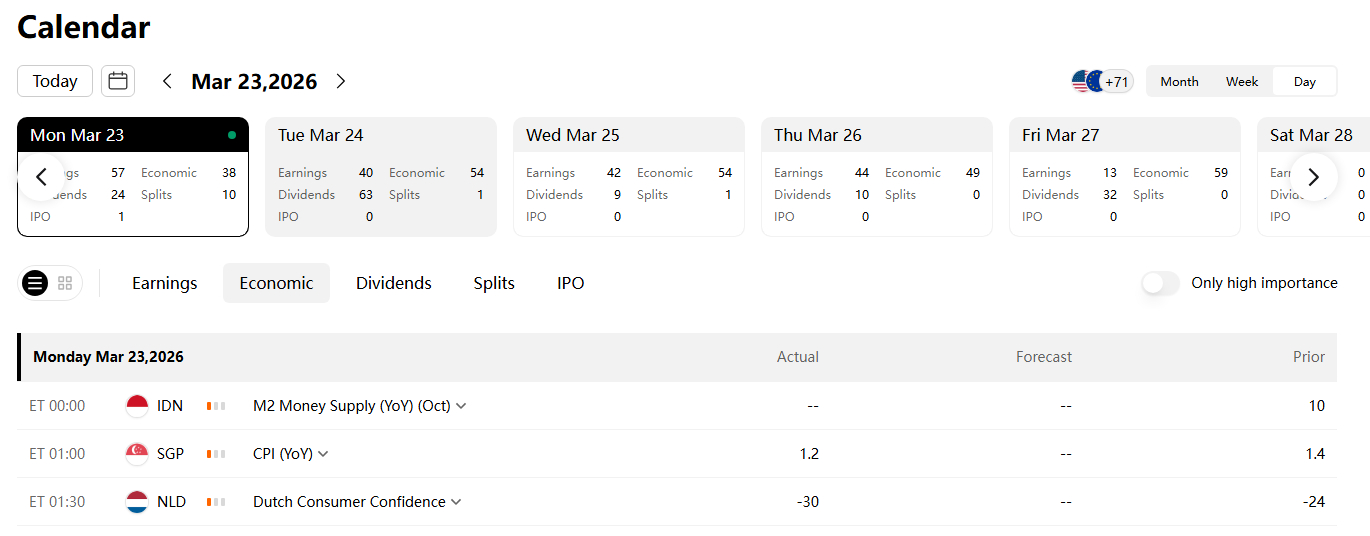
Open the financial calendar page, which displays the Economic Events module by default (covering all countries worldwide). At the top, you can accurately filter by "Country Filter" (e.g., U.S., China, Eurozone, etc.), "Indicator Type" (e.g., CPI, Non-Farm Payrolls, Interest Rate Resolution, etc.), and "Time Range" (Today/This Week/This Month). Click on a specific event to view the expected value, previous value, announced value of the indicator, and interpretation of market impact (Screenshot available: Financial Calendar Economic Events Filter Interface).
Switch to the IPO module (U.S. market only) to view recent U.S. IPO issuance plans, issue price ranges, and listing dates. It supports filtering by "Listing Time" and "Industry Classification". Click on a single IPO to view the core summary of the prospectus (key information in S-1/F-1 documents) to help judge the potential of new stocks (Screenshot available: IPO Module Filter and Details Interface).
Click on the Dividends module (U.S. market only) to view the dividend plans, record dates, and ex-dividend dates of U.S. listed companies. It supports filtering by "Dividend Ratio" and "Industry", and automatically reminds of upcoming dividend targets, making it easy for investors to layout high-dividend assets (Screenshot available: Dividend Module Reminder Settings Interface).
Switch to the Stock Splits & Mergers module (U.S. market only) to real-time synchronize announcements of stock splits and mergers of U.S. listed companies, mark the split/merger ratio and implementation date, and early warn of the short-term impact of stock splits & mergers on stock prices, avoiding trading errors caused by delayed information (Screenshot available: Stock Splits & Mergers Module Announcement List Interface).
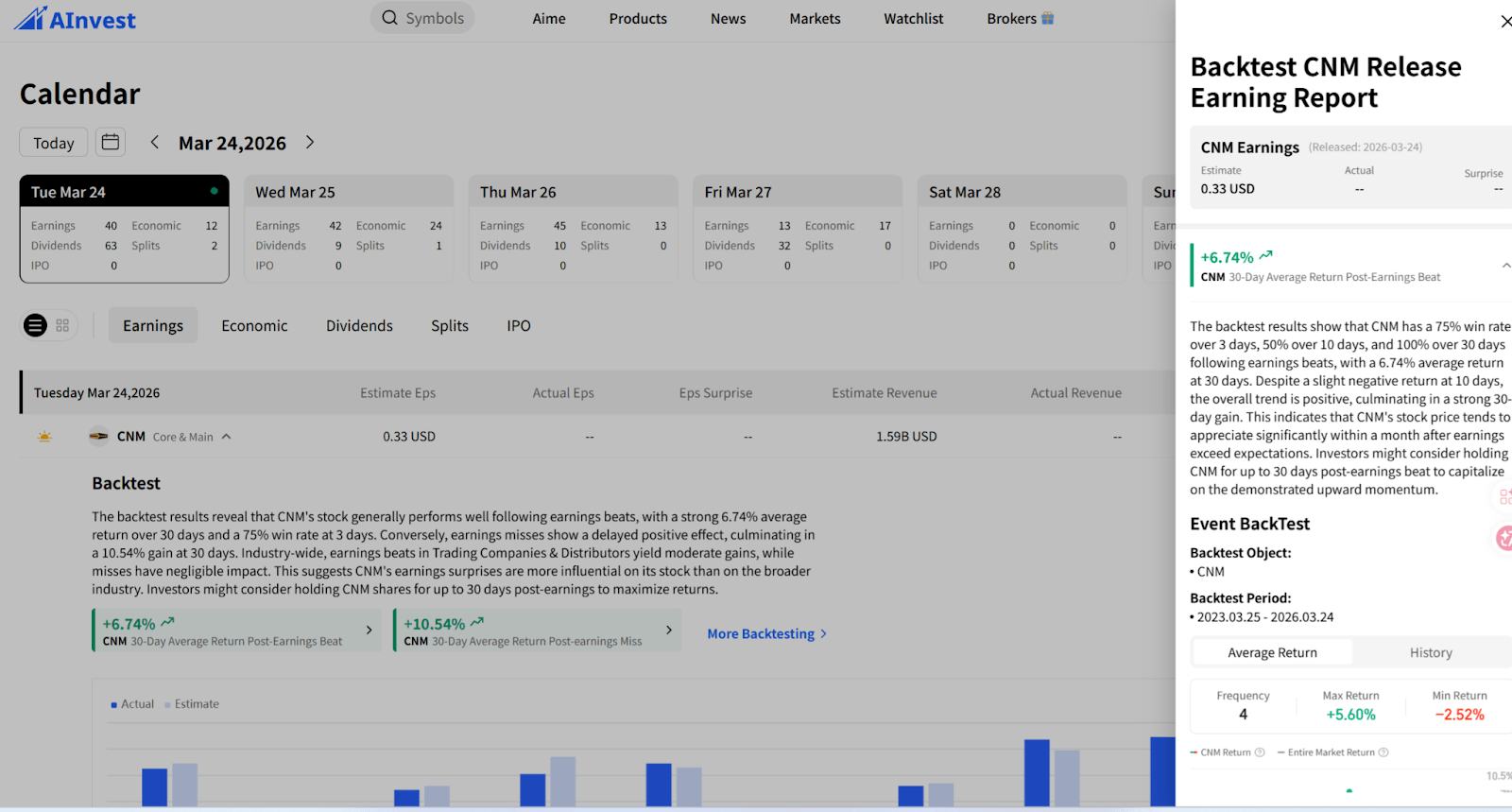
Click on the Earings module (U.S. market only) to view the release time and expected financial data (revenue, net profit) of U.S. listed companies' earnings reports. It supports filtering by "Industry" and "Market Capitalization". After the earnings report is released, it synchronizes the difference between actual data and expected data in real time to capture earnings report trends (Screenshot available: Earings Module Earnings Report Reminder Interface).
All modules support the "Add Reminder" function. Select the target event/IPO/earnings report, set mobile phone or page pop-up reminders, and you can accurately grasp key time nodes without real-time market monitoring (Screenshot available: Reminder Settings Operation Interface).
Expert Tips/Hotspot Connection
Why must you use this financial calendar function now? In 2026, the Federal Reserve entered a prudent observation period of high interest rates. The March FOMC meeting made it clear that only a single interest rate cut is expected throughout the year. The hawkish signal of longer high interest rates has led to the restructuring of the global asset pricing logic. Cryptocurrencies, stocks, and gold are all deeply affected by macroeconomic data and U.S. market dynamics, and the information gap directly determines investment profits and losses.
How to use the financial calendar to seize investment opportunities under the current Federal Reserve policy? Focus on two key directions: first, the U.S. core CPI, Non-Farm Payrolls report, and Federal Reserve interest rate resolution in the Economic Events module. These data directly determine the trend of the U.S. dollar and market liquidity, and liquidity is the core driving factor of the current cryptocurrency and gold markets; second, the U.S. IPO and Earings modules. Against the background of high U.S. stock valuations, new stock issuances and earnings report performance will be transmitted to the global market through risk appetite, and early mastery can avoid cross-asset volatility risks.
How to avoid the risk of losses through the financial calendar? Cryptocurrency and gold investors need to focus on the speeches of Federal Reserve officials and U.S. dollar index-related data in the Economic Events module, and avoid blindly increasing positions before the data is released; stock investors (especially U.S. stock investors) need to pay attention to the ex-dividend date in the Dividends module and the announcements in the Stock Splits & Mergers module to prevent losses caused by ignoring equity adjustments, and at the same time, use the Earings module to predict the risk of individual stocks' earnings reports falling short of expectations in advance.
In addition, the current cryptocurrency market is in a re-pricing stage after the liquidity tide recedes, U.S. stock valuations are under pressure at high levels, and gold volatility is intensifying due to the impact of real interest rates and the U.S. dollar. The 5 modules of the financial calendar form a "macro + micro" information closed loop, which can help investors break through information barriers and make accurate decisions in a complex market environment.
Want to see how institutions are positioning ahead of these earnings? Check https://www.ainvest.com/market/calendar/earnings/




