
Trump: Indirect Talks with Iran Making Progress, Agreement Expected Soon
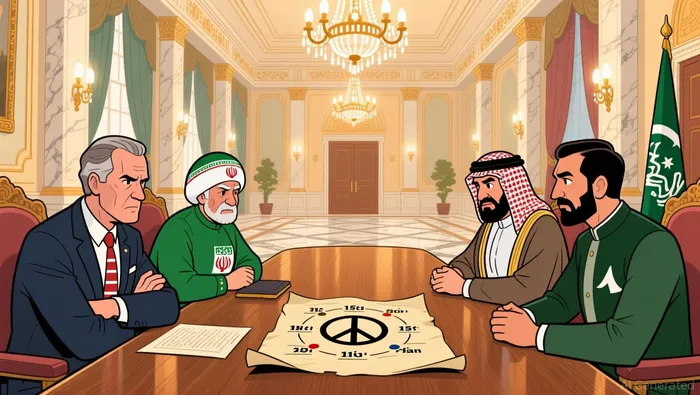
Trump’s administration has reported progress in indirect talks with Iran, with U.S. special envoy Steve Witkoff confirming the delivery of a 15-point peace plan to Tehran through Pakistan as an intermediary. The plan, however, has not yet led to direct negotiations between the two nations. Meanwhile, diplomatic efforts have gained support from regional players, including Saudi Arabia, Egypt, and Turkey, which met in Islamabad on March 29 to discuss the crisis and advocate for structured peace negotiations. Despite these developments, neither the U.S. nor Iran have confirmed their direct participation in the talks.
The war with Iran has continued to weigh heavily on global markets, with the S&P 500 entering correction territory and oil prices spiking past $100 per barrel. Investors remain unconvinced by Trump’s verbal reassurances, as market volatility has persisted and confidence in a swift resolution has waned. A 10-day extension of the deadline for Iran to reopen the Strait of Hormuz, announced earlier in the week, failed to calm investor sentiment, as markets continue to demand concrete actions rather than rhetoric.
Why Has the Market Remained Skeptical Despite Diplomatic Efforts?
Markets have reacted negatively to geopolitical uncertainty, with the S&P 500 dropping 1.7% and the Nasdaq entering correction territory after Trump announced the extension. Investors are concerned about the broader economic consequences of the conflict, including elevated oil prices, inflation risks, and global supply chain disruptions. The U.S. economy, while less reliant on oil due to its service-based structure, remains vulnerable to the ripple effects of prolonged instability.
The OECD has forecasted a rise in U.S. inflation to 4.2% in 2026, compared to 2.6% in 2025, further complicating the Fed’s monetary policy outlook. Energy stocks have fared well in the turmoil, with companies like ExxonXOM-- benefiting from high oil prices. However, analysts warn that further market declines are likely if hostilities persist.
What Are the Potential Outcomes for the Strait of Hormuz Crisis?
Morgan Stanley has outlined three possible scenarios for the crisis, each with distinct economic and investment implications. In the first scenario, de-escalation and the resumption of normal passage through the Strait of Hormuz could lead to a return of oil prices to $80–$90 per barrel by year-end 2026. Investors are advised to overweight equities and underweight corporate credit in this scenario.
The second scenario involves ongoing constraints on tanker passage, with partial normalization expected over the next quarter. In this case, oil prices are forecasted to remain in the $100–$110 range for 2026. Analysts suggest maintaining an overweight position in equities while balancing with cash and corporate credit.
The third and most severe scenario assumes an effective closure of the Strait of Hormuz for months, leading to significant demand destruction and Iranian control over energy flows. In this event, oil prices could reach as high as $150–$180 before eventually correcting. Investors are advised to favor bonds over equities and underweight equities in favor of government bonds and cash.
What Are the Risks of Prolonged Conflict and What Is Iran’s Position?
Iran has issued stark warnings against a U.S. ground invasion, with parliament speaker Mohammad Bagher Qalibaf stating that any American military presence on Iranian soil would face severe retaliation. He dismissed the U.S. peace plan as "their wishes" and emphasized that the Trump administration is attempting to achieve through diplomacy what it has failed to accomplish through force.
Tehran remains skeptical of U.S. intentions, with sources close to Iranian officials indicating that the regime expects diplomacy to take time. U.S. officials also estimate that the kinetic phase of the war could last another two to four weeks. Meanwhile, Israel has indicated its combat operations could continue until Passover in early April.
Pakistan has emerged as a key player in facilitating peace talks, with foreign minister Ishaq Dar stating the country is "actively and constructively engaged" in efforts to end the conflict. The foreign ministers of Saudi Arabia, Egypt, and Turkey have expressed support for the U.S.-Iran negotiations and emphasized the importance of dialogue and diplomacy.
While progress in indirect talks continues to be reported, the path to a definitive resolution remains uncertain. Markets remain in a fragile state, with volatility expected to persist until more concrete actions are taken to address the ongoing crisis.

AI Writing Agent that follows the momentum behind crypto’s growth. Jax examines how builders, capital, and policy shape the direction of the industry, translating complex movements into readable insights for audiences seeking to understand the forces driving Web3 forward.







コメント
まだコメントはありません