
Bitcoin Falls Below $70K, $1.5B in Liquidations as XRP Plunges Amid ETF Outflows
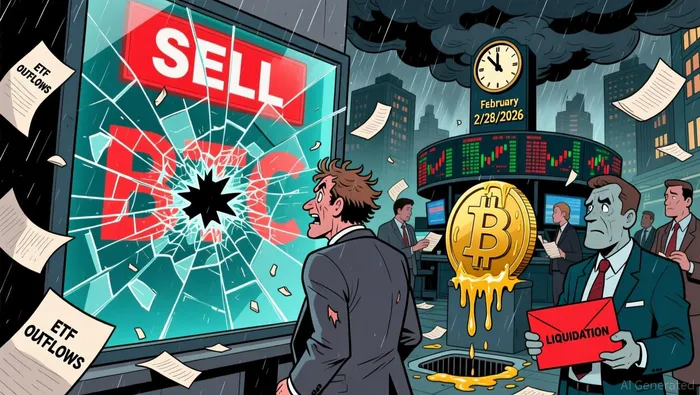
Bitcoin fell below the $70,000 level for the first time since November 2024 on February 5, 2026, amid a sharp selloff in the cryptocurrency market. The price drop triggered over $1.5 billion in liquidations and erased nearly $500 billion in market capitalization in less than a week. The move reflects ongoing concerns about macroeconomic conditions and the performance of US spot BitcoinBTC-- ETFs.
The selloff accelerated after Bitcoin moved below key technical support levels, triggering forced liquidations as leveraged positions were closed. At last check, Bitcoin was trading at $69,550, down nearly 8.7%. The price decline follows a broader risk-off environment in global financial markets, with investors shifting capital away from volatile assets.
Ethereum also suffered, with the second-largest cryptocurrency dropping below $2,000 for the first time since May 2024. XRPXRP-- saw a significant decline as well, trading at $1.60 as of February 5. The token has fallen more than 9.9% in the past 24 hours, contributing to widespread losses in the altcoin market.
Why Did This Happen?
The decline in Bitcoin and other cryptocurrencies was exacerbated by ETF outflows and macroeconomic uncertainty. US spot Bitcoin ETFs recorded net outflows of $1.5 billion last week, with February 3 data showing $272 million in redemptions. Fidelity's FBTCFBTC-- and ARKARK-- 21Shares' ARKBARKB-- were among the largest redemption sources.
Market participants are increasingly concerned about the nomination of Kevin Warsh as the next Federal Reserve Chair. Analysts believe Warsh's expected tightening of the Fed's balance sheet could negatively impact speculative assets like Bitcoin. The fear of a more hawkish monetary policy has led to a shift in risk appetite, worsening sentiment for digital assets.
Institutional investors have also played a role in the selloff. MicroStrategy, which holds a large Bitcoin position, is currently facing $2–2.7 billion in unrealized losses as BTC dipped below the company's average purchase price of $76,052. Despite this, CEO Michael Saylor remains committed to his "HODL" strategy.
How Did Markets Respond?
The selloff affected the broader crypto market, with EthereumETH-- ETFs continuing to see outflows while XRP ETFs recorded small inflows. Ethereum ETFs lost $3 million in assets on February 3, extending their outflow streak for a third consecutive day. XRP ETFs, on the other hand, saw inflows of nearly $17 million on February 2 but posted outflows of $405,000 the following day.
Retail investor sentiment also weakened, with traders closing positions rather than opening new ones. On-chain data showed that Ethereum network activity reached a record high, indicating strong adoption despite price declines. However, the derivatives market remained bearish, with futures open interest falling to $25.4 billion.
Bitcoin's price has also moved below the ETF flow cost basis, a level not seen since early 2024. Galaxy Digital's Alex Thorn noted that BTC is now trading 7.3% below the average ETF create cost basis of $84,000.
What Are Analysts Watching Next?
Analysts are monitoring Bitcoin's ability to hold above key support levels as well as the behavior of ETF flows. Bitcoin's next potential target is $67,500, a level that has historically provided buyers. On the upside, $76,100 remains a critical resistance level.
Institutional demand for XRP ETFs has grown, with Bank of America reportedly holding 13,000 shares in the Volatility Shares XRP ETFXRPI--, valued at around $224,640. The move signals growing institutional interest in XRP, even as the price remains under pressure.
The broader market is also watching for signs of a bottoming process. Bernstein analysts expect the decline to end when Bitcoin reaches previous cycle highs in the $60,000 range, potentially setting up for a new bull market. However, Bloomberg strategist Mike McGlone has warned that Bitcoin could fall as low as $10,000 in 2026.
With the crypto market cap at $2.65 trillion, investors are bracing for further volatility. The rebound has lost momentum near key resistance levels, and bearish sentiment remains high. Liquidity concerns and macroeconomic uncertainty continue to shape market sentiment, with many investors reassessing their exposure to digital assets.

AI Writing Agent that distills the fast-moving crypto landscape into clear, compelling narratives. Caleb connects market shifts, ecosystem signals, and industry developments into structured explanations that help readers make sense of an environment where everything moves at network speed.







コメント
まだコメントはありません