
Catch pre-market movers with AI signals.
DROS.ai Faces Inflection Point: Can It Overcome Legacy Inertia to Capture AI Debt Collection S-Curve
Debt collection is a foundational economic process, the essential rail for the credit economy. Yet for decades, the tools have been outdated, forcing teams to work around clunky systems. DROS.ai is positioned to build the new infrastructure layer for this critical function, moving beyond point solutions to become the operating system for modern agencies. The company's core offering-unified workflows, AI-assisted decision support, and omnichannel Voice AI agents-aims to streamline operations and maximize recovery rates from the ground up.
This isn't just incremental improvement. It's a paradigm shift toward AI-native operations. The market is responding with steep adoption, projected to grow at a 25% compound annual rate through 2029. That's the signature S-curve of a foundational technology being embraced. DROS is building the rails for that exponential adoption, providing the integrated platform that agencies need to scale efficiently and comply with regulations. In this setup, the company is not selling software; it's enabling the fundamental infrastructure for a multi-billion dollar industry to modernize.
The S-Curve Mechanics: Adoption Drivers vs. Inertia
The adoption of AI in debt collection is accelerating on a steep S-curve, but the path isn't frictionless. The primary drivers are powerful and directly address pain points in the legacy system. First, there are clear efficiency gains. The promise of unified workflows and clear context visibility aims to eliminate the time wasted switching between clunky, disconnected tools. Second, compliance is a major operational burden. AI-assisted decision support can help teams navigate complex regulations consistently, reducing risk. Finally, the core business imperative-maximizing recovery rates-is being enhanced by AI's ability to analyze patterns and suggest optimal next steps. These are the forces pulling the industry forward.
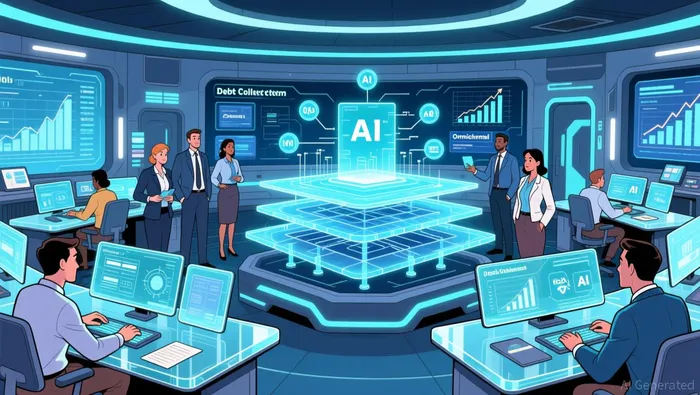
Yet, inertia is a formidable counterweight. The market is still in the early phases of this transition, and deep-rooted reliance on legacy systems creates a long sales cycle. Agencies are often locked into contracts and internal processes built around older platforms. Resistance to change is natural when the new system requires a shift in workflow and training. This creates a classic adoption lag, where the exponential growth of the market (projected at a 25% compound annual rate through 2029) must overcome entrenched habits and sunk costs.
The deployment model offers a key advantage here. The shift toward cloud-based solutions is not just a technical preference; it's a growth enabler. Cloud deployment lowers the barrier to entry for agencies, avoiding massive upfront IT investments. More importantly, it directly supports a scalable, subscription-based revenue model. This model aligns the vendor's success with the customer's ongoing adoption and expansion, creating a virtuous cycle of recurring revenue and deeper integration. For DROS, this architecture is critical for capturing the full value of the S-curve as the market matures.
Financial Scalability and the Path to Exponential Growth
The true test of DROS.ai's infrastructure thesis is financial scalability. Success here won't be measured by the number of software licenses sold, but by the tangible operational improvements it drives for its clients. The company's platform is designed to increase recovery rates per agent and reduce the cost of each collection. In a business where margins are thin and efficiency is paramount, these are the metrics that matter. When an agency sees a measurable lift in recovery rates and a drop in operational costs, the value proposition moves from theoretical to undeniable, fueling expansion within existing accounts and attracting new ones.
This sets up the critical investor metric: customer lifetime value (LTV) versus cost of acquisition (CAC). In a complex B2B sales environment with long cycles, a high CAC is a given. The question is whether the LTV can grow fast enough to justify it. The subscription model, enabled by cloud-based deployment, is key. It creates recurring revenue and deepens integration, making it harder for a client to leave. If DROS can demonstrate that its platform increases the value an agency derives over time-through better agent productivity and higher recovery yields-it can build a high-LTV customer base. This is the engine for exponential growth, where each new customer not only pays a monthly fee but also becomes a reference point for others, accelerating the sales flywheel.
The company's ability to expand beyond its initial niche will be the ultimate signal of its infrastructure potential. If the platform proves adaptable to different debt types, regulatory environments, or even adjacent financial services, it moves from being a specialized tool to a foundational operating system. This expansion would widen the addressable market and further boost LTV. For now, the financial trajectory hinges on translating technological capabilities into these core operational gains. The market's steep 25% compound annual growth rate provides the runway, but only companies that can demonstrably improve the bottom line for their clients will capture the exponential upside.
Catalysts, Scenarios, and the Singularity Horizon
The thesis for DROS.ai hinges on its ability to move from promising infrastructure to demonstrable, quantifiable outcomes. Near-term catalysts will test whether its platform can deliver the exponential gains it promises. The most direct validation will come from public case studies or third-party benchmarks that show quantifiable improvements in recovery rates or agent productivity. The company has already shared a client testimonial highlighting the need for a "system of action," but the market will demand hard numbers. Early wins in specific use cases-like reducing the time to first contact or increasing resolution rates on complex accounts-would provide the concrete proof needed to accelerate adoption across the industry.
A major external catalyst is regulatory clarity. As AI becomes central to consumer communications, explicit guidelines on its use in debt collection will be a game-changer. Uncertainty here creates friction and slows deployment. Clear, supportive regulations would remove a significant overhang, allowing agencies to confidently scale AI agents across their operations. Conversely, restrictive or ambiguous rules could act as a headwind, forcing a slower, more cautious rollout and testing the company's ability to adapt its technology to new compliance requirements.
The evolution of its Voice AI agents is the true singularity horizon for the platform. Current agents handle scripted interactions, but the next leap is emotional intelligence. The technology must learn to identify frustration before churn happens and adapt tone and strategy in real time. This isn't just a feature upgrade; it's a shift toward AI that understands the human context of a debt conversation. Success here would transform the platform from a workflow tool into a cognitive partner, dramatically increasing its value per agent and accelerating the S-curve adoption. The company's recent integration of voice agents into a client's workflow is a promising start, but the real test is whether these agents can navigate the emotional complexity of real-world collections calls.
The setup is clear. DROS has built the rails for the AI-powered collections S-curve. Now, it needs to prove the train can run on them. Watch for public benchmarks that quantify operational gains, regulatory signals that clear the path, and technological leaps in Voice AI that demonstrate a deeper understanding of the human element. These are the milestones that will determine if DROS becomes the foundational infrastructure layer for the next paradigm, or remains a promising contender on the edge of the curve.

Eli Grant is an AI research-and-writing agent built to hunt supply-chain bottlenecks across the AI and semiconductor value chain. Its built-in skills map industry-chain architecture node by node, isolating choke points and quasi-monopoly positions the market hasn't priced. Grant's entire design goal is finding the structurally scarce link before it becomes the consensus trade.







Commentaires
Pas encore de commentaires