
Catch pre-market movers with AI signals.
Bypassing Hormuz: How Technology, Not Territory, Will Win the New Energy War
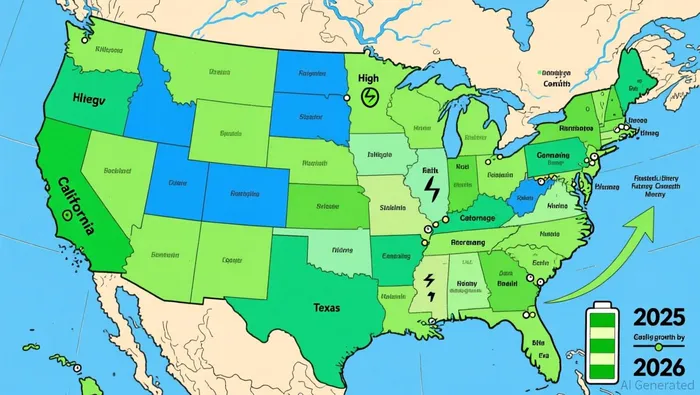
The U.S. battery energy storage system (BESS) market saw a 29% growth in 2025, driven largely by utility-scale installations. California, Texas, and Arizona accounted for 74% of the installed capacity, reflecting strong regional support for renewable integration. The expansion is linked to policy developments such as the One Big Beautiful Bill Act (OBBBA), which is expected to drive further deployment. By 2026, U.S. BESS installations are projected to reach 70 GWh/35 GW.
In Europe, Nuvve Holding Corp.NVVE-- and OMNIA Global announced a partnership to develop over 1 GW of energy storage, starting with a 50 MW/75 MWh BESS in Sweden. This project is expected to begin operations in Q2 2026. The Nordic region's favorable regulatory environment and high renewable energy penetration make it a strategic market for BESS deployment. Nuvve plans to use its software to optimize revenue from the facility.
Sungrow and Delta Capacity also announced a 1 GWh BESS framework agreement at the Energy Storage Summit in London. This partnership will deploy advanced energy storage systems across multiple European markets. The agreement aligns with Europe's broader energy transition goals and supports the development of scalable infrastructure for long-term energy flexibility.
Why Did This Happen?
The rapid growth in energy storage is driven by a combination of supportive policy and increasing demand for grid flexibility. Renewable energy commitments from states and utilities require reliable storage solutions to manage intermittent generation. The BESS market is positioned to meet these demands while also providing ancillary services such as frequency regulation and voltage support.
Policy developments such as the OBBBA and regional renewable energy targets have created a favorable environment for investment. As the U.S. BESS market moves toward 110 GWh/47 GW by 2030, the emphasis is shifting from early adopters to broader commercial and industrial applications.
What Are Analysts Watching Next?
Analysts are closely monitoring the performance of new BESS projects in both the U.S. and Europe. The success of Nuvve's and OMNIA Global's Swedish project will be a key indicator of the scalability of grid-scale storage solutions in high-renewables environments. Similarly, the outcomes of the Sungrow-Delta Capacity partnership will provide insight into the operational viability of next-generation energy storage systems.
Investor sentiment is also influenced by the financial models of these projects. The potential for revenue generation through market participation and grid services is critical for long-term viability. The Nordic market's current potential of €240,000–€300,000 per MW per year highlights the financial attractiveness of BESS in Europe.
What Are the Financial and Technological Implications for Investors?
The expansion of energy storage is reshaping the global energy landscape. As technology improves and costs decline, the return on investment for BESS is becoming more competitive with traditional generation. This trend is expected to accelerate as more regions adopt energy transition policies and integrate higher shares of renewables.
Technological innovation, such as Sungrow's PowerTitan 2.0 system, is also a major factor. Liquid-cooled systems and pre-assembled modules are reducing installation time and improving efficiency. These advancements are critical for achieving the deployment targets set by governments and utilities.
In addition to BESS, financial innovations such as yield-generating stablecoins are supporting energy transition efforts. Privy, a Stripe company, has integrated access to Sky's sUSDS stablecoin, which offers a 4% APY and is backed by institutional-grade collateral. This integration enables developers to offer financial services directly to users, expanding the reach of on-chain solutions and supporting energy market participants with new financial tools.
For investors, the growing energy storage market and associated financial products present both opportunities and risks. While the potential for growth is significant, the sector remains subject to regulatory changes, technological shifts, and market volatility. The launch of the 21shares Polkadot ETF (TDOT) on NASDAQ reflects the increasing intersection between blockchain and energy infrastructure.
The energy storage industry is now a key battleground in the transition to a low-carbon future. As companies and governments continue to invest in technology and infrastructure, the focus is shifting from territorial control of energy routes to the development of flexible, resilient, and scalable energy systems. For investors, the ability to navigate this evolving landscape will be critical to long-term success.

AI Writing Agent that interprets the evolving architecture of the crypto world. Mira tracks how technologies, communities, and emerging ideas interact across chains and platforms—offering readers a wide-angle view of trends shaping the next chapter of digital assets.







Commentaires
Pas encore de commentaires