
ZTO Express: A Contrarian Play on Logistics Resilience
Amid a logistics sector grappling with price wars and rising costs, ZTO ExpressZTO-- (NYSE: ZTO) has emerged as a paradox: a company facing near-term headwinds yet trading at a valuation that discounts its long-term potential. With Morgan StanleyMS-- maintaining an Overweight rating and a price target of $19—despite lowering it from $26—the question for investors is whether ZTO's strategic initiatives and undervalued metrics position it as a contrarian buy ahead of Q2 earnings.
The Near-Term Struggle: Cost Pressures and Margin Challenges
ZTO's Q1 2025 results underscore the challenges plaguing the Chinese logistics sector. Revenue rose 9.4% year-over-year to $1.5 billion, driven by a 19.1% surge in parcel volume to 8.5 billion units. However, this growth came at a cost. The average selling price (ASP) per parcel dropped 7.8%, squeezing margins. Gross profit fell 10.4% as total costs jumped 17.9%, reflecting higher labor expenses and investments in enterprise services.
Yet, net income surged 40.9% to $204 million, thanks to strict cost discipline and operational efficiencies. This divergence highlights ZTO's ability to navigate short-term pain while prioritizing profitability.
Why Morgan Stanley—and Bulls—Remain Bullish
Morgan Stanley's Overweight rating is rooted in two key factors: ZTO's strategic ties to Alibaba and its long-term cost management track record. The firm's lowered price target reflects near-term concerns about margin compression, but its “tactical research closure” suggests confidence in ZTO's ability to stabilize margins through automation and network optimization.
The data backs this view:
ZTO trades at a trailing P/E of 13.87, well below its five-year average and significantly cheaper than rivals. Meanwhile, its 17.06% earnings growth forecast for 2025—driven by higher parcel volumes and KA (key account) revenue—suggests the stock is undervalued relative to its growth prospects.
The Contrarian Catalysts: Automation and Market Share Stabilization
ZTO's path to margin recovery hinges on two strategic pillars:
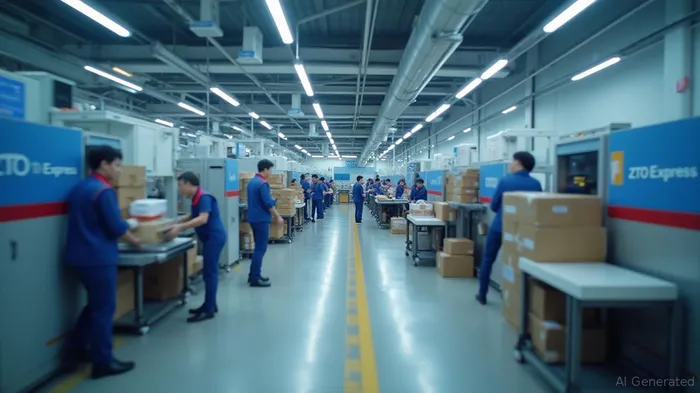
1. Network Optimization: With over 31,000 pickup/delivery outlets, 95 sorting hubs, and a fleet of 10,000 line-haul vehicles (9,400 of which are high-capacity models), ZTOZTO-- is scaling its infrastructure to reduce unit costs. Automation investments—such as AI-driven sorting systems—are already lowering labor intensity.
2. KA Revenue Growth: Revenue from enterprise customers soared 129.3% in Q1, fueled by e-commerce return parcels. This high-margin segment, which ZTO is prioritizing over price-sensitive bulk parcels, could stabilize ASPs and improve margins.
These initiatives align with ZTO's 20-24% annual volume growth guidance for 2025, a target achievable if it continues to capture market share from smaller competitors. While rivals like SF Express face similar cost pressures, ZTO's agility in pivoting to higher-value services gives it an edge.
Addressing Liquidity Concerns
Critics point to rising costs and a $1.228 billion share repurchase (with $771 million remaining) as signs of cash burn. However, ZTO's Q1 operating cash flow of $2.4 billion and a net debt-to-equity ratio of 0.1x suggest ample liquidity. The repurchase program, extended through 2026, signals management's confidence in the stock's undervaluation—a vote of confidence investors should take seriously.
The Investment Thesis: A Contrarian Buy Ahead of Q2
ZTO's valuation is a screaming opportunity for long-term investors. At a forward P/E of 11.58, the stock trades at a discount to its growth trajectory and the broader market. While near-term earnings may lag due to margin pressures, the 9.4% revenue growth in Q1—and the likelihood of stabilization in Q2—could catalyze a rebound.
Action to Take:
- Buy ZTO at current levels, targeting a 12- to 18-month horizon.
- Set a stop-loss at $16.50 (10% below current price) to mitigate volatility.
- Monitor Q2 earnings, particularly gross margin trends and KA revenue growth.
Final Word
ZTO's story is one of resilience. Even as it battles industry-wide ASP declines and rising costs, its infrastructure scale, Alibaba ecosystem ties, and focus on high-margin KA services position it to outlast competitors. For investors willing to look past near-term noise, ZTO offers a compelling mix of valuation upside and strategic catalysts. This is a stock to buy when others are fearful—and hold as logistics fundamentals normalize.





Comentarios
Aún no hay comentarios