
Zohranomics and the Wall Street Pushback: Assessing Risks and Opportunities in New York's Shifting Policy Landscape
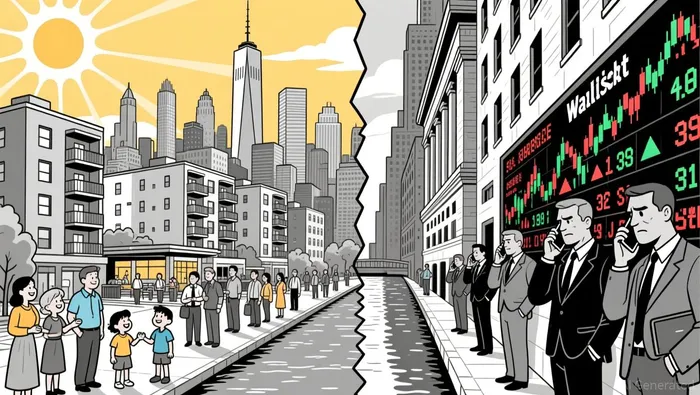
New York City's 2025 mayoral election has ignited a seismic shift in urban policy, with Zohran Mamdani's progressive agenda-dubbed "Zohranomics"-sparking both optimism and trepidation among investors. At its core, Mamdani's platform prioritizes affordability, social equity, and wealth redistribution, with proposals including a rent freeze for 2 million rent-stabilized tenants, universal childcare, and a 2% income tax surcharge on high earners. These policies aim to address systemic inequality but have drawn sharp criticism from Wall Street and business leaders, who fear capital flight, reduced private investment, and a potential erosion of New York's status as a global financial hub. This analysis examines the interplay between Mamdani's urban reforms and financial market dynamics, assessing risks and opportunities for investors navigating this polarizing policy landscape.
The Dual Edges of Zohranomics: Affordability vs. Capital Flight
Mamdani's agenda hinges on a $9 billion annual revenue boost from corporate and income tax hikes, targeting the top 1% of earners. While proponents argue these measures will fund transformative social programs-such as 200,000 new affordable housing units over a decade-critics warn of unintended consequences. A 2021 Stanford study noted that only 2.4% of millionaires move annually, but even a small exodus could strain city revenue, as the top 1% currently contribute over 40% of income tax. Similarly, corporate relocations to low-tax states like Texas and Florida, already underway under the previous administration, could accelerate under Mamdani's 11.5% corporate tax rate.
Wall Street's initial resistance has softened into cautious pragmatism. High-profile financiers like Jamie Dimon of JPMorgan Chase and the Partnership for New York City have shifted from opposition to engagement, recognizing the political reality of Mamdani's resounding electoral win. Yet tensions persist, particularly around Mamdani's rhetoric on "corporate greed" and his pro-Palestinian stance, which has alienated certain Jewish business leaders. This duality-pragmatic collaboration versus ideological friction-defines the current interplay between progressive governance and financial capital.
Real Estate Market Volatility: Rent Freezes and Developer Dilemmas
The real estate sector, a cornerstone of New York's economy, faces profound uncertainty under Mamdani's policies. A four-year rent freeze on stabilized units, combined with anti-displacement efforts, threatens to compress profit margins for multifamily property owners. According to a report by Reason, landlords managing stabilized units could see net operating income (NOI) decline as rising costs-insurance, maintenance, and debt servicing-outpace stagnant rents. For older buildings reliant on incremental rent increases, this could lead to insolvency within 16–17 years.
Developers are recalibrating strategies, with some pivoting toward mixed-use or affordable housing projects. However, the luxury market remains resilient, with Manhattan's $10 million+ sales surging 37% in early 2025 amid economic volatility. Cash transactions in this segment have also risen, reflecting high-net-worth buyers' preference for tangible assets as a hedge against policy uncertainty.
Mamdani's emphasis on cooperative and non-profit housing models could further reshape long-term investment dynamics. While this aligns with ESG (Environmental, Social, and Governance) priorities, it risks deterring private capital in favor of public financing. The success of his housing agenda will depend on political collaboration and the ability to balance affordability goals with market realities.
Corporate Tax Hikes and the Risk of Relocation
Mamdani's proposed 11.5% corporate tax rate-projected to raise $5 billion annually-has sparked fears of capital flight. Critics argue that this rate, higher than in 48 other U.S. states, could incentivize firms to relocate operations. Data from the New York City Comptroller's 2025 report shows that the city lost the third-highest number of financial sector jobs from 2020 to 2023, as firms sought lower-tax environments.
Yet New York's financial sector remains robust, with securities industry profits on track for record highs. The city's cultural and economic gravity-home to 1.2 million high-income earners and a global talent pool-suggests that large-scale relocations are unlikely. Still, smaller firms and niche industries may be more vulnerable to tax-driven migration.
Market Volatility and the Path Forward
The broader financial market has experienced heightened volatility in 2025, driven by Trump-era tariff reversals and geopolitical tensions. The Cboe Volatility Index (VIX) spiked to 50 in April 2025, the highest since the pandemic, as investors grappled with uncertainty. While Mamdani's policies are not the sole driver of this volatility, they contribute to a climate of unpredictability that affects asset valuations and risk premiums.
For investors, the key lies in hedging against policy-driven risks while capitalizing on opportunities in ESG-aligned sectors. Mamdani's focus on public infrastructure and green energy could attract capital from impact investors and municipal bond markets. Conversely, sectors like luxury real estate and corporate finance may face headwinds as tax policies and regulatory shifts reshape competitive dynamics.
Conclusion: Navigating the New Normal
Zohranomics represents a bold reimagining of urban governance, but its success hinges on balancing progressive ideals with economic pragmatism. For Wall Street, the challenge is to adapt to a policy environment that prioritizes equity over traditional profit models. While risks such as capital flight and market volatility persist, opportunities abound in sectors aligned with Mamdani's vision. Investors who navigate this landscape with agility-diversifying portfolios, engaging with policymakers, and leveraging ESG frameworks-may emerge stronger in New York's evolving financial ecosystem.







Comentarios
Aún no hay comentarios