
ZKsync's Tokenomics Redesign and Its Implications for Value Capture in Layer-2 Ecosystems
Deflationary Mechanisms: Linking Scarcity to Network Growth
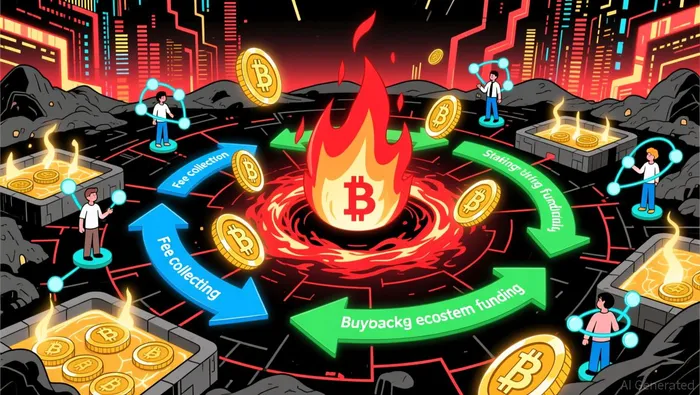
At the core of ZKsync's redesign is a deflationary framework that redirects 100% of network revenue-including transaction fees, cross-chain interoperability charges, and enterprise license income-toward token buybacks, burns, and staking rewards. By reducing circulating supply as usage scales, the model creates intrinsic scarcity, a critical driver of token value. For instance, if the network processes 1 million transactions monthly at an average fee of $0.01, this generates $120,000 in annual revenue, which could be allocated to buybacks or burns, accelerating supply contraction.
This approach mirrors successful deflationary models in other ecosystems but introduces a novel layer: revenue is directly tied to user activity. As ZKsync's Atlas upgrade enables over 15,000 transactions per second with near-zero fees, increased adoption amplifies the velocity of deflation, creating a flywheel effect where higher usage drives both utility and scarcity, according to a Coinotag report.
Revenue-Driven Utility: Staking Yields and Ecosystem Funding
Beyond deflation, ZKsync's redesign introduces revenue-driven utility to incentivize long-term participation. A portion of network fees will fund staking rewards, offering annual yields of 5–10%, a range competitive with DeFi protocols. This dual-purpose model not only secures the network but also aligns validator interests with platform growth.
Moreover, 20% of revenues will be reinvested into ecosystem development, fostering dApp innovation and infrastructure upgrades. This funding mechanism addresses a common pain point in layer-2 ecosystems, where liquidity and developer incentives often lag behind user growth. By tying token value to both security and innovation, ZKsync creates a virtuous cycle of value accrual, the Coinotag report notes.
Community Confidence and Technical Advancements
Market reactions have been robust, with ZK's 24-hour trading volume surging past $300 million post-announcement, signaling investor confidence in the new model, as reported by Coinotag. The redesign also garnered praise from Ethereum co-founder Vitalik Buterin, who highlighted ZKsync's role in advancing Ethereum's scalability and liquidity in a Cryptopolitan article.
Technically, the Atlas upgrade underpins this economic shift by optimizing throughput and finality. With one-second finality and sub-cent transaction costs, ZKsync becomes a viable hub for both retail and enterprise use cases, further amplifying fee revenue and token demand, the Coinotag piece adds.
Implications for Layer-2 Ecosystems
ZKsync's tokenomics redesign sets a precedent for layer-2 projects seeking to balance decentralization with economic sustainability. By embedding deflationary mechanics and utility-driven incentives, it addresses the "value capture gap" that has plagued many scaling solutions. Competitors may face pressure to adopt similar models, but ZKsync's integration of on-chain and off-chain revenue streams-including corporate licenses-provides a unique edge, according to a Bitcoinsistemi article.
For investors, the redesign signals a maturing ecosystem where token value is no longer speculative but anchored to real-world usage. However, risks remain, including regulatory scrutiny of buyback mechanisms and potential volatility in staking yields.
Conclusion
ZKsync's tokenomics overhaul represents a bold reimagining of value capture in decentralized networks. By aligning token economics with user activity, security, and innovation, it creates a blueprint for sustainable growth in the layer-2 space. As the Atlas upgrade rolls out, the market will closely watch whether this model can scale without compromising decentralization-a test that could redefine the future of Ethereum's ecosystem.






Comentarios
Aún no hay comentarios