
ZKP: A Privacy-First AI Compute Platform Disrupting Data Monetization
The Dual Consensus: Balancing Compute and Storage
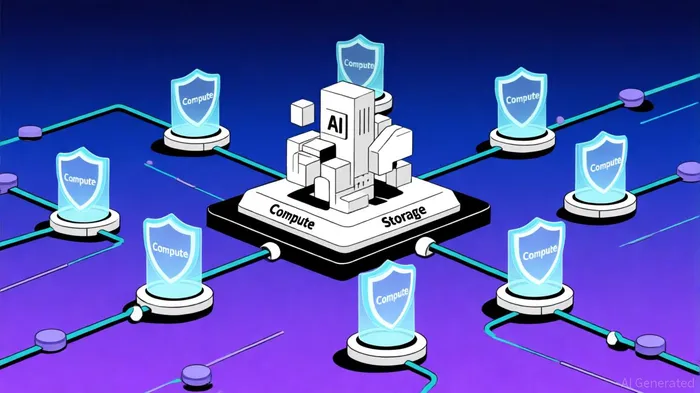
ZKP's dual consensus mechanism is its most innovative feature. Proof of Intelligence (PoI) ensures nodes contribute measurable computational power, enabling tasks like training AI models or processing large datasets in a distributed environment, as Coinrise explains as Coinrise explains. This is critical for AI workloads, which require not just storage but also high-performance computing. Meanwhile, Proof of Space (PoSp) verifies that nodes allocate storage resources, ensuring data remains accessible and secure, according to LiveBitcoinNews according to LiveBitcoinNews. Together, these mechanisms create a system where computation and storage are incentivized in parallel, preventing centralization and fostering a merit-based ecosystem, as CoinEdition notes as CoinEdition notes.
This hybrid approach addresses a key bottleneck in decentralized AI: the trade-off between scalability and fairness. Traditional blockchains often prioritize one resource (e.g., proof-of-work for computation) at the expense of others. ZKP's dual consensus, however, rewards both compute and storage contributors proportionally, creating a balanced network. For example, a node with excess GPU power can earn ZKP tokens by processing AI tasks, while a node with unused storage can earn rewards by hosting datasets. This dual incentive structure not only scales the network but also aligns with the distributed nature of AI's future.
Zero-Knowledge Architecture: Privacy Without Compromise
ZKP's use of zk-SNARKs and zk-STARKs elevates its value proposition. These cryptographic protocols allow nodes to verify computations without exposing sensitive data or model parameters. For instance, a pharmaceutical company could train an AI model on a decentralized network without revealing proprietary drug formulas, while a researcher could access datasets without exposing patient identities. This privacy-preserving framework is a game-changer for industries where data ownership and confidentiality are paramount.
The implications for data monetization are profound. ZKP's decentralized marketplace enables secure, verifiable exchanges of AI models and datasets, creating new revenue streams for contributors. A small startup with a novel AI algorithm, for example, could license it on ZKP's platform without fear of intellectual property theft. Similarly, individuals could earn income by sharing unused storage or computational power, turning underutilized resources into assets.
Tokenomics and Market Positioning: A Foundation for Growth
ZKP's tokenomics reinforce its long-term viability. With a total supply of 1 billion tokens, 48.5% is allocated to the community for ecosystem development, including airdrops, network incentives, and partnerships, according to Lookonchain according to Lookonchain. This allocation strategy prioritizes decentralization and user adoption, which are critical for a project aiming to disrupt centralized AI platforms.
The project's presale phase has already attracted attention in crypto circles, with analysts highlighting its potential to redefine decentralized compute environments. As ZKP approaches its whitelist activation, early adopters are betting on its ability to scale while maintaining privacy-a rare combination in the blockchain space.
Why ZKP Stands Out in the Decentralized AI Race
ZKP's dual consensus and zero-knowledge architecture address two of the most pressing challenges in AI: scalability and privacy. Unlike projects that focus solely on computation (e.g., Golem) or storage (e.g., Filecoin), ZKP integrates both, creating a holistic infrastructure for AI. Its use of ZKPs further differentiates it by enabling secure, trustless collaboration-a necessity for enterprises and individuals alike.
From an investment perspective, ZKP's presale-readiness and strong fundamentals make it a compelling opportunity. The project's emphasis on community-driven growth, coupled with its technical innovation, aligns with broader trends in decentralized AI. As AI workloads become increasingly distributed, ZKP's ability to reward contributors while preserving privacy could position it as a foundational layer for the next generation of AI ecosystems.
Conclusion
ZKP is more than a blockchain-it's a reimagining of how AI computation can be structured. By combining PoI, PoSp, and ZKPs, it creates a system where privacy and scalability coexist, enabling a new era of data monetization. For investors, the project's tokenomics and technical execution suggest a high-utility asset with strong long-term potential. As the decentralized AI market matures, ZKP's dual consensus mechanism may well become a blueprint for the future.







Comentarios
Aún no hay comentarios