
ZKP's 500x ROI Potential: Why It Outpaces XRP, Pepe, and Solana in 2026
The crypto market of 2026 is defined by a stark divide: projects with tangible infrastructure and real-world utility are outpacing speculative tokens and legacy networks struggling to adapt. Zero Knowledge Proof (ZKP), a privacy-first AI infrastructure blockchain, has emerged as a standout contender, with analysts forecasting returns of up to 800x. This article dissects why ZKP's infrastructure-driven model-rooted in decentralized computation, hardware innovation, and transparent governance-positions it to eclipse XRPXRP--, PepePEPE--, and SolanaSOL-- in the next 12 months.
The ZKP Edge: Infrastructure as a Competitive Moat
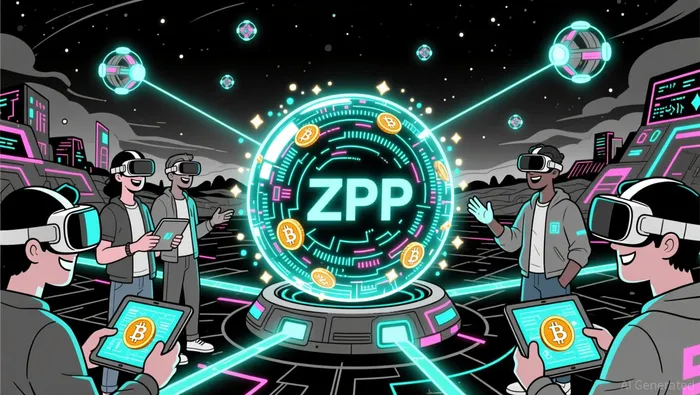
ZKP's value proposition lies in its dual-layer infrastructure: a blockchain protocol and physical hardware (Proof Pods) that enable private AI computation. Unlike XRP's institutional-centric liquidity struggles or Solana's developer fatigue, ZKP's Proof Pods are already shipping globally, offering users a tangible way to earn rewards by validating zero-knowledge proofs. These devices run a custom embedded OS optimized for secure, verifiable computation, creating a decentralized network that scales with adoption.
The project's presale model further reinforces its infrastructure-first ethos. Daily on-chain auctions distribute 200 million tokens, capping contributions at $50,000 per wallet to prevent whale dominance. This mechanism has already attracted $1.7 billion in participation, with 90% of tokens allocated to early adopters. By contrast, XRP's presale-like token distribution remains constrained by ongoing SEC litigation, while Pepe's meme-driven model lacks any hardware or infrastructure to anchor its value according to analysis.
XRP: Institutional Headwinds and Weak Price Action
XRP's 2026 trajectory is clouded by institutional challenges. Evernorth Holdings, a major XRP holder, faces $220 million in unrealized losses, signaling waning confidence among institutional investors. Despite ETF inflows, XRP's price action remains bearish, with analysts predicting a potential drop to $1.14 before a speculative rebound to $27 according to forecasts. This volatility contrasts sharply with ZKP's stable, infrastructure-backed growth.
Moreover, XRP's utility as a cross-border payment token is increasingly challenged by faster, cheaper alternatives. Solana's high throughput and low fees have already eroded XRP's market share in remittance corridors, while ZKP's AI-focused use cases-such as private data verification for enterprises- open entirely new revenue streams.
Solana: Consolidation and Developer Fatigue
Solana, once the darling of high-speed transactions, is in a consolidation phase as of late 2026. While its $118.99 support level holds, the network faces growing criticism over developer burnout and governance centralization. Short-term traders are wary of retests near $123.47, where liquidity gaps could trigger sharp corrections.
ZKP, by contrast, offers a hybrid consensus model compatible with EVM and WASM smart contracts, attracting developers with a scalable, privacy-preserving environment. Its Proof Pod hardware also provides a physical layer of security, a feature absent in Solana's purely software-driven architecture. Analysts argue that ZKP's dual infrastructure-on-chain and off-chain-creates a more robust foundation for long-term adoption.
Pepe Coin: A MemeMEME-- Without a Moat
Pepe Coin's 2026 outlook is bleak. Whale activity has intensified, with large holders offloading holdings amid bearish derivatives signals. Unlike ZKP, which has real-world partnerships (e.g., a $10M deal with the Australian Dolphins rugby team) and hardware deployment, Pepe remains a speculative asset with no infrastructure to justify its valuation.
The ROI Math: Why ZKP Outpaces the Field
ZKP's 500x ROI claim is not speculative hype-it's rooted in execution. The project's $100 million infrastructure is already operational, with Proof Pods generating daily rewards for users. This creates a flywheel effect: more hardware adoption → more network security → higher demand for ZKP tokens.
In contrast, XRP's ROI hinges on a favorable SEC ruling-a binary event with no guaranteed timeline. Solana's growth depends on developer retention, a fragile metric in a competitive ecosystem. Pepe, meanwhile, lacks any mechanism to sustain value beyond social media trends.
Conclusion: Infrastructure Wins in 2026
The crypto market is increasingly rewarding projects that build real-world infrastructure. ZKP's combination of hardware innovation, transparent governance, and AI-driven use cases creates a defensible moat that XRP, Pepe, and Solana cannot replicate. As institutional and retail investors pivot toward projects with tangible utility, ZKP's 500x ROI potential is not just plausible-it's inevitable.






Comentarios
Aún no hay comentarios