
ZKH Group's Strategic Rebalancing: A Path to Sustainable Growth in a Challenging MRO Market
In an industrial MRO (Maintenance, Repair, and Operations) sector marked by macroeconomic headwinds and margin pressures, ZKH Group's Q2 2025 results reveal a company in the throes of a calculated transformation. While the 12.1% year-over-year GMV contraction may raise eyebrows, this decline is not a sign of weakness but a deliberate recalibration toward profitability and long-term resilience. By dissecting ZKH's operational discipline, margin-enhancing initiatives, and customer-centric strategies, we uncover a compelling narrative of value creation in a market demanding both agility and foresight.
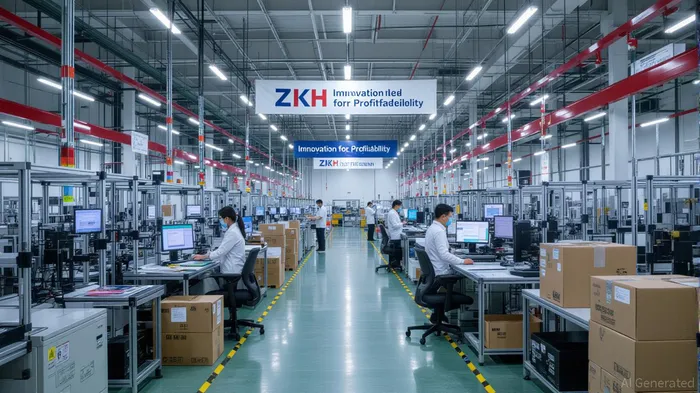
Operational Discipline: The Foundation of Resilience
ZKH's decision to optimize low-margin businesses has been a double-edged sword. The 3.7% revenue decline in Q2 2025 masks a critical shift: the company is prioritizing quality over quantity. This strategic pruning has already yielded results. The GBB platform's take rate increased by 14% year-over-year, driven by high-margin private-label products. The Taicang facility, launched in May 2025, is a cornerstone of this strategy. By centralizing R&D and production for private-label goods, ZKH is not only reducing dependency on third-party suppliers but also capturing higher margins. Private-label products now contribute over 8% of GMV, a figure poised to grow as the Taicang base scales.
Margin Expansion: A Catalyst for Profitability
The path to breakeven in Q2 2025 and profitability in Q3/Q4 hinges on margin discipline. ZKH's net loss narrowed by 19.3% to RMB53.5 million, a testament to cost optimization and pricing power. The GBB platform's 160.9% customer growth underscores the appeal of its value proposition: tailored, high-margin solutions for industrial clients. Meanwhile, AI-driven tools like the Smart Workbench and Product Recommendation Agent are amplifying operational efficiency, reducing labor costs, and accelerating revenue cycles. These innovations are not just incremental—they are structural, positioning ZKH to outperform peers in a sector where EBITDA margins often stagnate.
Customer Base Expansion: A Long-Term Moat
ZKH's 53.5% year-over-year customer growth, particularly in the U.S. market, is a strategic triumph. The U.S. market's revenue and customer base have nearly doubled since January 2025, fueled by a supplier network in Southeast Asia that balances cost and speed. This international expansion is not a gamble but a calculated move to diversify revenue streams and hedge against regional volatility. The U.S. market's rapid adoption of ZKH's private-label products also highlights the company's ability to localize offerings—a critical edge in a globalized MRO landscape.
Shareholder Returns and Strategic Confidence
The June 2025 expansion of ZKH's share repurchase program to US$50 million signals management's conviction in the company's intrinsic value. This move, coupled with the Taicang facility's ROI potential, reinforces a narrative of disciplined capital allocation. For investors, the repurchase program acts as a buffer against short-term volatility, while the company's focus on breakeven and profitability timelines provides a clear roadmap for value realization.
Investment Implications: Patience and Precision
ZKH's strategic rebalancing is a masterclass in navigating a challenging MRO market. The near-term GMV contraction is a necessary trade-off for long-term margin expansion and customer loyalty. For investors, the key is to separate the noise of quarterly figures from the signal of structural change. ZKH's AI-driven productivity, international diversification, and private-label pivot create a flywheel effect: higher margins fund R&D, which in turn drives customer retention and market share gains.
However, risks remain. The MRO sector's cyclical nature means demand could dip further if global industrial861072-- activity slows. ZKH's reliance on Southeast Asian suppliers also exposes it to geopolitical and logistical risks. Yet, the company's agile supply chain and focus on high-margin verticals mitigate these concerns.
Conclusion: A Resilient Play in a Fragmented Sector
ZKH Group's journey is a reminder that sustainable growth often requires painful but necessary choices. By embracing operational discipline, margin expansion, and customer-centric innovation, the company is building a moat in a sector where differentiation is scarce. For long-term investors, ZKH's strategic clarity and executional rigor present an opportunity to capitalize on a rebalancing that prioritizes profitability without sacrificing scale. As the industrial MRO market evolves, ZKH's ability to adapt and lead will likely define its next chapter—and its shareholders' returns.





Comentarios
Aún no hay comentarios