
ZK Pumping and the Role of Infrastructure Grants in Fueling Real Estate and Tech-Driven Growth
Strategic Infrastructure as a Catalyst
The FAST NY grant, allocated to the Webster Community Coalition for Economic Development, Inc., is transforming a 300-acre brownfield into a high-tech industrial hub. This initiative includes critical infrastructure upgrades such as road realignment, sewer system modernization and electrical master planning. These improvements are not merely logistical but represent a calculated effort to make the site "shovel-ready" for advanced manufacturing and logistics ventures. By reducing the barriers to entry for developers, Webster is positioning itself as a magnet for capital-intensive industries, a strategy that directly aligns with Governor Hochul's vision for regional economic revitalization.
The implications of such projects extend beyond immediate job creation. For instance, the $650 million fairlife® dairy facility, which is expected to generate 250 jobs, underscores how infrastructure readiness can attract high-value private investments. This synergy between public and private capital is emblematic of what could be termed "ZK Pumping"-a process where infrastructure grants act as a multiplier, amplifying returns through cascading effects on adjacent sectors.
Real Estate: From Brownfield to Blue-Chip Asset
The Xerox campus redevelopment exemplifies how infrastructure funding can reclassify underutilized land into premium real estate. By addressing foundational challenges like outdated utilities and transportation bottlenecks, Webster has elevated the desirability of its industrial corridors. According to a report by the Webster Economic Development Alliance, the Sandbar Waterfront Revitalization and the 600 Ridge Road site redevelopment have already driven a measurable increase in property valuations. This trend is not isolated; similar projects nationwide have demonstrated that infrastructure investment can boost land values by up to 30% within five years of project completion.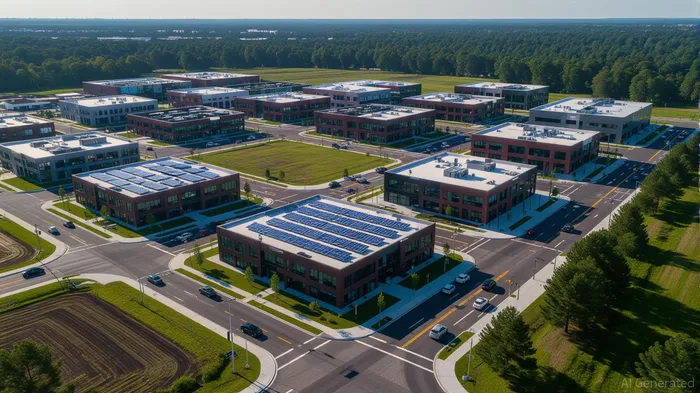
For investors, this creates a dual opportunity: speculative gains from early-stage land acquisitions and long-term appreciation as the area matures. The $9.8 million grant, by making the Xerox campus a viable location for advanced manufacturing, has effectively turned a liability into an asset class. This aligns with broader market dynamics, where industrial real estate-particularly in regions with strategic infrastructure-is outperforming traditional commercial assets.
Tech-Driven Growth: Beyond Physical Infrastructure
While the physical upgrades in Webster are transformative, the project's true innovation lies in its integration of technology. The proposed blockchain-based NATRA system, designed to revolutionize traffic governance through smart contracts, highlights how infrastructure grants can fund next-generation solutions. By embedding digital infrastructure into physical development, Webster is not only improving mobility but also attracting tech-driven enterprises that prioritize operational efficiency.
This confluence of infrastructure and technology is critical for long-term investment. As industries like logistics and advanced manufacturing become increasingly reliant on data-driven systems, regions that prioritize tech-enabled infrastructure will dominate the value chain. The $9.8 million grant, therefore, serves as a seed investment in a future where physical and digital infrastructure are inextricably linked.
Speculative vs. Long-Term Investment: Balancing the Equation
The Webster case study reveals a nuanced interplay between speculative and long-term investment. Short-term gains are evident in the immediate demand for land and construction services, while long-term value accrues through sustained industrial activity and population growth. For instance, the fairlife® facility's 250 jobs will not only stabilize the local economy but also create a ripple effect in housing, retail, and services.
Investors must, however, navigate risks. The success of ZK Pumping hinges on the timely execution of infrastructure projects and the alignment of private-sector interests. Delays or mismanagement could erode confidence, as seen in underperforming PPPs elsewhere. Yet, Webster's track record-with projects like the Sandbar Waterfront already delivering returns-suggests a robust framework for mitigating such risks.
Conclusion: A Model for Future-Proof Investment
The $9.8 million FAST NY grant in Webster, NY, is more than a local success story; it is a case study in how strategic infrastructure development can catalyze growth across real estate and technology sectors. By redefining brownfields as blue-chip assets and embedding tech-driven solutions into physical infrastructure, Webster has created a model that balances speculative potential with long-term resilience. For investors, the lesson is clear: infrastructure grants are not merely fiscal allocations but foundational tools for shaping the next era of industrial and urban evolution.





Comentarios
Aún no hay comentarios