
Zircuit (ZRC) Network Upgrade and Its Implications for Crypto Traders
The Zircuit (ZRC) network's v1.122.7 upgrade, supported by Bybit, marks a pivotal moment in the evolution of AI-powered blockchain infrastructure. This upgrade, which introduces Sequencer-Level Security (SLS) and a hybrid zero-knowledge (ZK) and optimistic rollup architecture, is not merely a technical enhancement but a strategic move to attract institutional capital. Bybit's active participation-ranging from increased withdrawal limits for VIP clients to the establishment of a Business-to-Business Unit (BBU)-signals a broader industry shift toward blockchain solutions that prioritize both scalability and institutional-grade security. For crypto traders, this convergence of technical innovation and institutional adoption presents a compelling case for ZRC as a high-conviction investment.
Technical Robustness: Zircuit's AI-Powered Blockchain as a Security and Scalability Catalyst
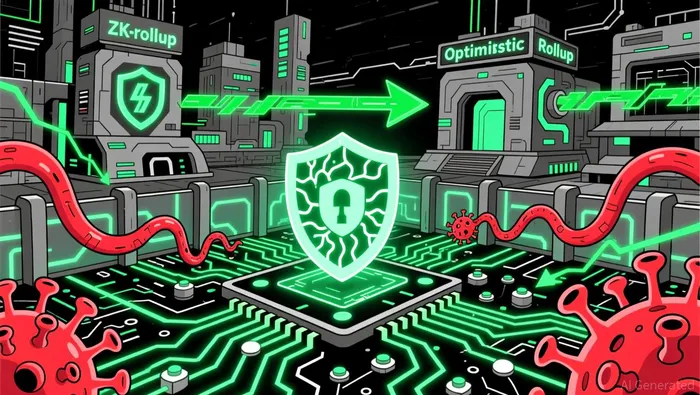
Zircuit's v1.122.7 upgrade centers on its AI-driven SLS system, which proactively detects and quarantines malicious transactions in real time. By analyzing on-chain and off-chain data, the system identifies threats such as reentrancy vulnerabilities and phishing attempts with an accuracy rate exceeding 99.5%. This is achieved through a hybrid architecture that combines ZK-rollups with Optimistic Rollups, enabling faster transaction finality while maintaining Ethereum's settlement guarantees.
The upgrade also includes a zkVM mainnet rollout, which optimizes withdrawals by integrating SP1 proofs via Sindri Labs' API, reducing costs by approximately 30%. These improvements are critical for institutional adoption, as they address two major pain points: operational efficiency and risk mitigation. For example, Zircuit's customizable transaction policies allow institutions to enforce KYC rules or asset flow restrictions without compromising on-chain flexibility. Such features align with the growing demand for blockchain solutions that meet traditional finance's compliance standards.
Bybit's Institutional Adoption Play: From BBU to Capital Mobility
Bybit's support for Zircuit's upgrade is part of a broader strategy to position itself as a bridge between crypto and institutional markets. The exchange recently launched a BBU, led by Yoyee Wang, to provide secure custody, efficient settlement, and access to tokenized products. This unit is designed to cater to institutional clients seeking capital-efficient solutions, a trend underscored by Bybit's recent increase in daily withdrawal limits for VIP Pro 6 tier clients to 60 million USDT.
The exchange's decision to suspend ZRC deposits and withdrawals during the August 5, 2025, upgrade further underscores its commitment to network stability. This move mirrors Bybit's earlier partnership with Anchorage Digital to provide institutional custody for its bbSOL token, reinforcing its credibility in the institutional space. For traders, Bybit's actions suggest that ZRC is being positioned as a strategic asset for institutional portfolios, particularly given its AI-driven security and cross-chain interoperability.
Implications for Crypto Traders: Security, Scalability, and Institutional Liquidity
The Zircuit upgrade's technical advancements directly benefit traders by reducing slippage and gas costs while enhancing trade execution speed. The Hyperliquid for AI Trading platform, which operates on EVM-compatible chains and SolanaSOL--, enables real-time signal detection and cross-chain trading, offering retail and institutional traders a unified interface for alpha generation. This is particularly relevant in volatile markets, where rapid capital redeployment is critical.
Moreover, the $495,000 grant program for developers and the planned $10 million ZRC token allocation for community-built AI models indicate a sustainable ecosystem growth strategy. For traders, this translates to increased liquidity and use cases for ZRC, which could drive demand. The token's price trajectory-peaking at $0.1379 in November 2024 and settling at $0.00734 by late 2025-reflects both speculative interest and the underlying technical value of the network. Analysts project a long-term upward trend, with ZRC potentially reaching $0.12 by 2030, driven by institutional adoption and AI-driven trading utility.
Conclusion: A Convergence of Innovation and Institutional Demand
Zircuit's v1.122.7 upgrade, coupled with Bybit's institutional-grade support, represents a rare alignment of technical innovation and market readiness. For traders, this signals a maturing blockchain ecosystem where AI-powered security and cross-chain scalability are no longer niche features but foundational requirements. As institutions increasingly seek solutions that balance compliance with performance, ZRC's hybrid architecture and Bybit's infrastructure investments position the token as a key player in the next phase of crypto adoption.






Comentarios
Aún no hay comentarios