
ZIM Integrated Shipping's Share Price Surge: Assessing the Sustainability Amid Global Shipping Challenges
Drivers of the Recent Rally
The immediate catalyst for ZIM's share price surge lies in its revised full-year 2025 adjusted EBITDA guidance, which now ranges between $2 billion and $2.2 billion-a 5% increase at the mid-point compared to its prior forecast. This revision reflects strong year-to-date performance, including a Q3 2025 earnings per share of $1.02, which exceeded analyst expectations of $0.92, despite revenue falling slightly short at $1.78 billion. The company also declared a quarterly dividend of $0.31 per share, signaling confidence in its ability to generate consistent cash flow amid volatile market conditions.
JPMorgan analysts, however, have tempered enthusiasm by lowering their 2025 EBITDA estimate to $2.1 billion and forecasting significant earnings pressure in the fourth quarter and into 2026. This caution underscores the fragility of ZIM's current momentum in the face of broader industry challenges.
Global Demand Pressures and Structural Overcapacity
The global shipping industry is grappling with a structural imbalance: supply is outpacing demand growth, a trend expected to persist through 2025 and beyond. ZIM's Chief Financial Officer, Xavier Destriau, has acknowledged that this overcapacity will likely continue to depress freight rates. For context, global container freight rates have fluctuated dramatically in 2025, dropping to $2,812 per 40-foot container by July 2025 from a peak of $5,901 in 2024, before rebounding to $1,959 per FEU in November 2025.
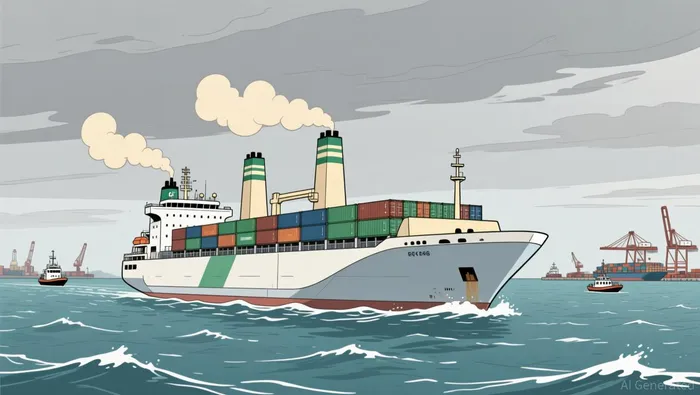
Key trade routes illustrate this volatility. The Asia-to-US West Coast route saw a 48% surge in November 2025 following General Rate Increases, while the Shanghai-to-Genoa route experienced an 11% decline in March 2025. These swings highlight the sector's susceptibility to geopolitical tensions (e.g., Red Sea disruptions) and trade policy shifts, such as U.S.-China tariff adjustments.
Operational Efficiency and Fleet Modernization
ZIM's operational efficiency metrics offer a glimmer of hope. The company operates a fleet of 115 container ships with a total capacity of 709,000 TEUs, 40% of which are LNG-powered-a strategic move that enhances both cost efficiency and environmental compliance. Additionally, ZIM is preparing for the resumption of Suez Canal operations, which is expected to reduce transit times and costs but may also intensify rate pressures due to increased effective capacity.
Despite these advantages, ZIM's Q3 2025 results revealed a 61% decline in adjusted EBITDA to $593 million, driven by a 35% drop in average freight rates to $1,602 per TEU and a 5% decrease in carried volume. These figures underscore the vulnerability of even well-managed fleets to macroeconomic forces.
Financial Leverage and Cost Structure
ZIM's financial health further complicates the sustainability of its rally. As of November 14, 2025, the company reported a debt-to-equity ratio of 1.52 and a net leverage ratio of 0.9x. While these metrics show slight improvement from 12-month averages, they remain elevated, exposing ZIMZIM-- to refinancing risks in a high-interest-rate environment.
Operating expenses have also been impacted by the industry's downturn. ZIM's operating income (EBIT) for Q3 2025 fell to $259 million from $1.235 billion in Q3 2024. CEO Eli Glickman has emphasized the company's improved cost structure and enhanced fleet profile as long-term strengths, but these gains may be offset by near-term volatility.
Conclusion: A Rally Built on Short-Term Optimism
ZIM's share price surge is justified by its agility in navigating a volatile market and its commitment to shareholder returns. However, the sustainability of this rally depends on the company's ability to weather structural overcapacity, geopolitical risks, and weak demand. While ZIM's LNG-powered fleet and strategic positioning offer competitive advantages, its elevated debt levels and exposure to rate fluctuations pose significant risks. Investors should monitor the company's Q4 performance and the broader industry's response to the IMO 2026 emissions rules, which could further reshape cost structures and freight dynamics.
In the near term, ZIM's rally appears to reflect optimism about its operational resilience. Yet, as JPMorgan's cautious outlook suggests, the path to long-term profitability remains uncertain.







Comentarios
Aún no hay comentarios