
Zevia's Strategic Positioning in the Modern Soda Market and Path to Profitability
The carbonated soft drink (CSD) market is undergoing a transformation, driven by shifting consumer preferences toward health-conscious and functional beverages. Zevia PBCZVIA--, a leader in zero-sugar sodas, has positioned itself as a formidable player in this evolving landscape. By leveraging cost discipline, brand innovation, and aggressive retail expansion, ZeviaZVIA-- is not only outpacing newer functional CSDs but also charting a clear path to profitability in 2026.
Cost Discipline: A Foundation for Sustainable Growth
Zevia's ability to balance growth with operational efficiency is a cornerstone of its strategy. In Q3 2025, the company reported a 12.3% year-over-year increase in net sales to $40.8 million, driven by expanded distribution at Walmart and the club channel. Despite challenges such as a 3.5 percentage point decline in gross profit margin to 45.6%-attributed to inventory write-downs from packaging refreshes and aluminum tariffs-the company has already achieved $15 million of its $20 million productivity savings goal for 2025. These savings, derived from warehousing and freight cost reductions, are critical to mitigating margin pressures and aligning with Zevia's target of adjusted EBITDA positivity by 2026.
Comparative analysis with newer functional CSDs highlights Zevia's disciplined approach. Many emerging brands struggle with balancing innovation costs against profitability, often prioritizing flashy product features over sustainable cost structures. Zevia, however, has integrated financial governance into its innovation strategy, ensuring that investments in packaging and distribution are offset by operational efficiencies. For instance, the company's Productivity Initiative is projected to yield an additional $5 million in savings by Q1 2026, further bolstering its margin resilience.
Brand Innovation: Capturing Consumer Sentiment
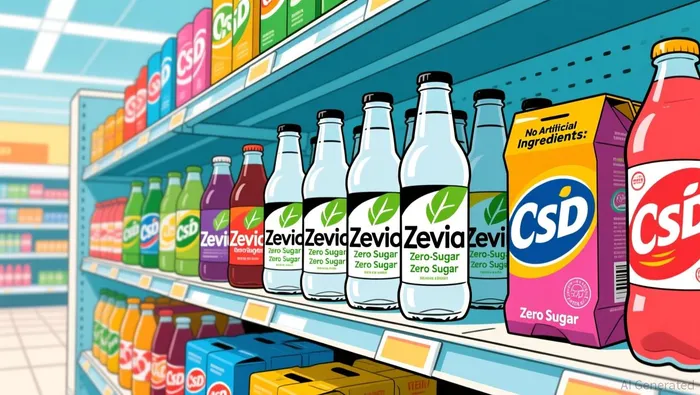
Zevia's brand innovation strategy is centered on emotional resonance and clear value propositions. The company's recent packaging refresh, emphasizing "zero sugar" and "no artificial ingredients," has driven a 60% increase in purchase intent, according to internal research. This aligns with broader consumer trends toward transparency and health-conscious choices, a shift that newer functional CSDs often fail to address comprehensively.
Product innovation has also been a key differentiator. The launch of flavors like Strawberry Lemon Burst underscores Zevia's commitment to expanding its flavor portfolio while maintaining its core identity as a no-sugar alternative. In contrast, many newer CSDs focus on superficial personalization or niche functional benefits (e.g., added vitamins or probiotics) without addressing the fundamental demand for clean-label ingredients. Zevia's approach not only strengthens brand loyalty but also positions it to capture a larger share of the $2.5 billion zero-sugar soda market.
Retail Expansion: Scaling Distribution with Precision
Zevia's retail expansion strategy has been instrumental in driving sales growth and market penetration. The company's partnership with Walmart, including over 400 Canadian stores, has significantly broadened its reach. This expansion, combined with a focus on the club channel, has enabled Zevia to achieve a 2025 sales guidance range of $162–164 million, up from a challenging 2024.
The company's geographic and channel diversification contrasts with the fragmented strategies of newer CSDs, which often prioritize digital-first or direct-to-consumer models at the expense of traditional retail presence. Zevia's emphasis on physical retail visibility-through shelf-space optimization and in-store promotions-ensures sustained consumer engagement. Analysts project that these efforts will drive household penetration to 20% by 2026, a critical threshold for long-term growth.
Outperforming the Competition: A 2026 Roadmap
Zevia's strategic advantages position it to outperform newer functional CSDs in 2026. While competitors grapple with rising tariffs and supply chain costs- factors that have pushed retail prices up by 5.4% in import-intensive sectors-Zevia's cost discipline and productivity initiatives provide a buffer against margin erosion. Additionally, its brand innovation aligns with Forrester's 2026 prediction that consumers will prioritize "genuine innovation" over superficial personalization.
Financially, Zevia's 2026 roadmap is ambitious yet achievable. With gross margins projected to improve to the upper 40s to low 50s starting in Q1 2026, and revenue guidance of $174.2 million for the year, the company is on track to achieve profitability. This trajectory is further supported by its $150 million range of projected 2026 net revenue, which reflects confidence in sustaining its 2025 momentum.
Conclusion: A Compelling CPG Growth Story
Zevia's strategic positioning in the modern soda market is a testament to its ability to harmonize cost discipline, brand innovation, and retail expansion. By addressing consumer demand for clean-label products, optimizing operational efficiencies, and scaling distribution through high-traffic retail channels, Zevia is not only navigating industry headwinds but also setting a high bar for competitors. As the company moves toward its 2026 profitability target, it emerges as a compelling consumer packaged goods (CPG) growth stock, offering investors a rare combination of scalable revenue and disciplined execution.







Comentarios
Aún no hay comentarios