
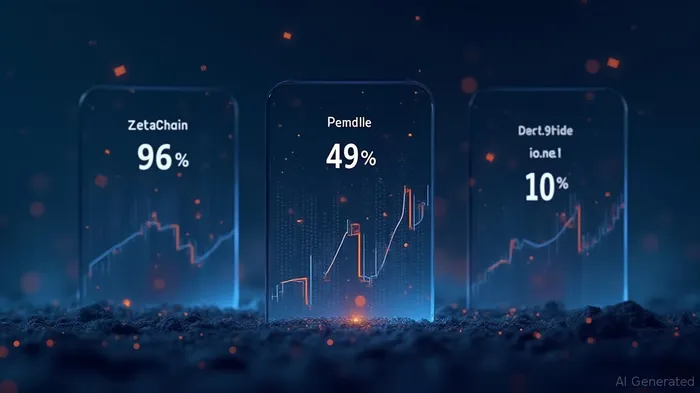
ZetaChain Drops 94% From High, Omnichain Connectivity Awaits Q3 Rebound Pendle Down 49% From High, Yield Trading Hub Poised For Q3 Surge io.net Plummets 88% From High, AI Compute Marketplace Ready For Q3 Rotation
Smart money is made in the lull, not the launch. When the crowd steps back, disciplined buyers scoop up quality tokens at clearance prices and ride them into the next leg higher. Today’s most compelling bargains sit at the intersection of three unstoppable trends: omnichain connectivity, on-chain yield trading, and decentralized GPU power. Cross-chain pioneer ZetaChain (ZETA), yield-derivatives hub Pendle (PENDLE), and AI compute marketplace io.net (IO) have all endured deep pullbacks even as their products, revenues, and ecosystems keep expanding. Together they form a trio that could lead the “real-infrastructure” rotation many analysts expect once Q3 liquidity returns. Why do these tokens deserve attention right now? Let’s find out.
ZetaChain (ZETA) is a universal bridge worth catching on the dip. In a market racing toward chain abstraction, ZetaChain’s “universal L1” vision, one network that can plug into any blockchain, even BitcoinBTC--, has quietly become reality. The project already runs omnichain smart contracts in production, enabling developers to build DEXs, social apps, and lending pools that move assets natively across EthereumETH--, CosmosATOM--, SolanaSOL--, and more. That connective tissue is exactly what institutions and retail users will need when the next liquidity wave hits in Q3 2025. Here’s why ZETAZETA-- looks oversold today and primed for a rebound.
ZetaChain’s all-time high was $2.86 on 15 Feb 2024, and it is currently trading at approximately $0.18, representing a 94% drawdown from its all-time high. A 46 million ZETA unlock scheduled for the first week of July has traders front-running supply expansion. The unlock is a textbook “sell-the-rumor” event; once supply overhang is absorbed, catalysts below can flip sentiment. ZetaChain’s strong tokenomics include utility as gas for omnichain contracts, staking to secure light-client validators, and governance on protocol upgrades. The supply is 2.1 billion max, with 926 million circulating, and the circulating cap is approximately $170 million—small for cross-chain infrastructure that already handles nine-figure TVL. The majority of new supply vests linearly over four years, with Q3 2025 being the single largest cliff, meaning dilution risk falls after this summer. Strategic partnerships include Alchemy, Tenderly, Ledger, and Ankr, which provide RPC, debugging, and wallet support. dApps live today include Cross-Chain DEX, OmniLend, Link3 Social, and several GameFi ports leveraging native USDC transfers across chains. ZetaChain is listed on Binance, CoinbaseCOIN--, OKX, and Bybit, providing ample liquidity for both retail and funds. Cross-chain volume has doubled year-over-year, but 70% of that still relies on risky wrapped assets. ZetaChain’s native route slashes bridge attacks and UX friction, exactly the bottlenecks regulators and TradFi entrants cite. As MiCA licensing pushes European platforms to safer infrastructure, a universal L1 with built-in compliance hooks stands to capture outsized flow. Capitulation levels, post-unlock float clarity, and Q3 narrative tailwinds make ZetaChain a compelling buy. If you’re hunting mid-cap infrastructure plays before the Q3 2025 rotation, ZetaChain offers asymmetric upside with real product-market fit. Accumulating below $0.20 could look prescient once omnichain volume becomes the market’s default setting.
Pendle (PENDLE) is a yield-trading powerhouse sleeping at the bottom. In a market obsessed with future restaking points, Pendle is already letting traders price, hedge, and lever every major yield stream, yet the token trades at mid-2024 levels despite a 20× TVL explosion. That disconnect makes PENDLE a rare “buy-the-dip” candidate before Q3 liquidity kicks back into DeFi. Pendle’s all-time high was $7.12 on 9 Apr 2024, and it is currently trading at approximately $3.61, representing a 49% drawdown from its all-time high. Sentiment drag includes profit-taking after March airdrop farming spree plus macro risk-off crushed price, even as protocol revenue hit record highs. Pendle’s strong tokenomics include a total supply of 281.5 million, with 164.6 million circulating (approximately 58%). More than 66% of circulating PENDLE is ve-locked, throttling liquid supply and boosting voting power over fee flows. The largest liquidity-incentive tranche is already live, with remaining unlocks bleeding out linearly into 2026, and no giant cliffs ahead. Strategic partnerships include restaking titans Ether.fi, KelpDAO, and Swell, all routing LRT yields through Pendle pools. DePIN meets DeFi with Aethir’s GPU-restaking token eATH integrated last week, proof Pendle can tap totally new yield verticals. Institutional eye-catchers include SpartanSPTN--, Jump, and Wintermute LP across Pendle pools, with Messari tagging it “highest real revenue per $ of TVL” in DeFi. DeFi’s next leg hinges on real yield and compliant fixed-income products. Pendle already clears more than $150 million daily notional in yield swaps while charging a 3 bps fee, revenue that accrues 100% to vePENDLE lockers. Add Solana’s firehose of staked SOL and Hyperliquid perpetual funding streams, and fee potential could 3× by year-end. Half-off from ATH with double the TVL, valuation lagging fundamentals, emission overhang fading, and macro fit make Pendle a compelling buy. For investors craving a dip buy with actual cash flow, Pendle offers asymmetric upside as the yield layer every restaking protocol plugs into. Accumulating sub-$4 PENDLE before the Q3 cross-chain roll-out could feel like buying UniswapUNI-- under a dollar.
io.net (IO) is the Internet of GPUs trading for pocket change. In an AI-hungry world where cloud giants are booked months out, io.net’s “Internet of GPUs” already rents out hundreds of thousands of graphics cards at Web2-beating prices—yet the token has bled approximately 88% since launch and now hovers under a dollar. That mismatch between real revenue and rock-bottom valuation makes IO an unusually juicy dip candidate ahead of Q3’s AI and DePIN rotation. Unlock drip and macro jitters crushed price, but the fundamentals below keep marching forward. io.net’s strong tokenomics include a max supply of 800 million IO, with 168.8 million circulating (21%). The remaining 300 million tokens vest linearly over 20 years, with no monster cliffs ahead. Utility includes gas for workload proofs, staking for slashing insurance, and governance over fee parameters. The staking flywheel requires GPU operators to bond IO, with delegators co-staking, sharing 70% of protocol fees. Strategic partnerships include a $30 million Series A led by Hack VC, Solana Labs, and OKX, valuing parent IO Research at a nine-figure clip. There are 91 production partners, from privacy L2s to Agentic-AI startups, onboarded by Feb 2025. 20 million IO Builder Grants just launched by the IOG Foundation to bankroll GPU-hungry AI projects, seeding fresh demand for compute and tokens. DePIN analysts peg decentralized compute TAM at $30 billion by 2028. io.net’s average GPU hour already prices approximately 30% below AWS A10 instances, carving a moat on cost while wrapped in cryptographic guarantees. As AI startups scramble for budget GPUs and regulators push data-sovereign infrastructure, a cross-chain marketplace that can spin up 300,000+ cards on demand sits in the sweet spot. Capitulation valuation, seller exhaustion, Q3 catalysts, and mean-reversion math make io.net a compelling buy. For dip-hunters seeking tangible cash flow and a front-row seat to the AI compute land-grab, io.net offers one of the cleanest asymmetry plays heading into Q3 2025. Sub-$1 IO might look like buying AWS in the garage-server era.
Cross-chain rails, yield marketplaces, and AI compute form the backbone of the next crypto build-out, and that’s exactly what ZetaChain, Pendle, and io.net already deliver. ZETA is unlocking native Bitcoin-to-EVM transfers, PENDLE is turning every restaking and staking stream into a tradable fixed-income market, and IO is renting out hundreds of thousands of GPUs at prices AWS can’t touch. Each network is live, revenue-generating, and partnered with blue-chip players, so the tech is battle-tested even as their tokens still trade 50–90% below prior highs. With this summer’s unlock overhangs nearly behind them, fresh cross-chain deployments, Solana integrations, and AI demand spikes on the horizon, fundamentals, technical readiness, and catalysts are finally pointing the same way. Add an improving macro backdrop and you have a rare setup where buying the dip in real-infrastructure tokens could capture the early innings of Q3’s next leg higher.






Comentarios
Aún no hay comentarios