
ZenaTech's Strategic Acquisition and the Accelerated Consolidation of the Geospatial Technology Sector
The geospatial technology sector is undergoing a seismic shift, driven by a wave of mergers and acquisitions (M&A) that reflects both technological evolution and strategic realignment. ZenaTech's recent acquisition of Putt Land Surveying, Inc. in October 2025 is emblematic of this trend, as noted in the ZenaTech acquisition announcement. As the 11th acquisition under ZenaTech's Drone as a Service (DaaS) business, the deal underscores the company's aggressive expansion in Arizona and its broader ambition to establish 25 DaaS locations nationwide by mid-2026. But ZenaTech's move is not an outlier-it is part of a broader pattern of consolidation accelerating across the geospatial industry, fueled by demand for AI-driven analytics, cloud integration, and the need for scalable infrastructure, according to Grand View Research.
A Sector in Motion: The Forces Behind Consolidation
The geospatial technology market, valued at $548.07 billion in 2024, is projected to grow at a compound annual growth rate (CAGR) of 17.9% through 2029, reaching $1.18 trillion, per a Business Research Company report. This explosive growth is driven by three key factors: advancements in artificial intelligence and machine learning, the proliferation of 5G networks enabling real-time data processing, and the increasing reliance on geospatial data for urban planning, defense, and environmental monitoring, according to the US Geospatial Market report.
According to a report by Grand View Research, geographic information systems (GIS) and spatial analytics accounted for the largest revenue share in 2023, while 3D scanning is expected to grow at the fastest CAGR from 2024 to 2030. These technologies are not just complementary-they are now essential for companies seeking to differentiate themselves in a competitive landscape. As a result, firms are consolidating to bundle capabilities, reduce costs, and offer end-to-end solutions.
ZenaTech's acquisition of Putt Land Surveying, a 40-year-old firm specializing in boundary and topographic surveys, aligns with this logic. By integrating Putt's local expertise with its DaaS platform, ZenaTechZENA-- can offer clients in Arizona a hybrid model: traditional surveying services augmented by drone-based data collection and AI-driven analysis, as described in the ZenaTech acquisition announcement. This move mirrors the strategy of larger players. For instance, in 2025, the National Geospatial-Intelligence Agency (NGA) awarded a $615.7 million contract to Lockheed Martin for geospatial intelligence collection, while Palantir USG secured a $28.3 million deal for AI-enabled data analytics, per the NGA contracts page. These contracts highlight how government demand is shaping private-sector consolidation, as companies bid to meet increasingly complex requirements.
Case Studies in Consolidation: Beyond ZenaTech
ZenaTech's acquisition is part of a broader surge in M&A activity. In 2024-2025, the sector saw high-profile deals such as Indra Sistemas' acquisition of Spain-based Deimos, a satellite systems integrator, and Redwire's purchase of Hera, a developer of space domain awareness technologies, according to a JanesCapital report. These transactions reflect a shift toward vertical integration, where firms are not only acquiring technical capabilities but also expanding into adjacent markets like satellite imaging and low-Earth-orbit constellations.
Meanwhile, the NGA's Luno B contract-a $200 million multi-vendor initiative involving Airbus, BAE Systems, and Maxar-demonstrates how consolidation is not limited to private deals. Government agencies are increasingly favoring partnerships that combine the agility of startups with the scale of established firms (see NGA contracts page). This trend benefits companies like ZenaTech, which can leverage its DaaS model to enter federal contracts while maintaining a footprint in commercial markets.
Strategic Implications for Investors
For investors, the accelerating consolidation in geospatial technology presents both opportunities and risks. On the upside, companies that successfully integrate AI, cloud computing, and drone-based data collection-like ZenaTech-are well-positioned to capture market share. The DaaS model, in particular, offers a scalable, subscription-based revenue stream that reduces clients' capital expenditures while increasing recurring income for providers, as outlined in the ZenaTech acquisition announcement.
However, challenges persist. Trade tensions between the U.S. and China have disrupted supply chains for geospatial components, pushing firms to prioritize domestic manufacturing at higher short-term costs (see US Geospatial Market report). Additionally, the sector's reliance on skilled labor and data privacy regulations could slow adoption in some regions.
Conclusion: A Tipping Point for the Industry
ZenaTech's acquisition of Putt Land Surveying is more than a regional play-it is a microcosm of a sector at a tipping point. As geospatial technology becomes indispensable for infrastructure, defense, and climate resilience, consolidation will continue to accelerate. For investors, the key will be identifying firms that can balance innovation with operational scale, much like ZenaTech is attempting with its DaaS strategy.
The next few years will likely see more cross-border deals, government-driven partnerships, and AI-first platforms reshaping the industry. Those who recognize the urgency of consolidation-and the strategic value of companies like ZenaTech-may find themselves well-positioned to capitalize on a market poised for exponential growth.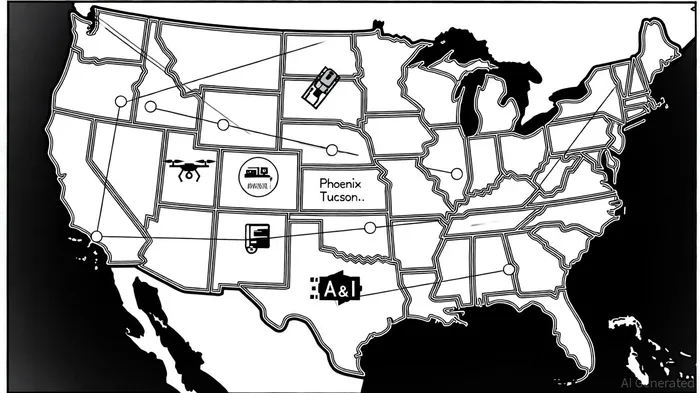





Comentarios
Aún no hay comentarios