
ZEC Short Exposure on Hyperliquid: A Microcosm of Altcoin Derivative Positioning and Risk Management in 2025
ZEC's Short Exposure: A Tale of Leverage and Resilience
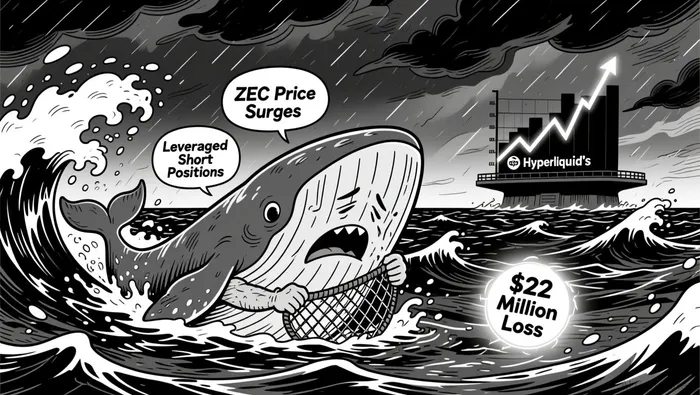
The largest ZEC short on Hyperliquid, held by a whale since late September 2025, has become a cautionary tale of overleveraging. With ZEC prices surging past $686-a 90% increase from the short's entry point-the position's margin has been bolstered by an additional $5 million in USDCUSDC-- to delay liquidation according to reports. This mirrors a broader trend in altcoin derivatives: speculative shorting of high-beta assets, often at extreme leverage ratios, to capitalize on perceived overvaluations. However, ZEC's resilience-driven by renewed treasury accumulation and institutional adoption-has turned this whale's bet into a $22 million paper loss, underscoring the risks of rigid positioning in a market where fundamentals can rapidly outpace expectations according to financial analysis.
Interestingly, this whale's portfolio is not entirely bearish. It includes a $26 million 15x leveraged ETH short with a $7 million unrealized gain and a smaller $3.48 million MON short. This diversified approach suggests a strategy of hedging altcoin exposure while maintaining a bearish bias on EthereumETH--. Yet, the ZEC short's precarious liquidity threshold-requiring ZEC to fall below $1,112 to avoid liquidation-exposes the fragility of such strategies in a market where macroeconomic shocks (e.g., U.S.-China trade tensions) can trigger cascading liquidations as research shows.
Altcoin Derivatives: A Double-Edged Sword
ZEC's short exposure is emblematic of a broader surge in altcoin derivatives activity. Open interest in ZEC futures reached $360 million in Q3 2025, with a long/short ratio of 2.8 indicating strong retail demand according to market data. This contrasts sharply with the broader altcoin market, where open interest for tokens like UNIUNI-- and AAVEAAVE-- has declined as traders cut speculative bets following the October 10 liquidation event. For example, UNI's open interest dropped to $305.3 million, while AAVE's fell to $154.5 million, reflecting a flight to liquidity amid heightened volatility according to trading analytics.
The divergence between ZEC and other alts highlights the role of catalysts in shaping derivative positioning. While ZEC's price surge was driven by institutional inflows (e.g., $59 million from Winklevoss Capital) and privacy-focused use cases, tokens like UNI and AAVE faced headwinds from regulatory uncertainty and reduced liquidity. This is evident in the actions of high-profile traders like Arthur Hayes, who offloaded AAVE and UNI holdings as part of a risk-reduction strategy. Such behavior underscores the importance of fundamental narratives in sustaining derivative activity, even as leverage and volatility remain core market drivers.
Risk Management in a High-Stakes Environment
The ZEC short's margin adjustments and liquidation risks exemplify the challenges of managing leveraged positions in a fragmented derivatives market. As of November 2025, altcoin derivatives trading volumes have surged to $900 billion, with perpetual futures accounting for 78% of activity according to research. However, liquidity remains a critical vulnerability. Smaller alts like SOL face order-book depth issues, while platforms like Hyperliquid and AsterASTER-- have emerged as key liquidity providers, capturing 73% of DEX derivatives volume according to market analysis.
Effective risk management in this environment requires a multi-layered approach. Institutional-grade strategies, such as core-satellite portfolios (anchoring in BitcoinBTC-- while allocating to high-growth alts), have gained traction according to trading guides. Additionally, stop-loss orders and dynamic position sizing are essential to mitigate the impact of sudden price swings. For example, ZEC's 8.6% weekly gain in November was accompanied by $18.8 million in perpetual futures liquidations, illustrating how even bullish momentum can trigger panic selling according to market reports.
Regulatory developments further complicate risk management. The U.S. CLARITY Act and Japan's bank-issued stablecoin pilots are fostering institutional participation, but they also introduce compliance risks for traders relying on decentralized platforms according to financial analysis. As a result, market participants must balance innovation with caution, particularly in jurisdictions where regulatory frameworks are still evolving.
Conclusion: ZEC as a Barometer for Altcoin Sentiment
ZEC's short exposure on Hyperliquid is more than an isolated case-it is a microcosm of the altcoin derivatives market's strengths and vulnerabilities. The whale's leveraged bets, while emblematic of speculative excess, also highlight the resilience of assets with strong fundamentals and institutional backing. Meanwhile, the broader market's shift toward liquidity preservation and risk diversification reflects a maturing ecosystem grappling with the lessons of October 2025's $19 billion liquidation event according to market analysis.
For investors, the key takeaway is clear: derivative positioning in altcoins must be approached with a disciplined, adaptive strategy. ZEC's trajectory demonstrates that even in a volatile market, assets with robust use cases and institutional adoption can outperform. However, the risks of overleveraging-exemplified by the ZEC short's precarious margin-serve as a stark reminder of the need for prudent risk management in an era where derivatives dominate trading activity.






Comentarios
Aún no hay comentarios