
Zebra Technologies: Pioneering Intelligent Operations in the Age of Industrial Digital Transformation
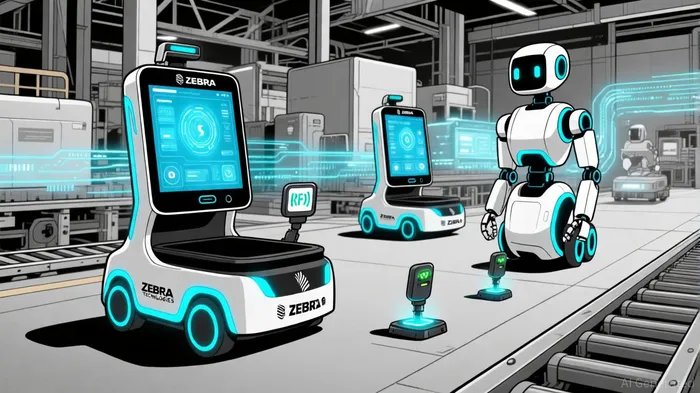
In an era where industrial digital transformation is no longer a luxury but a necessity, Zebra TechnologiesZBRA-- has emerged as a formidable force, redefining the boundaries of what enterprises can achieve through AI-driven solutions. The company's strategic pivot from a hardware-centric identity to a provider of “intelligent operations” underscores its ambition to integrate advanced technologies like AI, automation, and real-time data with human expertise, creating a seamless bridge between the physical and digital worlds[1]. This transformation is not merely aspirational—it is backed by robust financial performance, innovative product launches, and a growing ecosystem of partnerships that position ZebraZBRA-- as a linchpin in the industrial AI revolution.
Strategic Reinvention: From Printers to Intelligent Operations
Zebra's evolution from a “printer” company to a solutions provider is emblematic of its broader vision. By rebranding to emphasize its role in enabling “intelligent operations,” Zebra has aligned itself with the demands of modern enterprises seeking to optimize frontline workflows[1]. At the heart of this strategy is the integration of AI into everyday operations. For instance, Zebra Companion AI delivers tailored insights to frontline workers, while AI vision applications on mobile computers accelerate high-performance solutions for enterprises[1]. These tools are not standalone products but part of a cohesive framework that includes machine vision, RFID, and autonomous mobile robots (AMRs), all aimed at transforming industries like manufacturing, healthcare, and logistics[1].
The company's recent unveiling of the Connected Factory Framework at Hannover Messe 2025 further solidifies its leadership in industrial digitalization. This framework emphasizes three pillars: actionable visibility, optimized quality, and an augmented workforce—cornerstones of Industry 4.0[4]. CEO Bill Burns has articulated a long-term growth target of 5–7%, with AI integration central to achieving this, both internally and for customers[5].
Financial Fortitude and Market Validation
Zebra's strategic bets are translating into tangible financial results. In Q4 2024, the company reported net sales of $1.334 billion, a 32.2% year-over-year increase, with its Enterprise Visibility & Mobility (EVM) and Asset Intelligence & Tracking (AIT) segments growing by 33.1% and 28.8%, respectively[2]. This momentum continued into Q1 2025, with net sales reaching $1.308 billion, an 11.3% year-over-year rise[3]. The EVM segment grew 8.6%, while AIT surged 18.4%, driven by demand for RFID and barcode technologies[3].
Third-party analysts have taken notice. Monexa.ai highlights Zebra's “resilient financial position,” noting strong cash flow generation and a moderate debt-to-equity ratio despite macroeconomic headwinds[3]. Similarly, Forbes underscores the importance of a data-centric approach in industrial automation, a domain where Zebra's industrial data fabric—connecting sensors, machines, and systems—enables real-time decision-making[6]. These validations reinforce Zebra's credibility as a leader in the AI-driven enterprise solutions market.
Partnerships and Innovation: Building an Ecosystem
Zebra's success is not built in isolation. Strategic alliances with tech giants like Google Cloud and Qualcomm have bolstered its AI and machine vision capabilities[1]. Additionally, its investment in Xemelgo—a provider of intelligent automation software—demonstrates a commitment to expanding its ecosystem[5]. Such moves are critical in an industry where interoperability and scalability are paramount.
Product innovation has also been a hallmark. The launch of the EM45 mobile computer, powered by AI, exemplifies Zebra's focus on enhancing operational efficiency[3]. Meanwhile, the Mobile Computing AI Suite, introduced at the Frontline AI Summit, signals Zebra's intent to create smarter, more connected workplaces[9]. These innovations are not just incremental improvements but foundational shifts in how enterprises approach digital transformation.
Navigating Challenges and Future Outlook
Despite its strengths, Zebra faces headwinds, including tariffs and global supply chain uncertainties. The company has adopted a cautious outlook for 2025, projecting sales growth of 3–7%[8]. However, its ability to adapt—such as through cost optimization and strategic R&D investments—positions it to weather macroeconomic volatility.
Looking ahead, Zebra's focus on AI and automation aligns with broader industry trends. As Forbes notes, the future of industrial automation hinges on software-defined systems, advanced analytics, and cybersecurity—areas where Zebra is already making inroads[6]. With its CEO emphasizing a “data-driven AI era” and its financials showing resilience, Zebra is well-placed to capitalize on the $1.1 trillion industrial automation market expected to expand in the coming years[7].
Conclusion
Zebra Technologies' journey from a hardware manufacturer to a leader in AI-driven intelligent operations is a testament to its strategic foresight and execution. By embedding AI into the fabric of industrial workflows, the company is not only addressing current market demands but also future-proofing its position in a rapidly evolving landscape. For investors, Zebra represents a compelling case study in how innovation, financial discipline, and ecosystem-building can converge to drive sustainable growth in the age of digital transformation.





Comentarios
Aún no hay comentarios