
Zeb Nickel Project's AEM Survey and Path to Drilling: Strategic De-risking and Capital Efficiency in Critical Metal Exploration
In the evolving landscape of critical metal exploration, the Zeb Nickel Project in South Africa has emerged as a compelling case study in strategic de-risking and capital efficiency. As global demand for nickel intensifies—driven by its role in electric vehicle batteries and green energy technologies—the project’s recent airborne electromagnetic (AEM) survey results and follow-up strategies underscore a disciplined approach to advancing exploration while minimizing financial exposure.
Strategic De-risking Through Advanced Geophysics
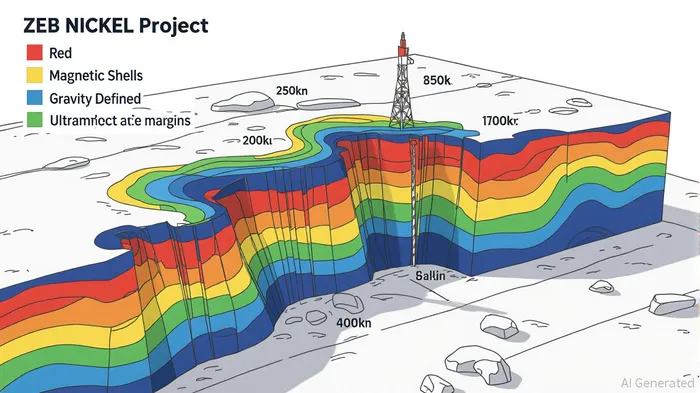
The Zeb Nickel Project’s 2023 AEM survey, conducted using high-power SpectremPlus™ technology, has significantly advanced geological confidence by identifying coherent conductive responses aligned with the project’s chonolith/feeder-style nickel sulphide model. According to a report by Uru Metals, these conductive zones were localized along ultramafic intrusive margins and in proximity to magnetic and gravity shells, a pattern consistent with sulphide accumulation [1]. This alignment with geological expectations reduces uncertainty, as the anomalies are interpreted as potential indicators of intrusion-related mineralisation rather than stratigraphic or surface effects [1].
The integration of AEM data with gravity and magnetic models has further refined the project’s geological framework. By creating a 3D model, the team narrowed the focus to a well-defined corridor where sulphide mineralisation is considered geologically plausible [1]. This approach has filtered out false positives, such as graphitic horizons or weathering fronts, thereby strengthening the technical case for the project [1]. As stated by Zeb Nickel Corp., this 3D integration has enabled the identification of four high-priority drill targets, extending to depths of over 800 meters—far beyond previous exploration efforts [4].
Capital Efficiency in Exploration: Targeted Spending and Cost-Saving Measures
Critical metal exploration is inherently capital-intensive, but Zeb Nickel has adopted a cost-conscious strategy to optimize resource allocation. The company’s AEM survey, covering 736 line-kilometres at a 150-metre traverse spacing, was executed safely and on budget [1]. By leveraging existing high-resolution gravity and magnetic datasets, the survey avoided redundant data collection, reducing both time and expenditure [1].
To further refine targets and minimize drilling risks, Zeb Nickel is advancing ground-based electromagnetic surveys. These include moving-loop and fixed-loop methods, which provide higher signal-to-noise ratios and enable constrained plate modelling of conductive bodies [1]. This step is critical for differentiating sulphide-rich zones from other conductive features, thereby reducing the likelihood of drilling in unproductive areas [1].
The company has also secured £500,000 through a share placement to fund these follow-up geophysical surveys and administrative costs associated with obtaining mining rights [3]. This targeted capital raise reflects a strategic focus on high-impact activities, such as deep diamond drilling at the four identified targets, which are interpreted as vertically stacked feeder-pipe structures [4]. By prioritizing these high-probability targets, Zeb Nickel aims to confirm the presence of nickel-copper-PGE sulphide mineralisation without overextending its financial resources [5].
Path to Drilling: Balancing Ambition and Prudence
The project’s next phase involves deep diamond drilling at the four high-priority targets, with intended depths of 600–1,000 meters [5]. These targets, identified through 3D geophysical modelling, are consistent with a feeder-pipe architecture, suggesting the potential for massive sulphide deposits [4]. By focusing on these structures, Zeb Nickel aims to de-risk the project further while maximizing the likelihood of a significant discovery.
The company’s approach exemplifies a balance between ambition and prudence. As noted in a FinancialContent analysis, the AEM results do not confirm mineralisation but provide a robust foundation for drill-ready targets [1]. This cautious optimism is a hallmark of capital-efficient exploration, where each step is designed to incrementally reduce uncertainty without incurring unnecessary costs.
Conclusion
The Zeb Nickel Project’s AEM survey and follow-up strategies illustrate a model of strategic de-risking and capital efficiency in critical metal exploration. By integrating advanced geophysical data, refining targets through ground-based surveys, and securing targeted funding, the project has positioned itself to advance toward drilling with a strong technical and financial foundation. For investors, this approach offers a compelling blend of innovation and fiscal discipline in a sector where both are increasingly vital.
Source:
[1] High-power AEM Interpretation Highlights [https://www.globenewswire.com/news-release/2025/09/08/3146374/0/en/High-power-AEM-Interpretation-Highlights.html]
[2] URU reports positive results from AEM survey at Zeb [https://www.miningweekly.com/article/uru-reports-positive-results-from-aem-survey-at-zeb-concludes-fundraise-2025-09-08]
[3] High-power AEM Interpretation and Fundraise [https://www.sharesmagazine.co.uk/news/market/LSE20250908070009_5810592/high-power-aem-interpretation-and-fundraise]
[4] 3-D Geophysical Modelling Defines Four Priority Drill Targets [https://www.juniorminingnetwork.com/junior-miner-news/press-releases/3028-tsx-venture/zbni/181251-zeb-nickel-project-3-d-geophysical-modelling-defines-four-priority-drill-targets.html]
[5] Zeb Nickel Discovers 4 Major Drill Targets for Massive... [https://www.stocktitan.net/news/ZBNIF/zeb-nickel-project-3-d-geophysical-modelling-defines-four-priority-1o0x53n550hg.html]







Comentarios
Aún no hay comentarios