
The New Zealand Neutral Rate Dilemma: Navigating Demographics, Productivity, and Low-Yield Markets
New Zealand's neutral interest rate—the theoretical rate at which monetary policy neither stimulates nor restrains economic activity—has been in a sustained decline since 2020, driven by a confluence of structural and global forces. This downward trajectory, now projected to reach 2.85% by early 2026, reflects deeper challenges in productivity growth and demographic shifts that are reshaping the country's economic landscape. For investors, the prolonged low-rate environment presents both opportunities and risks, demanding a strategic reevaluation of asset allocation.
The Decline in Productivity: A Drag on the Neutral Rate
Post-GFC labor productivity growth in New Zealand has stagnated, reducing expectations of future income gains. This slowdown has prompted households to save more, funneling capital into the economy at lower real interest rates. The Reserve Bank of New Zealand (RBNZ) estimates that global natural interest rates have fallen by 1.5 percentage points since 2008, further compressing domestic rates. Weak productivity is now a self-reinforcing cycle: lower income expectations reduce consumer spending, dampening business investment and perpetuating slow productivity gains.
Demographic Shifts: A Double-Edged Sword
New Zealand's aging population and evolving labor force dynamics are both mitigating and exacerbating the decline. On one hand, older households delaying retirement have reduced their savings rates, as they no longer need to build retirement funds. This increases aggregate consumption and supports demand for services. Conversely, an aging population will strain healthcare systems and pension schemes, creating long-term fiscal pressures. 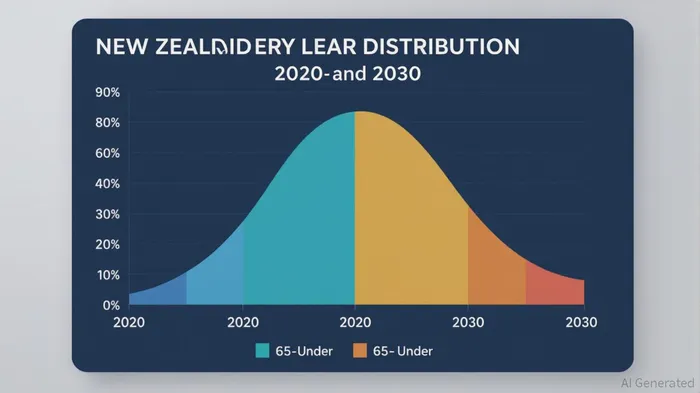 underscores this demographic shift, which will amplify demand for healthcare and infrastructure spending.
Global Financial Pressures: A Persistent Headwind
New Zealand's integration into global markets leaves it vulnerable to external shocks, such as U.S.-Iran trade tensions and Asia-centric export risks. These uncertainties have forced the RBNZ to adopt an accommodative stance, with the OCR now in a 2.5%–3.5% neutral range. Meanwhile, global corporate savings surpluses and slower productivity gains across advanced economies are pushing natural rates lower worldwide.
Investment Implications: Strategies for a Low-Yield Era
Amid this environment, investors must adopt a multifaceted approach to navigate the risks and capture opportunities. Here are the key considerations:
1. Prioritize Infrastructure and Healthcare
Infrastructure investments, such as toll roads, utilities, and renewable energy projects, offer stable cash flows and inflation-hedging properties. illustrates how such assets have outperformed broader markets during prolonged low-rate periods. Healthcare stocks, particularly those focused on aging-related services and pharmaceuticals, are also poised to benefit from demographic trends.
2. Exercise Caution with High-Debt Equities
High-debt equities face heightened risks. Companies reliant on refinancing or expansionary credit conditions may struggle as the prolonged low-rate environment compresses margins and raises valuation concerns. underscores the disparity in risk profiles.
3. Focus on Quality Growth and Dividend Yield
Investors should prioritize quality growth stocks with sustainable competitive advantages and dividend-paying assets. Firms such as exemplify this strategy, offering both capital appreciation and income stability.
4. Hedge Against Policy Uncertainty
The RBNZ's reliance on unconventional tools to address the "effective lower bound" of interest rates signals prolonged monetary experimentation. Investors should diversify into global bond markets or inflation-linked securities to mitigate domestic policy risks.
Conclusion
The decline in New Zealand's neutral interest rate is not merely a cyclical phenomenon but a structural shift rooted in productivity stagnation and demographic realities. While the path forward is uncertain, a disciplined focus on sectors that thrive in low-yield environments—coupled with a cautious stance on high-debt equities—will be critical for long-term portfolio resilience. As the RBNZ's projections suggest a prolonged low-rate landscape, investors must adapt to a world where traditional yield-seeking strategies may no longer suffice.







Comentarios
Aún no hay comentarios