
Zcash (ZEC) Price Prediction and Long-Term Value Proposition: A 7-Year High and Strategic Position in Privacy-Centric Crypto Adoption
The Catalysts Behind ZEC's 7-Year High
Zcash's recent price surge is underpinned by three critical drivers: institutional demand, technological innovation, and regulatory tailwinds. Grayscale's ZcashZEC-- Trust (ZCSH) now holds $137 million in assets under management (AUM), signaling growing institutional confidence in the asset, according to the CoinEdition article. Simultaneously, Futures Open Interest (OI) for ZEC has hit an all-time high of $529 million, with a 15% spike in the last 24 hours, indicating robust speculative and hedging activity, as noted in the CoinEdition article.
Technologically, Zcash's optional privacy model-powered by zero-knowledge proofs (zk-SNARKs)-has become a differentiator. Unlike Monero's mandatory privacy, Zcash allows users to choose between transparent and shielded transactions, making it more palatable to institutions and regulators, as detailed in a CoinDesk analysis. This flexibility has been amplified by the Zashi wallet's default shift to shielded transactions, which is expected to normalize privacy usage and expand Zcash's anonymity set, according to the CoinDesk analysis.
Regulatory developments further amplify Zcash's appeal. As 2026 approaches, jurisdictions like the EU and U.K. are tightening wallet ownership reporting requirements, pushing investors toward privacy-first solutions, as suggested by a Coinotag report. Zcash's optional privacy model, combined with its recent Halo 2 and Orchard upgrades (which eliminated the need for a "trusted setup"), positions it as a compliance-friendly alternative to fully opaque protocols, as discussed in a Medium deep-dive.
Strategic Position: Zcash vs. Monero in the Privacy Race
While Zcash and Monero both dominate the privacy coin space, their strategic divergences are reshaping market dynamics. Zcash's market capitalization briefly surpassed Monero's at over $7 billion in 2025, driven by its institutional-friendly approach, as reported in the CoinDesk analysis. Monero, on the other hand, has seen a 13.4% monthly gain in 2025, fueled by its unwavering commitment to mandatory privacy and anticipation of 2026 regulatory changes, as noted in the Coinotag report.
Zcash's edge lies in its flexibility. By allowing users to opt for transparent transactions (via view keys), it bridges the gap between privacy and regulatory compliance-a critical factor as governments crack down on untraceable assets, as described in the CoinDesk analysis. This is evident in Zcash's adoption by entities like the Zcash Foundation and Electric Coin Company (ECC), which are integrating privacy tools into broader financial frameworks, as noted in the CoinDesk analysis. In contrast, Monero's rigid privacy model, while appealing to hardcore privacy advocates, has limited its institutional adoption.
Real-World Use Cases and Network Effects
Zcash's real-world adoption is accelerating, particularly in sectors where privacy is a premium. The Zashi wallet's default shielded transactions have already driven a significant portion of Zcash's monthly 10 million+ transactions to be encrypted, according to the CoinDesk analysis. This shift is notNOT-- just a technical upgrade-it's a cultural one. As Zcash's shielded share grows, the network's anonymity set expands, making it increasingly difficult for adversaries to de-anonymize users, as detailed in the CoinDesk analysis.
Moreover, Zcash's economic model mirrors Bitcoin's scarcity, with a capped supply of 21 million coins and halvings every four years. The 2024 halving reduced block rewards by 50%, curbing inflation and sell pressure-a tailwind for long-term value retention, as noted in the Medium deep-dive. This scarcity, combined with privacy, creates a compelling narrative for Zcash as a "digital gold" alternative.
Regulatory Tailwinds and Long-Term Value
The 2025-2026 regulatory environment is a double-edged sword for privacy coins. While stricter reporting requirements threaten to stifle adoption, they also create a "survival of the fittest" scenario where only the most robust protocols thrive. Zcash's optional privacy model, coupled with its recent upgrades, positions it to weather these challenges.
Analysts from TYMIO and AMLBot note that the 2026 wallet ownership reporting mandates are already reshaping investor behavior, with capital rotating toward privacy coins that balance compliance and confidentiality, as described in the Coinotag report. Zcash's ability to offer both-via view keys and institutional-grade tools-gives it a unique edge.
Conclusion: A $10,000 Future?
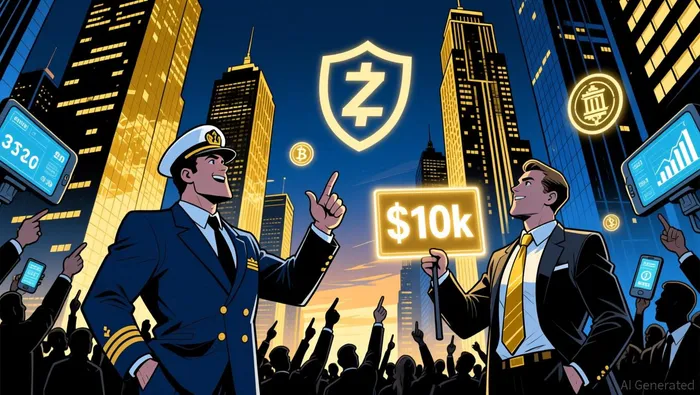
Arthur Hayes' $10,000 prediction may seem audacious, but it's grounded in Zcash's fundamentals. At $500, ZEC is trading at a fraction of its potential if it captures even a small share of the $1.7 trillion crypto market. With institutional adoption, technological innovation, and regulatory tailwinds aligning, Zcash is not just a privacy coin-it's a privacy-first infrastructure asset.
For investors, the question isn't whether Zcash can reach $10,000-it's whether they're positioned to capitalize on the inevitable shift toward privacy-centric finance.






Comentarios
Aún no hay comentarios