
Zcash (ZEC): Governance Chaos, Developer Exodus, and the Road to Recovery
In the ever-shifting landscape of cryptocurrency, few stories encapsulate the tension between decentralization and governance as starkly as ZcashZEC-- (ZEC). Over the past two years, Zcash has faced a perfect storm: a high-profile governance breakdown, the mass resignation of its core development team, and a surge in competition from privacy-focused rivals like MoneroXMR--. These events have not only rattled the ZECZEC-- price but also raised existential questions about the project's long-term viability. Yet, amid the chaos, there are glimmers of resilience-and even opportunity.
The Governance Breakdown: A Crisis of Leadership
Zcash's governance crisis began in late 2025 when the entire Electric Coin Company (ECC) team, led by CEO Josh Swihart, resigned en masse. The team accused the nonprofit Bootstrap board of creating "intolerable working conditions" and deviating from Zcash's founding mission of building "unstoppable private money" according to reports. The dispute centered on strategic decisions, including the privatization of Zashi, a mobile wallet tied to Zcash's privacy features, and broader governance reforms that the developers deemed misaligned with the project's ethos as detailed in analysis.
This exodus triggered an immediate market reaction: ZEC's price plummeted from a November 2025 high of $744 to around $456–$479 within weeks according to market data. The crisis underscored a critical vulnerability in Zcash's structure: while the protocol itself remains open-source and decentralized, its development and governance are heavily reliant on a small, centralized team. As Zcash founder Zooko Wilcox noted, the network's cryptography and codebase are unaffected by governance disputes-but the human element is not as explained in interviews.
Developer Exodus and the Rise of CashZ
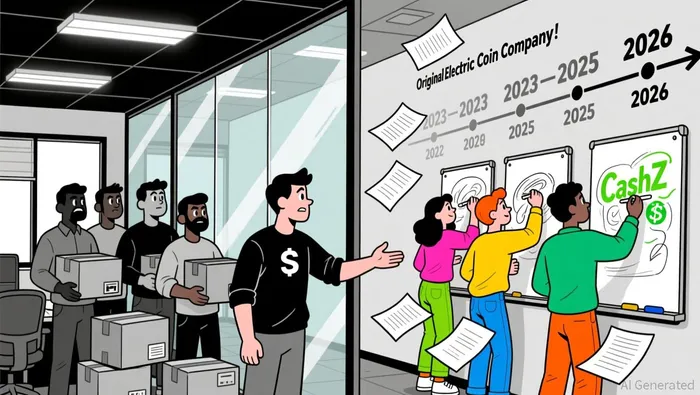 The ECC team's departure left a void in Zcash's development pipeline. According to data from late 2025, developer activity on the Zcash protocol had fallen to its lowest level since November 2021, raising concerns about innovation stagnation according to reports. However, the team's exit also catalyzed a new initiative: the formation of cashZ, a for-profit startup aimed at scaling Zcash independently of nonprofit governance constraints as reported.
CashZ's mission is twofold: to accelerate Zcash's adoption through user-friendly tools like the Zashi wallet and to explore new applications for Zcash's privacy technology. The project has already seen early traction, with reports of seven successful merchant integrations in 2025 and a focus on expanding transaction volume according to community minutes. While cashZ's for-profit model diverges from Zcash's original cypherpunk ideals, it reflects a pragmatic response to the governance crisis-a shift from ideological purity to market-driven scalability.
Privacy vs. Compliance: Zcash vs. Monero
The ECC team's departure left a void in Zcash's development pipeline. According to data from late 2025, developer activity on the Zcash protocol had fallen to its lowest level since November 2021, raising concerns about innovation stagnation according to reports. However, the team's exit also catalyzed a new initiative: the formation of cashZ, a for-profit startup aimed at scaling Zcash independently of nonprofit governance constraints as reported.
Zcash's governance turmoil has intensified its rivalry with Monero (XMR), another privacy-focused cryptocurrency. Monero's mandatory privacy features-such as ring signatures and stealth addresses-have historically drawn regulatory scrutiny, with exchanges like Binance and Kraken delisting it in 2023 over compliance concerns as documented. In contrast, Zcash's optional shielded transactions allow users to choose between privacy and transparency, a flexibility that Grayscale Research highlighted as a key advantage in increasingly regulated markets according to market analysis.
This distinction has paid dividends. In Q4 2025, Zcash surged 800% year-to-date, outperforming BitcoinBTC-- and EthereumETH--, while Monero rose 127% according to trading data. Zcash's integration with major ecosystems like SolanaSOL-- and its alignment with institutional-grade compliance frameworks (e.g., Grayscale's proposed Zcash ETF) position it as a more palatable option for regulated investors as noted in policy analysis. Yet, Monero's loyal user base and deeper technical privacy guarantees ensure it remains a formidable competitor.
Market Resilience and the Path Forward
Despite the governance chaos, Zcash's fundamentals show surprising resilience. As of early 2026, Zcash's shielded supply share has stabilized at around 23%, up from near 8% in early 2025-a sign that users value its privacy features according to market reports. Additionally, the Zcash community has taken steps to stabilize governance, with grassroots efforts to establish a new framework that balances decentralization with accountability as detailed in analysis.
However, challenges remain. The ECC team's departure has created a leadership vacuum, and cashZ's for-profit model risks fragmenting the ecosystem. Moreover, regulatory headwinds persist: while Zcash's optional privacy model is more compliant, it still faces scrutiny from agencies like the U.S. Treasury's Financial Crimes Enforcement Network (FinCEN) as reported.
Conclusion: Innovation or Decline?
Zcash's governance crisis is a cautionary tale about the fragility of centralized development in a decentralized world. Yet, it also highlights the project's inherent resilience. The formation of cashZ and the continued adoption of shielded transactions suggest that Zcash's core value proposition-privacy with flexibility-remains intact. For investors, the key question is whether the ecosystem can rebuild trust and innovation without the ECC team.
If history is any guide, Zcash has a knack for reinvention. The same team that once pioneered zk-SNARKs now faces a new frontier: scaling privacy in a world that demands both secrecy and compliance. Whether this crisis accelerates Zcash's evolution or hastens its decline depends on the next chapter of its story-one that will be written by the community, not just its developers.







Comentarios
Aún no hay comentarios