
Zcash (ZEC) and the Future of Privacy-Driven Digital Assets: Strategic Positioning for Institutional Adoption and Network Resilience Post-Halving
Strategic Positioning: Privacy as a Competitive Advantage
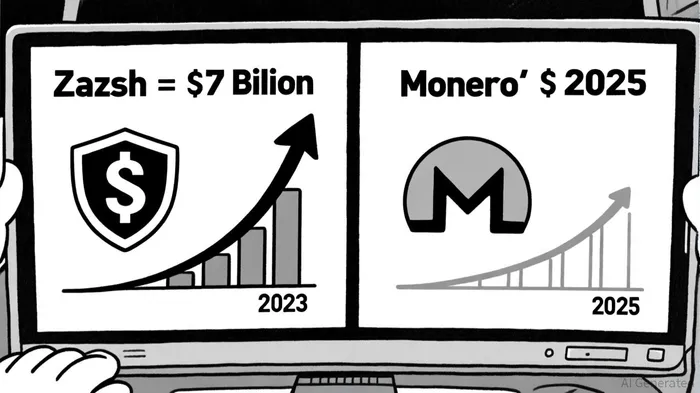
Zcash's rise to prominence as the leading privacy coin is no accident. According to a Coinotag report, Zcash has overtaken Monero due to its optional transparency model, which allows users to toggle between shielded and public transactions. This flexibility is a game-changer for institutions navigating complex compliance frameworks. For example, a multinational corporation can use public transactions for auditable reporting while reserving shielded transactions for sensitive internal transfers.
The Electric Coin Company (ECC), Zcash's primary developer, has further solidified this advantage with its Q4 2025 roadmap. Key initiatives include reducing technical debt, enhancing the Zashi mobile wallet for seamless user experience, and optimizing development fund management. The Coinotag report highlights these upgrades as critical for scaling Zcash's adoption in institutional settings, where usability and operational efficiency are paramount.
Zero-knowledge proofs (ZKPs), the cryptographic backbone of Zcash, are also gaining traction in enterprise applications. Experts from Chainalysis and Deloitte have highlighted ZKPs as a foundational technology for scalable private DeFi platforms, a point the Coinotag report also underscores. This dual utility-consumer privacy and institutional-grade security-makes Zcash a rare asset in the crypto space.
Post-Halving Resilience: Scarcity, Speculation, and Institutional Inflows
Zcash's November 2025 halving event, which will cut miner rewards from 3.125 to 1.5625 ZECZEC-- per block, has already triggered a bullish narrative. Historical data from the 2020 halving shows a 170% price surge post-event, and the current market is primed for a similar response. As of October 2025, ZEC has surged 14% in a single month, reaching $261, with trading volume hitting $940 million-according to BanklessTimes.
Technical indicators reinforce this optimism. The Relative Strength Index (RSI) is at 79, signaling overbought conditions, while the Moving Average Convergence Divergence (MACD) remains in positive territory, as noted by BanklessTimes. Analysts like Javon Marks predict a breakout above $308.46 could propel ZEC toward $598, a 130% gain from current levels. Immediate support is identified near $240, with a consolidation zone at $225 if volume wanes.
Institutional adoption has also accelerated post-halving. Grayscale's $137 million Zcash Trust underscores the token's appeal to large investors, according to Bitget. Meanwhile, partnerships like NymVPN's integration of Zcash's privacy features validate its real-world utility. With 27% of transactions now shielded, Zcash is proving that privacy and adoption can coexist.
Navigating Regulatory Challenges: Compliance Without Compromise
The EU's proposed 2027 ban on privacy coins poses a significant risk, but Zcash's optional transparency model offers a workaround. Unlike Monero's mandatory privacy, Zcash allows institutions to comply with anti-money laundering (AML) regulations by selectively disclosing transaction data. This adaptability could preserve Zcash's relevance in jurisdictions where stricter privacy coins are restricted, a point the Coinotag report highlights.
ECC's roadmap also prioritizes compliance. By improving the Zashi wallet's user interface and reducing technical debt, the team is addressing institutional pain points like onboarding complexity and operational friction. These efforts align with broader trends in crypto regulation, where "compliant privacy" is becoming a competitive differentiator.
Future Projections: A Bullish Outlook Through 2031
Price predictions for ZEC remain robust. Short-term targets of $308.46 and $598 are within reach, while long-term forecasts suggest ZEC could hit $1,318.93 by 2031, according to Cryptopolitan. These projections hinge on three factors: regulatory clarity, continued adoption of ZKPs in DeFi, and Zcash's ability to maintain its first-mover advantage in the privacy space.
However, risks persist. The EU's 2027 ban could disrupt Zcash's growth trajectory, and broader crypto market cycles may temper its momentum. Yet, given its strategic positioning and institutional backing, Zcash is uniquely equipped to weather these challenges.
Conclusion
Zcash's journey from a niche privacy coin to a $7 billion market cap asset is a testament to its adaptability. By combining cryptographic innovation with regulatory pragmatism, Zcash has carved out a niche that few privacy-focused cryptocurrencies can match. For investors, the post-halving rally and institutional adoption trends present a compelling case for long-term exposure. In a world where privacy is both a right and a commodity, Zcash is not just surviving-it's leading the charge.







Comentarios
Aún no hay comentarios