
ZCash (ZEC) and the Catalyst for Its Recent Price Surge
The recent volatility in ZCashZEC-- (ZEC) has sparked renewed interest in the privacy-focused cryptocurrency, with its price surging over 200% in a single week and reaching a three-and-a-half-year high of $163 in late September 2025, according to a FinancialContent report. While the broader crypto market has benefited from the "Uptober" rally, ZEC's performance has been particularly striking, driven by a confluence of on-chain activity, institutional adoption, and speculative fervor. This article dissects the catalysts behind ZEC's surge, focusing on the interplay between network usage, institutional inflows, and market sentiment.
On-Chain Activity: A Tale of Two Metrics
ZCash's on-chain data in Q3 2025 reveals a mixed picture. Median transaction fees spiked to $29 in September-the third such spike of the year-suggesting short-term demand for network usage but without clear external triggers, according to a Sandmark analysis. Meanwhile, monthly active addresses averaged 1,900, a modest increase from 1,600 in early Q3 but still far below the 2018 peak of over 10,000. This stagnation in user growth contrasts with the price action, raising questions about whether the surge is driven by speculative trading rather than organic adoption.
The MVRV (Market Value to Realized Value) ratio further complicates the narrative. At 0.918 in Q3 2025, the ratio indicates that most ZECZEC-- holders are at an unrealized loss, a bearish signal that typically precedes profit-taking or capitulation, per the Sandmark analysis. Yet, the price continued to climb, suggesting that spot buyers-rather than long-term holders-are fueling the rally. This divergence is underscored by derivatives metrics: futures open interest remained flat at $17 million, and perpetual funding rates hovered near 0.05% annualized, signaling muted leverage and retail-driven buying, as noted in the same Sandmark piece.
Institutional Adoption: A Privacy Play with Legs
The most compelling catalyst for ZEC's surge has been institutional adoption, particularly the launch of the Grayscale Zcash Trust (ZCSH) in Q3 2025. By offering a familiar structure to institutional investors-similar to its BitcoinBTC-- and EthereumETH-- trusts-Grayscale has provided a regulated on-ramp for capital that previously shunned direct crypto exposure, according to the FinancialContent report. This development coincided with a 15.5% month-on-month increase in shielded transactions, a key use case for ZEC's privacy features, as the FinancialContent report also observed.
Privacy demand has been further amplified by macro trends. As regulatory scrutiny intensifies on transparent blockchains, ZEC's zero-knowledge proofs (ZK-SNARKs) have attracted investors seeking alternatives to surveillance-heavy assets. According to a report by Sandmark, ZEC's market capitalization briefly exceeded $1.8 billion in September 2025, driven by a combination of Grayscale inflows and speculative buying.
Broader Market Dynamics: Uptober and the Coinbase Factor
ZEC's performance cannot be fully understood without contextualizing the broader market. The "Uptober" phenomenon-a seasonal rebound in crypto markets-has historically seen privacy coins outperform, and ZEC was no exception. However, the most immediate trigger for the September surge was speculation around a Coinbase listing. While unconfirmed, rumors of a potential listing drove trading volume to $789 million in a single week, a 213% spike from prior levels, per the FinancialContent report.
Technical indicators also played a role. ZEC broke above key resistance levels in late September, attracting algorithmic traders and momentum funds. Yet, the lack of sustained growth in active addresses suggests that this technical-driven rally may be fragile.
Conclusion: A Privacy-Driven Paradox
ZCash's Q3 2025 surge is a paradox: a privacy coin gaining traction in a market increasingly focused on transparency. While institutional adoption and speculative demand have driven the price higher, on-chain metrics like the MVRV ratio and stagnant active addresses highlight structural weaknesses. For investors, the key question is whether ZEC can sustain its momentum as the "Uptober" narrative fades and regulators turn their attention to privacy coins.
For now, ZEC remains a high-risk, high-reward asset. Its ability to balance privacy innovation with mainstream adoption will determine whether this surge is a fleeting anomaly or the start of a new chapter. 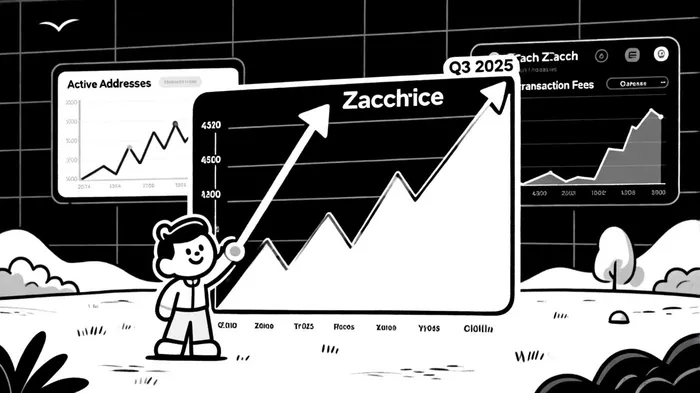







Comentarios
Aún no hay comentarios