
Zcash's Resurgence and the Revival of Privacy Coins: Navigating a Regulatory-Evolving Crypto Landscape
The resurgence of ZcashZEC-- (ZEC) in 2025 has reignited debates about the future of privacy in cryptocurrency. After a 247% monthly return in late 2025, ZECZEC-- has become a focal point for investors seeking refuge from financial surveillance amid geopolitical instability and tightening regulatory scrutiny, according to OnChain Standard. This revival, however, is not without its challenges. As global regulators intensify their focus on privacy coins, Zcash's unique features-optional transparency and shielded transactions-position it as both a test case and a potential bridge between privacy and compliance.
The Privacy Coin Renaissance: Drivers and Risks
Zcash's recent surge reflects a broader shift in investor sentiment. According to a report by CoinDesk, privacy tokens like Zcash, DashDASH--, and Railgun have outperformed the broader crypto market as investors rotate back to 2018-era narratives of financial privacy, as noted by OnChain Standard. This trend is fueled by growing concerns over surveillance, particularly in jurisdictions with aggressive data collection policies. Zcash's integration into platforms like ThorSwap and Zashi CrossPay has further boosted its utility, enabling shielded cross-chain swaps and expanding its real-world adoption, according to CoinLaw statistics.
Yet, the regulatory landscape remains a double-edged sword. The U.S. Financial Crimes Enforcement Network (FinCEN) proposed a rule in January 2025 requiring record-keeping for all private coin transactions exceeding $500, directly threatening Zcash's shielded transaction model, according to Decrypt. Similarly, the European Union's Markets in Crypto-Assets (MiCA) framework has led to a 22% reduction in European exchanges offering privacy coins, as reported by Decrypt. These developments underscore a global trend: 97 countries have updated compliance frameworks for privacy coins in 2025, with 73 exchanges delisting them entirely, according to CoinLaw statistics.
Strategic Positioning: Zcash's Hybrid Approach
Zcash's optional privacy features may offer a path forward in this regulatory quagmire. Unlike Monero (XMR), which enforces absolute anonymity, Zcash allows users to toggle between shielded and transparent transactions. This flexibility has been leveraged through upgrades like the audit-friendly viewing key option introduced in 2024, enabling compliance with Know-Your-Customer (KYC) requirements while preserving privacy for those who need it, according to CoinLaw statistics.
Investors are adapting to these dynamics by diversifying their strategies. Decentralized exchanges (DEXs) and peer-to-peer (P2P) platforms have become critical for accessing privacy coins, bypassing centralized exchange restrictions, as discussed by OnChain Standard. For instance, Zcash's Grayscale Trust has provided accredited investors with a regulated on-ramp to ZEC, mitigating some compliance risks, per Decrypt. Meanwhile, projects like Zcash are exploring "exchange-only" transparent addresses to align with evolving regulations without compromising core privacy principles, a point highlighted by OnChain Standard.
Global Regulatory Sandboxes: A New Frontier
Amid the tightening noose of global regulations, jurisdictions like Switzerland and Liechtenstein have emerged as safe havens. These countries have established regulated sandbox environments that permit privacy coin use under strict KYC/AML frameworks, according to CoinLaw statistics. For example, Switzerland's approach allows innovators to test privacy-preserving technologies while adhering to compliance standards, attracting institutional investors seeking privacy-preserving payment systems, according to The Complete Coin Guide.
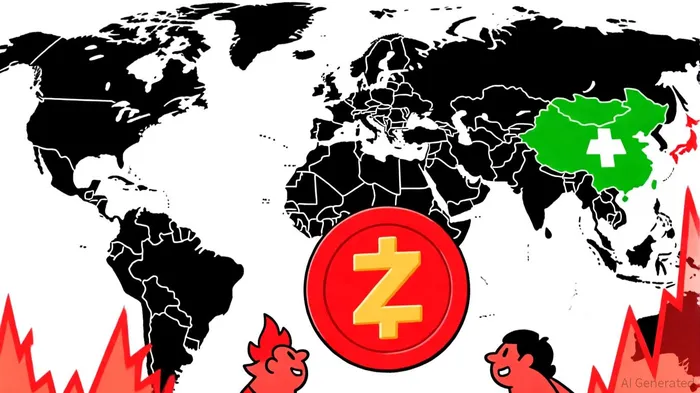
This regulatory middle ground is critical for Zcash's long-term viability. While Japan and South Korea have banned institutional trading of privacy coins, Switzerland's sandbox model demonstrates that privacy and compliance are not mutually exclusive. Zcash's optional transparency features could serve as a blueprint for other privacy coins navigating similar challenges, as noted by CoinLaw statistics.
Investor Implications: Balancing Risk and Reward
For investors, the key lies in strategic positioning. Privacy coins now account for 11.4% of global crypto transactions, with Zcash capturing 28% of the privacy coin market capitalization, according to Decrypt. However, trading volumes for privacy coins dropped 35% year-over-year in 2025 due to regulatory pressures, per CoinLaw statistics. This volatility necessitates a nuanced approach:
- Diversification: Investors should balance exposure to privacy coins with regulated DeFi projects and stablecoins, particularly in regions with high economic instability (e.g., Latin America), as shown by CoinLaw statistics.
- Compliance Tools: Utilizing non-custodial wallets and audit-friendly features (e.g., Zcash's viewing keys) can mitigate regulatory risks while preserving privacy, according to CoinLaw statistics.
- Geographic Arbitrage: Focusing on jurisdictions with sandbox environments (e.g., Switzerland) allows investors to access privacy coins without exposing themselves to stricter regimes, as discussed in The Complete Coin Guide.
The Road Ahead: A Test of Resilience
Zcash's resurgence highlights the enduring demand for financial privacy, even in a world increasingly hostile to anonymity. However, its success will depend on its ability to adapt to regulatory pressures without sacrificing its core value proposition. Technological innovations, such as Layer-2 privacy solutions and upgrades to zk-SNARKs efficiency, will be critical in reducing computational overhead and improving adoption, as observed by OnChain Standard.
For now, Zcash remains a bellwether for the privacy coin sector. Its performance in 2025-marked by a 150% weekly surge and an 18% retracement-reflects the volatile interplay between investor enthusiasm and regulatory uncertainty, according to CoinLaw statistics. As the crypto landscape evolves, Zcash's hybrid model may prove to be a lifeline for privacy in a world where financial surveillance is the norm.







Comentarios
Aún no hay comentarios