
Zcash's Governance Reorganization and the Emergence of cashZ: Assessing the Long-Term Implications for Privacy-Centric Crypto
The recent governance reorganization within the ZcashZEC-- (ZEC) ecosystem has sparked intense debate among investors, developers, and privacy advocates. At the heart of this shift lies the departure of the Electric Coin Company (ECC), the primary development team, from Bootstrap, the nonprofit governing body, and the subsequent formation of a for-profit entity, cashZ. This structural realignment raises critical questions about the future of Zcash's privacy-focused roadmap, its market resilience, and the broader implications for privacy-centric cryptocurrencies.
The Governance Split: A Fork in the Road
The ECC's exit from Bootstrap, described as a "constructive discharge" due to disputes over working conditions and mission alignment, marks a pivotal moment in Zcash's history. The team's decision to establish cashZ-a for-profit entity- reflects a strategic pivot to bypass nonprofit governance constraints, enabling faster development cycles and greater flexibility in advancing Zcash's privacy innovations. While the Zcash protocol remains open-source and decentralized, the split has introduced uncertainty about long-term funding models and community cohesion.
Historical precedents, such as Bitcoin CashBCH-- (BCH) and Ethereum ClassicETC-- (ETC), illustrate the mixed outcomes of governance splits. For instance, BCH, which forked from BitcoinBTC-- in 2017, has struggled to gain traction, now ranking 17th in market capitalization. In contrast, Ethereum's adaptability through iterative upgrades (e.g., EthereumETH-- 2.0) has solidified its dominance in the smart contract space. Zcash's situation differs in that its governance reorganization does not involve a hard fork but rather a reallocation of development resources. This distinction may mitigate fragmentation risks, as the protocol itself remains intact, allowing cashZ and the Zcash Foundation to coexist.
Market Reactions and Investor Sentiment
Zcash's market performance in 2025 has been nothing short of remarkable. The token surged to a peak of $422, surpassing MoneroXMR-- in market capitalization and reaching $6.86 billion. Analysts attribute this growth to renewed interest in privacy-focused assets and Zcash's pioneering use of zero-knowledge proofs (ZKPs) to enable confidential transactions. However, the governance split has introduced volatility. In 2026, ZECZEC-- has seen an 18% year-to-date decline, potentially linked to uncertainty over cashZ's ability to sustain development momentum.
Price predictions for ZEC vary widely. Conservative estimates project a range of $45–$75, while bullish forecasts suggest potential growth to $200, contingent on regulatory clarity and institutional adoption. The emergence of cashZ could influence these trajectories. By reducing friction in development and aligning with Zcash's core principles, cashZ aims to accelerate protocol improvements, which may bolster investor confidence. For example, cashZ's focus on reducing technical debt and enhancing usability could attract retail and institutional users seeking privacy without sacrificing compliance.
Long-Term Structural Implications
The governance reorganization underscores a broader trend in crypto: the tension between decentralized governance and scalable development. Unlike traditional forks, which often fragment communities, Zcash's split has preserved the protocol's integrity while introducing a new player, cashZ, to drive innovation. This model mirrors Ethereum's transition from a single development team to a more decentralized ecosystem, though Zcash's for-profit structure introduces unique dynamics.
A critical challenge lies in funding sustainability. The Zcash Foundation and cashZ must navigate a transition from block rewards to transaction fees and community-driven financing. A proposed split-fee system aims to decentralize revenue generation, but its success depends on aligning economic incentives with compliance requirements. Privacy coins historically face regulatory hurdles, as seen with Monero's struggles under the EU's Markets in Crypto-Assets (MiCA) framework. Zcash's optional transparency feature- allowing users to choose between shielded and transparent transactions-may offer a competitive edge by balancing privacy with regulatory adaptability.
Privacy as a Strategic Moat
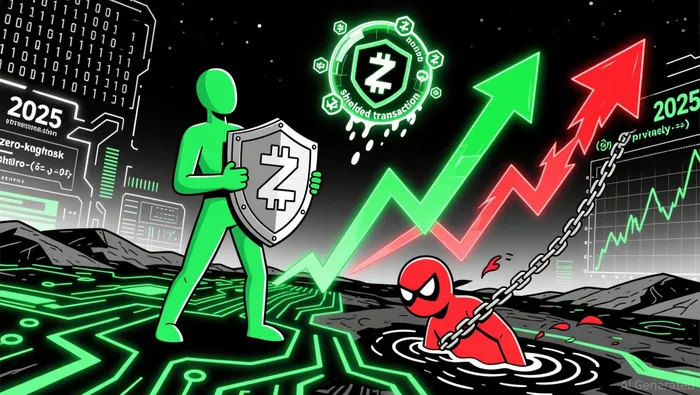
Privacy is increasingly viewed as foundational infrastructure in crypto, with Zcash positioned at the center of this shift. The 2025 market surge for privacy coins reflects growing demand for confidential transactions, particularly as institutional adoption accelerates. Zcash's zk-SNARK-based privacy technology, enhanced by upgrades like Orchard and Halo 2, provides a technical advantage over always-private coins like Monero. These innovations have driven a 15.5% month-over-month increase in shielded transaction adoption in September 2025, signaling strong user demand.
However, regulatory scrutiny remains a wildcard. The Financial Action Task Force (FATF)'s Travel Rule and EU MiCA impose strict compliance requirements on privacy coins. Zcash's optional transparency model may mitigate these risks, as institutions can leverage transparent transactions for compliance while using shielded ones for privacy. This duality could position Zcash as a bridge between privacy and regulatory frameworks, a critical advantage in 2026's evolving landscape.
Investment Considerations
For investors, Zcash's governance reorganization presents both opportunities and risks. On the upside, cashZ's formation could accelerate development and enhance Zcash's usability, potentially driving adoption in both retail and institutional markets. The Zcash Foundation's roadmap for Q4 2025- focusing on technical debt reduction and secure fund management-further supports long-term growth.
Conversely, governance splits inherently introduce uncertainty. The ECC's departure highlights the fragility of decentralized governance models, particularly when core developers and community priorities diverge. While Zcash's open-source nature ensures continuity, cashZ's for-profit structure may raise concerns about centralization. Investors must weigh these risks against Zcash's technical strengths and market positioning.
Conclusion
Zcash's governance reorganization and the emergence of cashZ represent a defining moment for privacy-centric crypto. While the split introduces short-term volatility, it also underscores the resilience of decentralized ecosystems. By balancing privacy with regulatory adaptability, Zcash has the potential to solidify its role as a cornerstone of the privacy infrastructure layer. For investors, the key will be monitoring cashZ's ability to deliver on its roadmap and navigate regulatory challenges-a test that could determine Zcash's long-term value in an increasingly privacy-conscious world.






Comentarios
Aún no hay comentarios