
Zcash's Governance Crisis and Its Implications for Privacy-Centric Crypto Assets
In the world of blockchain, governance is the invisible hand that shapes the fate of protocols. ZcashZEC-- (ZEC) is currently grappling with a governance crisis that has upended its trajectory, raising urgent questions about the future of privacy-centric crypto assets. The resignation of the Electric Coin Company (ECC), Zcash's core development team, in early 2026, followed by the formation of a new entity, has exposed deep fractures in the project's governance structure. This event, framed as a "constructive discharge" by ECC CEO Josh Swihart, underscores the fragility of decentralized governance models and the risks inherent in balancing mission-driven innovation with institutional control. For investors, the crisis is a case study in how governance instability can ripple through market sentiment, regulatory perceptions, and long-term project viability.
The Zcash Governance Crisis: A Fracture in Mission and Structure
Zcash's governance model has always been a hybrid of decentralization and institutional oversight. The Bootstrap board, a 501(c)(3) nonprofit, governed the Electric Coin Company (ECC), which spearheaded Zcash's development. However, in early 2026, ECC's core team resigned en masse, citing misalignment with the board's governance actions. According to Swihart, the board-led by figures like Zaki Manian, Christina Garman, and Michelle Lai-had created "intolerable working conditions" under U.S. labor law, effectively forcing the team to exit. The resignation triggered the formation of a new company to continue Zcash's development, independent of the Bootstrap board.
While the Zcash protocol itself remains operational, the crisis has exposed critical vulnerabilities. The departure of key developers raises concerns about continuity, funding, and the ability to execute on Zcash's core mission: building "unstoppable private money". The Bootstrap board, meanwhile, has defended its actions, with Zcash founder Zooko Wilcox calling the board members "individuals of exceptionally high integrity". This schism highlights a recurring tension in blockchain projects: the clash between decentralized ideals and the practical realities of organizational governance.
Governance Models: Zcash vs. BitcoinBTC-- and Ethereum
To contextualize Zcash's crisis, it's instructive to compare its governance structure with Bitcoin and EthereumETH--, two of the most established blockchain projects.
Bitcoin's Governance: Stability Through Decentralization
Bitcoin's governance is famously decentralized and consensus-driven. Protocol changes require broad community agreement, often emerging through informal coordination rather than formal decision-making. This model prioritizes stability over rapid innovation, which has helped Bitcoin maintain its status as "digital gold." However, it also means Bitcoin is less adaptable to evolving privacy and scalability demands. For instance, Bitcoin lacks protocol-level privacy features like Zcash's zero-knowledge proofs (zk-SNARKs), making it less appealing for users seeking anonymity.
Ethereum's Governance: Innovation Amid Fragmentation
Ethereum, by contrast, has embraced a more dynamic governance model. While still decentralized, it allows for structured upgrades via Ethereum Improvement Proposals (EIPs). This flexibility has enabled Ethereum to evolve rapidly, as seen in the 2022 Merge to Proof-of-Stake and the 2025 Pectra update. However, Ethereum's governance has faced its own challenges, including a "perception crisis" marked by fragmented messaging and institutional hesitancy. Despite these issues, Ethereum's governance structure has demonstrated resilience, balancing innovation with decentralization.
Zcash's Governance: A Fragile Hybrid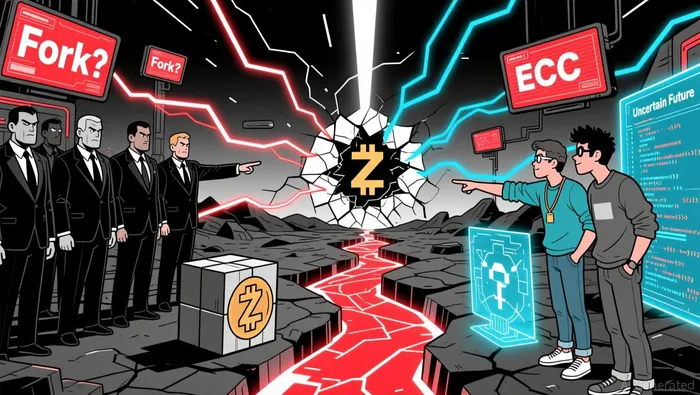
Zcash's hybrid model-combining nonprofit oversight with a for-profit development team-has proven less resilient. The Bootstrap board's control over ECC created a centralized bottleneck, which clashed with the decentralized ethos of the project. This structure contrasts sharply with Bitcoin's fully decentralized governance and Ethereum's community-driven upgrades. The ECC's resignation underscores how hybrid models can become unstable when institutional and technical priorities diverge.
Market and Regulatory Implications
The Zcash crisis has already impacted market dynamics. ZEC's price dropped by over 18% in 2026, reflecting investor uncertainty. This decline mirrors broader trends in privacy coins, which have faced regulatory headwinds. For example, the EU's Markets in Crypto-Assets (MiCA) regulation, which took effect in 2025, has imposed strict compliance requirements on privacy tokens, raising concerns about their long-term viability. Meanwhile, the U.S. GENIUS Act and the Financial Action Task Force's (FATF) Travel Rule have further complicated the regulatory landscape, forcing exchanges and payment processors to navigate anti-money laundering (AML) and know-your-customer (KYC) obligations.
Privacy coins like MoneroXMR-- (XMR) and DashDASH-- (DASH) have also experienced volatility, with Monero surging 123% in October 2025 amid heightened demand for anonymity. However, this growth has been accompanied by regulatory scrutiny, particularly as governments seek to combat illicit finance. Zcash's governance crisis adds another layer of risk, as institutional investors may view the project as less stable compared to Bitcoin or Ethereum.
Investment Implications: Red Flag or Buying Opportunity?
For investors, the Zcash crisis presents a paradox. On one hand, the formation of a new development entity could catalyze innovation, particularly if the team succeeds in reinvigorating Zcash's privacy features. The project's optional shielded transactions (via zk-SNARKs) remain a unique value proposition in an era of AI-driven surveillance and data collection. On the other hand, the governance instability raises red flags. The departure of core developers and the lack of a clear funding mechanism for the new entity could hinder long-term development.
Historical precedents offer caution. Ethereum's 2016 DAO fork and Bitcoin's 2017 scaling debates both demonstrated how governance crises can lead to market fragmentation and volatility. While Ethereum eventually recovered and evolved, Zcash's path is less certain. Investors must weigh the potential for innovation against the risks of regulatory scrutiny and organizational instability.
Conclusion: Governance as a Critical Risk Factor
Zcash's governance crisis is a microcosm of broader challenges in the blockchain space. It highlights how governance structures-whether decentralized, hybrid, or centralized-shape the trajectory of projects. For privacy-centric crypto assets, governance risk is not just a technical issue but a fundamental determinant of long-term value. While Zcash's new development entity could reinvigorate the project, the current turmoil underscores the importance of robust governance frameworks. Investors should approach Zcash with caution, treating governance stability as a non-negotiable criterion for assessing the viability of privacy-focused protocols.






Comentarios
Aún no hay comentarios