
The Zcash Dev Team Exodus: A Case for Bitcoin's Unique Governance Resilience
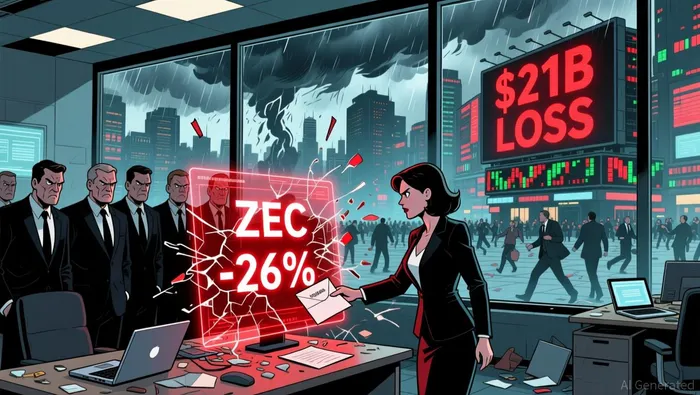
The exodus of Zcash's core development team in early 2026 has exposed critical vulnerabilities in the governance structures of privacy-focused cryptocurrencies, offering a stark contrast to Bitcoin's decentralized resilience. According to a report by , the Electric Coin Company (ECC) team resigned en masse after a governance clash with Bootstrap, the nonprofit overseeing ZcashZEC--, over employment terms and the privatization of the Zashi wallet. This mass departure, described by former ECC CEO Josh Swihart as a "constructive discharge," underscored the fragility of centralized governance models in open-source projects. The fallout saw Zcash's price drop 26% in a week, erasing $21 billion in market value, while the Zcash Foundation scrambled to reassure stakeholders that the protocol itself remained unaffected.
Centralized Governance: A Recipe for Crisis
Zcash's governance model, which relies on a nonprofit (Bootstrap) to oversee a for-profit development team (ECC), created inherent conflicts of interest. The dispute over privatizing the Zashi wallet-framed by ECC as a necessary step to attract external capital- was rejected by Bootstrap for allegedly violating the nonprofit's public-interest mandate. This structural tension, as noted by , reflects a broader paradox: while Zcash's protocol is technically decentralized, its development and funding mechanisms remain centralized, concentrating power in a small group of stakeholders. The result was a leadership vacuum that left the project vulnerable to market panic and operational instability.
In contrast, Bitcoin's governance model, though not without its own challenges, has demonstrated resilience through its decentralized, consensus-driven approach. The 2017 block size dispute, often cited as Bitcoin's most contentious crisis, ultimately resolved through Segregated Witness (SegWit) and the Lightning Network, innovations that prioritized scalability without compromising decentralization. Unlike Zcash's hierarchical structure, Bitcoin's governance relies on a distributed network of miners, developers, and node operators to validate changes, ensuring no single entity can unilaterally alter the protocol.
Decentralized Governance in Action: The 2021 Miner Hash War
Bitcoin's 2021 "hash war" further illustrates the strength of its decentralized governance. When competing upgrades to Bitcoin CashBCH-- (BCH)-Bitcoin ABC and BitcoinBTC-- SV-clashed over block size limits, stakeholders resolved the dispute through computational power, with Bitcoin ABC emerging victorious. This process, while contentious, avoided the kind of institutional gridlock that plagued Zcash. noted, the court dismissed claims of antitrust violations in the hash war due to the lack of centralized collusion, highlighting the organic nature of decentralized decision-making.
Zcash's governance crisis, by contrast, lacked such organic resolution. The Zcash Foundation's attempts to maintain continuity after the ECC exodus were met with skepticism, as the project's decentralized ethos clashed with its centralized operational reality. This duality, observed, left Zcash's future in limbo, with cashZ-a new wallet launched by the exiled developers-positioned as a direct challenge to the Zcash Foundation's authority.
Risk Implications for Investors
For investors, the Zcash exodus underscores the risks of centralized governance in blockchain projects. While Zcash's privacy features remain technically robust, its governance structure has proven susceptible to internal conflict and market volatility. Bitcoin, meanwhile, has navigated crises through its decentralized consensus mechanisms, even when disagreements have threatened to fracture the community. The 2017 block size war and 2021 hash war both resolved without hard forks, preserving Bitcoin's network effect and institutional credibility.
The philosophical divide between the two projects also matters. Bitcoin's emphasis on transparency and institutional adoption contrasts with Zcash's focus on privacy and innovation. Yet, as Policy Review noted, Bitcoin's governance resilience lies in its ability to adapt without centralized intervention-a trait that Zcash's model has yet to replicate.
Conclusion
The Zcash dev team exodus serves as a cautionary tale for investors evaluating altcoins with centralized governance structures. While Zcash's technical innovations remain valuable, its governance model has exposed vulnerabilities that Bitcoin's decentralized framework has historically mitigated. As the crypto market matures, projects that align technical decentralization with robust governance mechanisms-like Bitcoin-are likely to outperform those reliant on institutional intermediaries. For now, Zcash's future hinges on whether it can reconcile its governance flaws without compromising its core mission, a challenge Bitcoin has navigated with relative success.






Comentarios
Aún no hay comentarios