
Zcash's 2025 Rally: Is Privacy the Next Big Crypto Trend?
The Privacy Premium: Why Zcash's Rally Matters
The Zcash surge is rooted in a simple but powerful idea: privacy is becoming a financial necessity. Shielded tokens on the Zcash network now account for nearly 30% of its total supply, up from negligible levels just a year ago, the Coinotag piece notes. This growth is driven by Zcash's use of zero-knowledge proofs (zk-SNARKs), a cryptographic technique that allows users to verify transactions without revealing sensitive data. Unlike Monero's ring signatures, zk-SNARKs are also considered more quantum-computing resilient, giving Zcash a technical edge in an era of advancing surveillance technologies, as Finbold reports.
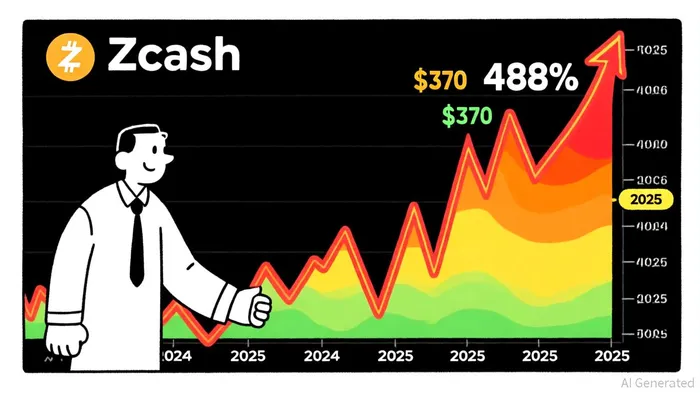
Investor demand for privacy isn't just speculative. The Grayscale Zcash Trust (ZCSH) saw $46 million in net inflows in October 2025, with shares trading at a 340% premium to ZEC's spot price, as Finbold noted. This institutional interest, coupled with retail traders' appetite for anonymity, has fueled a surge in open interest-Zcash's futures contracts ballooned from $29 million to $375 million in a single month, the Coinotag coverage reported.
Regulatory Pressure and the Privacy Paradox
The same regulatory forces that have driven demand for privacy coins are also threatening their survival. By early 2025, 97 countries had implemented stricter compliance frameworks for cryptocurrencies, leading to 73 global exchange delistings of privacy coins, according to CoinLaw data. Zcash, however, has navigated this landscape more deftly than its peers. While Monero (XMR) has resisted opt-in traceability features, Zcash introduced audit-friendly viewing keys to appease regulators, CoinLaw noted. This strategic pivot has allowed Zcash to retain listings on major exchanges, even as competitors like Monero face bans in jurisdictions like the U.S. and EU, as detailed in an OnChain Standard piece.
Yet regulatory pressure has also created volatility. Over 64% of Zcash's open interest in October 2025 was in short positions, leading to massive liquidations as the price surged, a development reported by Cryptopolitan. This volatility reflects a broader tension: investors are betting on privacy coins' long-term value while bracing for short-term regulatory shocks.
Investor Behavior: Fear, Hype, and the Future
The Zcash rally reveals a split in investor behavior. On one hand, 61% of privacy coin users prioritize financial privacy over investment potential, a trend amplified by rising concerns over financial surveillance, per CoinLaw. On the other, 27% of users are speculators betting on Zcash's ability to outperform in a privacy-driven future, CoinLaw data shows. This duality is evident in Zcash's trading patterns: while active addresses declined 8% year-over-year due to KYC requirements, CoinLaw also reports that trading volumes on peer-to-peer platforms like LocalMonero rose 19%.
Regulatory uncertainty has also spurred innovation. Projects like Encifher are now enabling encrypted Zcash tokens (eZEC) on high-throughput blockchains like SolanaSOL--, addressing privacy gaps in cross-chain transactions, according to a CoinDesk article. These developments suggest that privacy coins are evolving to meet regulatory demands without sacrificing their core value proposition.
The Road Ahead: Can Privacy Coins Scale?
Zcash's 2025 rally raises a critical question: Is privacy the next big crypto trend, or a niche play doomed by regulation? The data leans toward the former. The privacy coin sector's total valuation hit $14.8 billion in October 2025, with Zcash and Monero capturing 85% of the market, the earlier Coinotag update noted. Meanwhile, newer entrants like FiroFIRO-- (FIRO) and Haven Protocol (XHV) are gaining traction, signaling a maturing ecosystem, according to CoinLaw.
However, scalability remains a challenge. Zcash's network health and mining centralization-ViaBTC controls a significant portion of its hashrate-require close monitoring, the Coinotag update warned. For privacy coins to sustain their growth, they must balance innovation with decentralization while navigating an increasingly hostile regulatory environment.
Conclusion: Privacy as a Financial Right
Zcash's 2025 rally isn't just about price-it's about principle. As governments and corporations expand their surveillance capabilities, privacy is becoming a financial right, not a luxury. Zcash's technical advantages, institutional adoption, and adaptive regulatory strategy position it as a leader in this shift. Yet the road ahead is fraught with risks, from delistings to quantum computing threats. For investors, the key is to distinguish between short-term volatility and long-term value. In a world where privacy is the new scarcity, Zcash's journey may offer one of the most compelling narratives in crypto.






Comentarios
Aún no hay comentarios