
Yunhong Green CTI's Reverse Stock Split: A Desperate Maneuver or Strategic Revival?
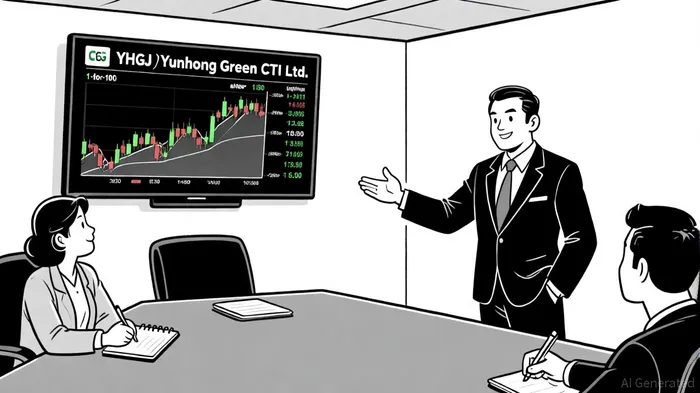
In the latest chapter of Yunhong Green CTIYHGJ-- Ltd.'s (Nasdaq: YHGJ) struggle to maintain relevance in a volatile market, the company executed a 1-for-10 reverse stock split on October 1, 2025, following stockholder approval in August[1]. This move, while technically a compliance-driven maneuver to avoid Nasdaq delisting[2], raises critical questions about the company's strategic priorities and its ability to restore investor confidence.
Market Perception: A Signal of Distress or Pragmatism?
Reverse stock splits are rarely celebrated in financial circles. As noted by Investopedia, such actions are often “viewed with skepticism by investors” and are “frequently associated with weaker financial health”[3]. For Yunhong Green CTI, the decision to consolidate shares from 27.8 million to 2.8 million[4] underscores a company operating in survival mode. While the firm argues that the split will “streamline its equity structure” and improve marketability[5], the timing—coming after a second 180-day extension to meet Nasdaq's $1.00 minimum bid price requirement[2]—suggests a defensive posture rather than a proactive strategy.
The psychological impact on investors is palpable. A reverse split inherently signals that a stock has fallen into the “penny stock” category, deterring institutional buyers and amplifying retail investor caution[6]. According to a 2025 study published in The Journal of Financial Research, companies that execute reverse splits experience an average 12% decline in trading volume in the short term, as liquidity dries up and skepticism takes hold[7]. For Yunhong Green CTI, this could exacerbate existing challenges, particularly if the post-split price fails to sustainably exceed $1.00.
Liquidity: A Double-Edged Sword
The immediate effect of the reverse split is a reduction in the number of shares outstanding, which theoretically elevates the per-share price. On October 1, 2025, YHGJYHGJ-- began trading at $5.20 post-split[8], a nominal improvement from its pre-split price of $0.52[9]. However, liquidity remains a concern. Academic research highlights that reverse splits often lead to “reduced market depth” and “higher bid-ask spreads,” as smaller investor bases struggle to absorb the restructured share count[10].
This dynamic is particularly problematic for Yunhong Green CTI, which already faces a fragmented shareholder base. While the company claims the split will attract “a broader range of investors,”[11] the reality is that institutional investors—critical for long-term stability—are unlikely to re-enter a stock perceived as high-risk. As one analyst noted in a 2024 report, “Reverse splits are a Band-Aid solution. They don't fix fundamentals; they merely delay the inevitable if earnings don't improve”[12].
Long-Term Shareholder Value: A Test of Execution
The ultimate test for Yunhong Green CTI lies in whether this reverse split catalyzes meaningful operational or financial improvements. Historically, companies that successfully navigate reverse splits—such as Netflix in 2015—do so by pairing structural changes with revenue growth and margin expansion[13]. For Yunhong Green CTI, however, the path is murkier.
The company's reliance on capital structure adjustments rather than core business improvements suggests a lack of conviction in its long-term prospects. As Bloomberg's 2025 market analysis observes, “Reverse splits are a last resort for firms that have exhausted other options. The key for shareholders is to scrutinize the business plan, not just the balance sheet”[14]. Yunhong Green CTI's recent earnings reports, which show declining revenue and persistent losses[15], offer little reassurance.
Broader Trends and Strategic Implications
Yunhong Green CTI's reverse split reflects a broader trend among small-cap companies facing exchange delisting threats. According to Nasdaq data, 23% of firms that executed reverse splits in 2024 failed to maintain compliance within 12 months[16]. This statistic underscores the fragility of such strategies.
For investors, the lesson is clear: reverse splits are not a cure-all. They may buy time, but they do not address the root causes of underperformance. Yunhong Green CTI's shareholders must now weigh whether the company can leverage this structural reset to pivot toward profitability or if it will join the ranks of firms that succumb to market forces.
Conclusion: A Cautionary Tale
Yunhong Green CTI's 1-for-10 reverse stock split is a calculated but ultimately symbolic move. While it may temporarily stave off delisting, the company's long-term viability hinges on its ability to deliver tangible value—through innovation, cost discipline, or revenue growth. Until then, the split serves as a stark reminder that in capital markets, structural gimmicks rarely substitute for substance.





Comentarios
Aún no hay comentarios