
Yum China's Q2 Earnings: Assessing Marginal Growth Amid Record EPS and Stock Decline
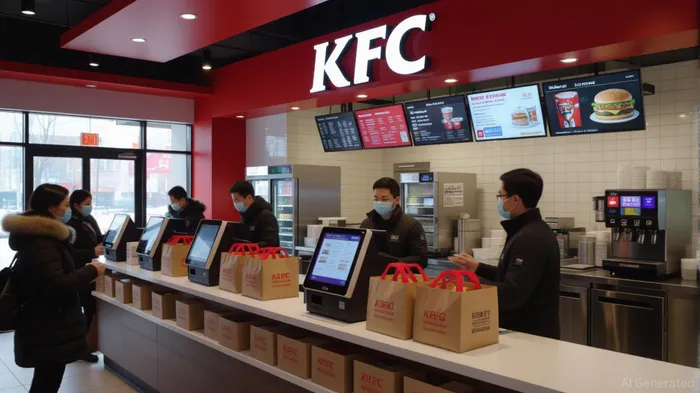
Yum China (YUMC) reported its Q2 2025 earnings on August 5, 2025, delivering a mixed bag of results that highlight both resilience and vulnerabilities in its business model. While the company achieved a record operating margin of 10.9% and a 14% year-over-year increase in operating profit, its stock plummeted 6.11% post-earnings, closing at $43.64. This sharp decline raises a critical question: Is the market overreacting to marginal growth, or is this a strategic entry point for investors?
Earnings Highlights: A Tale of Two Metrics
Yum China's Q2 results showcased operational discipline and digital innovation. Revenue rose 4% to $2.79 billion, narrowly missing the Zacks Consensus Estimate of $2.85 billion. However, adjusted EPS of $0.58 exceeded expectations, reflecting cost control and supply chain efficiencies. The company's operating margin hit a record 10.9%, driven by automation projects and reduced food input costs. Same-store sales growth returned to positive territory at 1%, with KFC and Pizza Hut contributing 1% and 2% respectively.
Digital transformation remains a cornerstone of Yum China's strategy. Digital ordering now accounts for 94% of total sales, generating $2.4 billion in revenue for the quarter. Delivery sales, though rising 22% YoY, now represent 45% of total sales, a double-edged sword as labor costs climb. The company also opened 336 net new restaurants, with 26% franchised, aligning with its asset-light strategy.
The Disconnect: Why the Market Reacted
Despite these positives, the stock's 6.11% drop suggests investor skepticism. The revenue shortfall, though minor, signaled slowing top-line growth in a competitive market. Analysts noted that Yum China's operating margin gains were offset by rising labor costs (27.2% of sales) and margin compression in Pizza Hut, which saw a 580-basis-point decline in operating margin.
The broader market context also played a role. Yum ChinaYUMC-- underperformed the S&P 500, which gained 7.6% year-to-date, while the stock fell 3.5%. Investors are wary of macroeconomic risks, including U.S.-China tensions and regulatory shifts, which could impact franchisee profitability. Additionally, the company's guidance for Q3 and FY2025—$3.24 billion and $11.99 billion respectively—was met with cautious optimism, as it lacks the aggressive growth seen in prior years.
Strategic Entry Point? Weighing the Risks and Rewards
The 5% decline in Yum China's stock may present an opportunity for long-term investors, but it requires a nuanced analysis. On one hand, the company's digital infrastructure, franchise expansion, and margin resilience position it well for sustained growth. Its Zacks Rank #2 (Buy) rating and favorable earnings estimate revisions suggest confidence in future performance.
Historically, YUMC's earnings releases have shown positive EPS figures, such as the $0.58 reported on September 30, 2023. However, the limited data points and absence of analyst ratings make it challenging to assess long-term trends.
On the other hand, near-term risks persist. Rising labor costs, competitive pressures in China's fast-food sector, and the need to sustain same-store sales growth could weigh on margins. The company's capital expenditure guidance of $600–700 million for FY2025 reflects a strategic pivot to store format adjustments, but this could strain cash flow if execution falters.
Investment Advice: A Cautious Bull Case
For investors considering Yum China, the key is to balance its structural strengths with near-term challenges. The company's digital transformation and asset-light model are defensible long-term advantages, particularly in a market where off-premise dining is accelerating. However, the stock's valuation—trading at a P/E ratio of 28x—suggests some optimism is already priced in.
A strategic entry point would involve dollar-cost averaging into the stock, given its volatility and the uncertainty around margin sustainability. Investors should monitor same-store sales trends, delivery cost management, and the pace of franchisee adoption. If Yum China can maintain its 1% same-store sales growth and expand margins by 50 basis points annually, the stock could outperform the market in the next 12–18 months.
In conclusion, while the 5% decline reflects legitimate concerns, it may also be a correction that undervalues Yum China's operational execution and digital moat. For those with a 3–5 year horizon, this could be a compelling opportunity—but one that demands patience and a close watch on execution risks.
"""





Comentarios
Aún no hay comentarios