
Yum China's AI Revolution: Fueling Margins and Dominance in Fast Food
Yum China, the operator of KFC and Pizza Hut in China, is quietly rewriting the rules of fast-food profitability through its bold embrace of artificial intelligence. Over the past three years, the company has invested heavily in AI-driven tools like the Q-Smart system and a frontline innovation fund, creating a moat of operational efficiency that could sustain margin growth for years. For investors, this is a story of tech-driven transformation that's just hitting its stride.
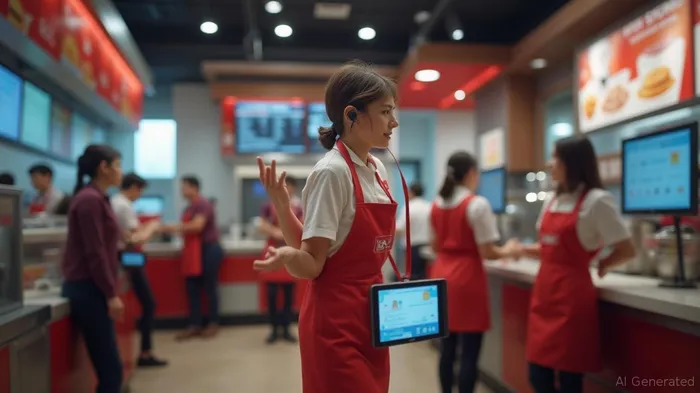
The AI Edge: How Yum ChinaYUMC-- is Squeezing Out Savings
Let's start with the numbers. Yum China's restaurant margins expanded by 100 basis points in 2025 to 18.6%, fueled by AI's role in cutting costs. The KFC segment saw margins climb to 19.8%, while Pizza Hut's margin soared by 190 basis points to 14.4%—a stark contrast to the industry's typical single-digit margins. These gains aren't just about cheaper chicken; they're the result of a systematic AI overhaul.
At the heart of this is the Q-Smart AI assistant, now piloting in KFC stores. This hands-free system, accessible via smartwatches and earbuds, automates inventory management, labor scheduling, and food safety checks. By eliminating manual processes, Q-Smart slashes waste: think real-time inventory alerts instead of overstocked fryers, and optimized staff schedules that reduce idle time. Early pilots show this could cut operational costs by 2-3% annually per store—a small margin boost that compounds across Yum China's 16,000+ locations.
The Frontline Innovation Fund: Democratizing Tech for Growth
Yum China isn't just deploying top-down AI solutions. Its 100 million yuan ($13.9 million) Frontline Innovation Fund empowers employees to dream up tech fixes to daily headaches. In March 2025, nearly 200 teams from 30 markets participated in an All-Staff Hackathon, proposing ideas like AI-driven delivery route optimization and voice-activated kitchen safety checks. The best concepts get funding—and a shot at scaling across the chain.
This democratized approach ensures AI isn't just for engineers. A manager in Shanghai troubleshooting inventory issues can now code a quick solution, test it in her store, and share it nationwide. The result? A culture of continuous improvement that keeps competitors scrambling to catch up.
Why This Matters for Investors
Margin expansion is the holy grail for fast-food giants. Yum China's AI initiatives are doing what few have mastered: turning tech investments into sustainable EBITDA growth. With commodity prices stabilizing and automation reducing labor friction, the path is clear for margins to hit 20%+ by 2026—a level that could send EPS soaring.
Consider this: If Yum China's 16,000 stores each improve efficiency by just $10,000 annually through AI, that's a $160 million boost to pre-tax profits. And with plans to open 1,600-1,800 new stores this year, these efficiencies will compound as the company grows.
Risks and the Bottom Line
No investment is risk-free. Wage inflation and tech adoption hurdles could slow progress. Yet Yum China's track record—93% of sales now digital, 540 million loyalty members—suggests it's nimbler than rivals. Plus, its AI tools are designed to scale, not just for today's challenges but for tomorrow's delivery-driven, on-demand market.
For investors, YUM is a buy here. The stock trades at 16x forward earnings, a discount to its growth trajectory. With AI fueling margins and expansion, this isn't just a bet on Chinese fast food—it's a stake in the future of automated retail. As Jim would say: “This is a company that's cooking with gas—and AI.”





Comentarios
Aún no hay comentarios