
Yukon Metals' 15% Stock Drop: Mispriced Opportunity or Warning Sign?
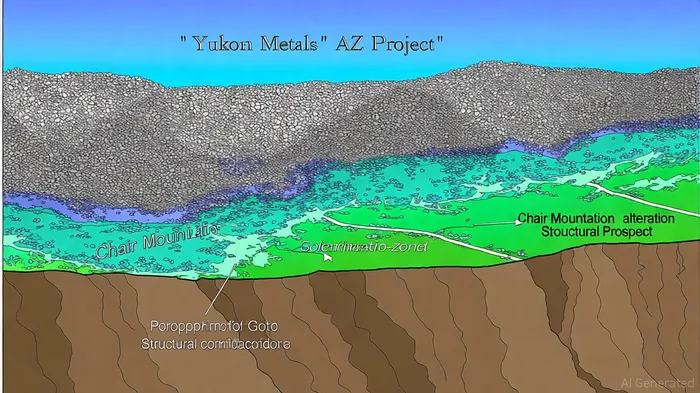
Yukon Metals Corp. (CSE: YMC) has experienced a 15% decline in its stock price following the release of initial drilling results from its AZ Project in the Yukon Territory. This sharp drop has sparked debate among investors: is the market overreacting to mixed results, or are valid concerns about the project's economic viability emerging? To answer this, we must dissect the technical data, contextualize the market's reaction, and evaluate the company's long-term potential.
Technical Results: A Promising but Incomplete Picture
The 2025 drilling program at the AZ Project confirmed a large copper-gold system, with significant intersections at Chair Mountain and the Southeast Prospect. At Chair Mountain, Hole AZ25-001 returned 14.4 meters at 0.44% copper, including a high-grade subinterval of 2.10% copper over 0.9 meters, alongside 0.37 g/t gold [1]. Surface sampling revealed even stronger grades, such as 5.73 g/t gold and 1.14% copper in an intensely altered diorite outcrop [2]. These results align with Yukon Metals' geological model of a porphyry-skarn system, supported by potassic alteration and structurally controlled mineralization [3].
However, the Southeast Prospect, while showing porphyry-style alteration, did not return economically significant copper grades in Hole AZ25-004 [4]. This duality—high-grade surface samples versus less compelling drill results in some areas—may have contributed to investor skepticism. The company acknowledges that the system is “open along strike and at depth,” with follow-up soil sampling, induced polarization (IP) geophysics, and additional drilling planned to refine targets [5].
Market Reaction: Overreaction or Rational Caution?
The 15% stock drop occurred despite Yukon Metals' emphasis on a “coherent intrusive–volcano sedimentary architecture” consistent with large porphyry systems [6]. According to a report by MarketScreener, the stock closed at $0.61 on September 17, 2025, down 3.10% from its previous close [7]. While the company's CEO, Rory Quinn, described the results as validating their geological models, the market appears to have discounted the long-term potential of a system that remains unproven at scale.
This reaction may reflect broader market dynamics. Copper prices have fluctuated amid macroeconomic uncertainty, and junior explorers often face heightened volatility. Additionally, the absence of immediate economic grades in the Southeast Prospect—despite encouraging alteration patterns—could have triggered caution. However, historical context suggests optimism: the AZ Project's 1.2-kilometer gossan zone and 2024 surface samples grading up to 3.49% copper [8] indicate a fertile system that warrants further testing.
Risk-Reward Analysis: A Strategic Investment Perspective
To assess whether this drop represents a mispriced opportunity, consider the following:
Exploration Potential: Yukon Metals has expanded the AZ Project to 13,110 hectares and mobilized a second drill rig to test newly identified copper zones [9]. The presence of hematite alteration, gossan, and structurally controlled epithermal mineralization [10] suggests a high-probability target for porphyry-style deposits, which historically host large, economically viable resources.
Financial Position: The company is well-funded, with a 17-project portfolio covering over 43,000 hectares and a $9,000m drilling program underway [11]. This diversification reduces reliance on the AZ Project alone and provides flexibility to advance multiple targets.
Market Timing: Copper demand is projected to surge due to the global energy transition, creating tailwinds for discoveries. If Yukon Metals can convert its current resource potential into a defined porphyry deposit, the stock could re-rate significantly.
Conclusion: A Cautious Bull Case
While the 15% drop may initially appear punitive, it reflects the market's short-term focus on immediate economic viability rather than the AZ Project's long-term potential. The technical data supports a large, open system with porphyry characteristics, and Yukon Metals' follow-up plans—soil sampling, IP geophysics, and targeted drilling—position the company to de-risk the project in the coming months.
Investors with a medium-term horizon and a tolerance for exploration risk should view this as a strategic entry point. However, those prioritizing near-term cash flow or seeking lower-risk plays may prefer to wait for phase-two results. In either case, the AZ Project's potential to evolve into a major copper-gold asset cannot be ignored.







Comentarios
Aún no hay comentarios