
YTL Corporation Berhad: A High-Conviction Growth Story in Renewable Energy and Utilities
In the evolving landscape of Southeast Asian utilities and renewable energy, YTL Corporation Berhad has emerged as a standout player, blending traditional infrastructure with forward-looking sustainability goals. The company's recent financial performance and strategic investments have sparked investor interest, particularly amid claims of a 73% compound annual growth rate (CAGR) in profitability. But can this growth model endure, and does it align with the scalability demands of a decarbonizing global economy?
Financial Performance: Profitability Outpaces Revenue Growth
YTL's 2023 Annual Report highlighted a record revenue of RM29.6 billion and a profit before tax of RM2.7 billion, driven by robust contributions from utilities, cement, and hospitality divisions[2]. For the fourth quarter of 2023, net profit surged more than 170% year-on-year to RM480.99 million, attributed to higher demand and improved pricing in key sectors[5]. However, the company's 2025 results revealed a mixed picture: while revenue grew modestly by 1.1% to RM30.8 billion, net income fell 12% to RM1.88 billion, pressured by rising expenses and a compressed profit margin[4].
Data from financial platforms indicates a two-year CAGR of 75.48% for net income and 58.81% for gross profit, underscoring strong profitability gains[3]. Yet, revenue growth remains tepid at 1.78% CAGR for 2023–2025[3]. This divergence raises questions about the sustainability of YTL's growth model: Can the company maintain high-margin expansion without top-line acceleration?
Renewable Energy: A Strategic Pillar with Ambitious Goals
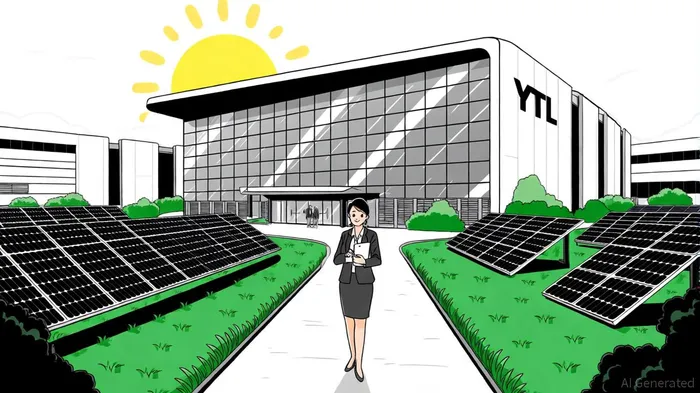
YTL's commitment to decarbonization is central to its long-term strategy. The company aims to reduce carbon emissions by 30% by 2025 and achieve carbon neutrality by 2050[3]. Key initiatives include a 50 MW solar project in Malaysia, a 30 MW plant in Jordan, and a 20-year power purchase agreement (PPA) for renewable energy[4]. The YTL Green Data Center Park, co-powered by on-site solar energy, further cements its role as a pioneer in sustainable infrastructure[2].
While these projects align with global ESG trends, scalability remains a challenge. The 2024 Sustainability Report emphasizes embedding ESG goals into operations but lacks detailed financial projections for renewable energy investments beyond 2025[1]. This opacity complicates assessments of how these initiatives will contribute to long-term growth metrics.
Assessing Scalability: Balancing Ambition and Realism
YTL's growth model hinges on two pillars: leveraging its utilities and infrastructure assets for stable cash flows and scaling renewable energy ventures to capitalize on decarbonization. The company's RM96.2 billion asset base[3] provides a solid foundation, but scaling renewable projects requires significant capital and regulatory alignment.
A critical risk lies in the mismatch between profitability and revenue growth. While YTL's net income CAGR of 75.48% suggests strong operational efficiency, the lack of top-line momentum could limit reinvestment capacity. Additionally, the 12% decline in 2025 net income highlights vulnerability to cost pressures[4]. For the 73% CAGR claim to hold, YTL must demonstrate that its renewable energy ventures can generate scalable returns without eroding margins.
Conclusion: A High-Conviction Bet with Caveats
YTL Corporation Berhad's strategic pivot toward sustainability positions it as a compelling player in Malaysia's energy transition. Its profitability growth and renewable energy initiatives reflect a clear vision, but the absence of detailed scalability projections and the recent dip in net income underscore the need for caution. Investors should monitor the company's ability to balance capital allocation between high-margin utilities and capital-intensive renewables while navigating macroeconomic headwinds.







Comentarios
Aún no hay comentarios