
Youxin Technology's 1-for-80 Share Consolidation and Its Strategic Implications
Youxin Technology Ltd (Nasdaq: YAAS) has taken an aggressive step to avoid delisting from Nasdaq by executing a 1-for-80 share consolidation, reducing its outstanding Class A ordinary shares from 171.26 million to 2.14 million [1]. While the move aligns with Nasdaq's minimum bid price requirements, its strategic implications for investor perception and operational efficiency remain contentious. This analysis evaluates the consolidation's potential to stabilize the company's market position or exacerbate existing challenges.
Investor Perception: A Double-Edged Sword
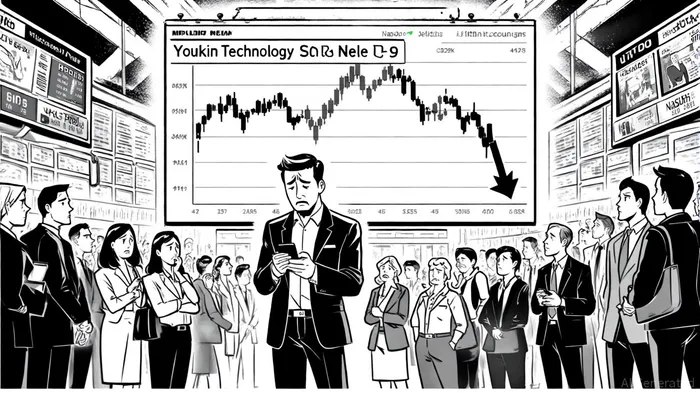
Share consolidations, particularly at extreme ratios like 1-for-80, are often interpreted as signals of desperation rather than strength. According to a report by Investopedia, reverse splits are frequently associated with companies facing delisting risks or insolvency, eroding investor confidence [4]. Youxin's stock plummeted 26.8% following the Nasdaq delisting notice on September 22, 2025, underscoring market skepticism [3]. While the consolidation temporarily raises the share price—bringing it closer to $1.00—it does not address underlying operational weaknesses, such as declining revenue or poor profitability.
Historical precedents highlight this duality. Apple's 2-for-1 reverse split in 2000 restored institutional investor confidence and catalyzed a long-term bull run [2]. Conversely, companies like Mullen Automotive, which executed a 1-for-100 split in 2024, saw their stock prices collapse by 99% in the same year [5]. Youxin's situation mirrors the latter: its consolidation appears reactive rather than proactive, potentially deepening perceptions of instability.
Operational Efficiency: Illusion Over Substance
From an operational standpoint, the consolidation reduces administrative complexity by decreasing the number of shares outstanding and simplifying shareholder records. However, as noted in a 2025 study on financial sector consolidation, such moves rarely yield meaningful efficiency gains unless paired with substantive business reforms [6]. Youxin's operations remain unaffected by the consolidation, and its appeal to Nasdaq's Hearings Panel suggests the company has yet to demonstrate sustainable compliance with listing standards [1].
The consolidation's primary benefit—meeting Nasdaq's $1.00 bid price threshold—is temporary. If the company fails to improve its fundamentals, the market may view the higher share price as artificial, leading to further sell-offs. For example, Lucid Group's 1-for-10 reverse split in August 2025 briefly boosted its stock to $19.80 but did not resolve supply chain or profitability issues [7]. Youxin's appeal process, which delays delisting, buys time but does not guarantee long-term viability.
Strategic Alignment: A High-Stakes Gamble
Youxin's decision to pursue a 1-for-80 consolidation reflects a high-risk strategy. While it aligns with Nasdaq's regulatory requirements, it diverges from best practices observed in successful tech company consolidations. For instance, Booking Holdings' 1-for-6 split in 2023 was part of a broader restructuring that included cost-cutting and market expansion, ultimately driving a 22,000% stock price increase [8]. YouxinYAAS--, by contrast, lacks a clear roadmap for operational or financial turnaround.
The company's reliance on regulatory appeals rather than substantive reforms raises questions about its strategic coherence. As Forbes notes, effective consolidations require cultural alignment and operational integration, not just financial engineering [9]. Without addressing root causes of its decline—such as declining user engagement or competitive pressures—Youxin's consolidation risks becoming a short-term fix with long-term consequences.
Conclusion: A Desperate Measure in a Desperate Situation
Youxin's 1-for-80 share consolidation is a calculated but precarious move. While it temporarily averts delisting, it fails to address the company's operational and financial challenges. Investor perception remains clouded by skepticism, and operational efficiency gains are limited without broader reforms. The case of Youxin underscores a broader trend: high-ratio reverse splits are often harbingers of decline rather than catalysts for growth. For investors, the consolidation should be viewed as a red flag, not a sign of recovery.





Comentarios
Aún no hay comentarios