
YouTube's Rising Influence in the Streaming and Content Ecosystem: A Strategic Disruptor and Long-Term Investment Opportunity
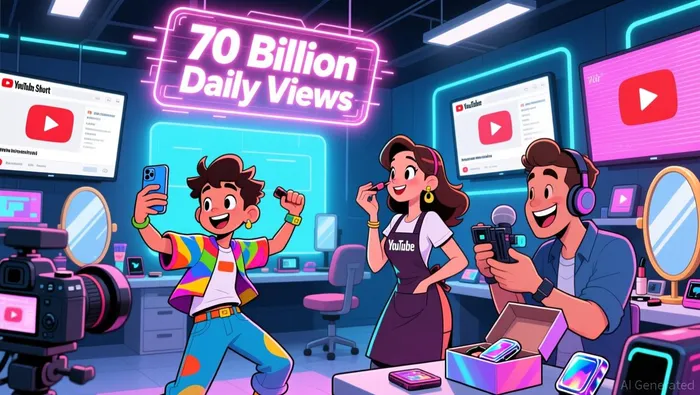
In the evolving landscape of digital media, YouTube has emerged as a formidable force, reshaping how audiences consume content and how creators monetize their work. With 2.7 billion monthly active users in 2023 and YouTube Shorts amassing 70 billion daily views by February 2024, the platform's dominance is undeniable. This growth is not merely quantitative but transformative, as YouTube's creator-driven model challenges traditional streaming giants and redefines the competitive dynamics of the industry. As the bidding war for Warner Bros.WBD-- Discovery (WBD) intensifies, YouTube's strategic position as a disruptor becomes increasingly critical, offering compelling insights for investors seeking exposure to the next phase of media evolution.
YouTube's Strategic Position as a Disruptor
YouTube's ascendancy is rooted in its ability to democratize content creation while maintaining a robust financial ecosystem. The platform's creator economy added over $55 billion to the U.S. GDP in 2024, underscoring its economic significance. This growth is fueled by a dual strategy: leveraging short-form content (via YouTube Shorts) to capture younger audiences and expanding into live sports and premium subscriptions to diversify revenue streams. For instance, YouTube's $2 billion NFL Sunday Ticket deal and its recent exclusive NFL game rights highlight its pivot into live broadcasting, a domain traditionally dominated by cable networks.
 This disruption is particularly relevant in the context of the WBDWBD-- bidding war. Netflix's $27.75-per-share offer for WBD faces competition from Paramount's $30-per-share all-cash bid, with market speculation favoring the latter. However, Netflix has strategically positioned YouTube as a counterargument to anti-competitive concerns, citing Nielsen data showing YouTube's 12.4% U.S. TV viewership share-surpassing Netflix's 8.2%-as evidence of a competitive landscape. By emphasizing YouTube's role as a "natural check" on market concentration, Netflix aims to justify its bid while highlighting the platform's broader influence.
Long-Term Investment Potential
YouTube's financial trajectory further solidifies its appeal as a long-term investment. Projected to generate $45.6 billion in revenue in 2025-$36 billion from advertising and $9.6 billion from YouTube Premium subscriptions-the platform is on track to rival Netflix's $46.2 billion in total video revenue. By 2030, the global video streaming market is expected to reach $416.8 billion, with YouTube's 2+ billion user base and AI-driven ad tech positioning it to capture a significant share.
The creator economy, a cornerstone of YouTube's ecosystem, is also poised for explosive growth. Goldman Sachs estimates the sector could expand to $480 billion by 2027, driven by AI-powered tools that lower production costs and enable creators to scale their businesses. Startups like ElevenLabs and Runway, which raised $180 million and $308 million respectively in 2025, exemplify the innovation fueling this growth. For investors, this signals opportunities in AI-driven content tools, audience monetization platforms, and niche verticals such as educational content (via Teachable) or celebrity interactions (via Cameo).
Investment Vehicles and Strategic Exposure
For investors seeking direct exposure to YouTube's ecosystem, Alphabet (GOOGL) remains the primary vehicle, given its ownership of YouTube and its AI-driven ad tech. However, the creator economy's diversification into AI tools and social commerce platforms opens additional avenues. ETFs like the Global X Artificial Intelligence & Technology ETF (AIQ) and the iShares Future Exponential Technologies ETF (XT) offer indirect exposure to AI innovations underpinning the creator economy.
Venture capital is also a critical lever. In 2025, over $900 million was deployed into AI-integrated creator startups, with firms like Andreessen Horowitz and Benchmark leading the charge. Notable investments include ShopMy ($77.5 million) and Whatnot ($265 million), which enable creators to monetize through e-commerce and live shopping. These platforms reflect a broader trend: institutional capital is increasingly viewing top creators not as individual influencers but as scalable media companies with diversified revenue streams.
Conclusion
YouTube's strategic position as a disruptor in the WBD bidding war and its long-term investment potential are inextricably linked. By leveraging its creator-driven model, AI-driven ad tech, and expansion into live sports, YouTube is not only challenging traditional media but also redefining the rules of the streaming ecosystem. For investors, prioritizing exposure to Alphabet, AI-focused ETFs, and AI-integrated creator platforms offers a pathway to capitalize on this transformation. As the media industry continues to fragment, YouTube's ability to adapt and innovate will remain a defining factor in its-and the broader creator economy's-success.







Comentarios
Aún no hay comentarios