
YouTube's Policy Shift and Creator Economy Resilience: Evaluating Long-Term Investment Potential in Digital Content Platforms
In 2025, YouTube's seismic policy shifts redefined the creator economy, prioritizing authenticity over algorithmic shortcuts. The platform's new monetization rules, enforced from July 15, 2025, demonetized AI-generated, faceless, and repetitive content, demanding creators demonstrate "clear human involvement" through original scripting, narration, or transformative editing, as detailed in the YouTube monetization rules. This recalibration wasn't just a regulatory pivot-it was a strategic repositioning to preserve YouTube's value proposition in an era of content oversaturation. For investors, the question is no longer whether YouTube can sustain growth, but how its evolving ecosystem will shape the future of digital content as a $1.3 trillion market by 2033, according to an industry report.
Policy Changes: A Filter for Quality, Not Quantity
YouTube's 2025 updates raised the bar for monetization, requiring 1,500 subscribers and 5,000 watch hours over 12 months-up from 1,000 subscribers and 4,000 watch hours, per the YouTube policy update. The platform also introduced human reviewers to audit flagged content, reducing erroneous demonetization and stabilizing creator revenue streams, as noted in a VIDIQ analysis. While these changes initially caused turbulence, they've accelerated a natural selection process: channels reliant on AI-generated or repurposed content are collapsing, while those producing original, high-effort content-educational tutorials, personal storytelling, and niche expertise-are thriving.
For example, creators leveraging AI tools like multi-language dubbing and localized thumbnails now see 30–50% higher engagement in markets like India and Brazil, as reported in a YouTube trends article. Meanwhile, gaming and educational channels that added voice-over commentary to gameplay or curated content have retained monetization, proving that technology can enhance-not replace-human creativity.
User Behavior: The Rise of "Session-Based Retention"
YouTube's algorithm now prioritizes session-based retention, rewarding creators who build watch loops between Shorts, live streams, and long-form content, according to a retention analysis. This shift aligns with user behavior: 70% of viewers now spend 20+ minutes per session, up from 12 minutes in 2023, per a viewership analysis. Shorts remain a discovery engine, but monetization hinges on converting viral views into long-form engagement. Creators who mastered this strategy-such as POV-style Shorts linking to 10-minute tutorials-saw RPMs (revenue per thousand views) jump from $1.20 to $5.80 in Q3 2025, according to a monetization update.
However, the policy's emphasis on originality has also fragmented the creator base. While 5% of full-time creators earn $100k+, over 50% now make less than $15k annually, according to a Grand View Research report. This bifurcation mirrors broader economic trends: the creator economy is professionalizing, with top channels raising institutional capital and adopting balance-sheet strategies akin to traditional media companies, as discussed in a Forbes piece.
Financial Performance: A $550 Billion Moat
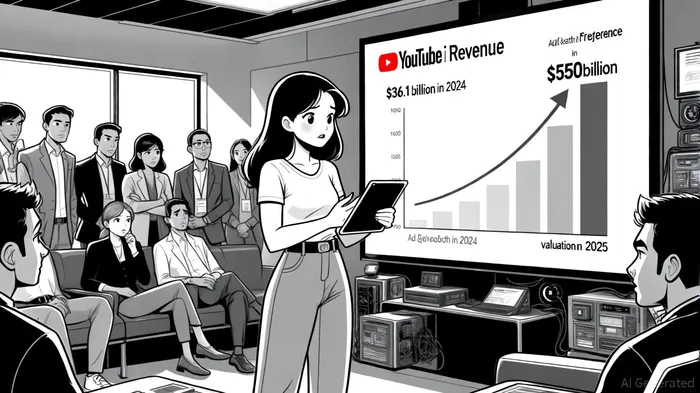
YouTube's financials underscore its dominance. In 2024, ad revenue hit $36.1 billion, with Q4 2024 alone generating $10.47 billion-driven by AI-driven ad targeting and brand partnerships, per Resourcera data. Subscription services (YouTube Premium, YouTube TV) added $14.5 billion, with 122 million Premium users providing stable, recurring revenue, according to ThumbnailTest stats. Alphabet's $100 billion cash reserves further insulate YouTube from volatility, enabling investments in AI moderation tools and global expansion, as highlighted in a HighRadius analysis.
Yet challenges persist. Regulatory scrutiny over antitrust and content moderation-particularly in the EU and India-could force costly compliance overhauls, warned in the KPMG outlook. Meanwhile, TikTok and Instagram Reels are eroding YouTube's short-form dominance, though YouTube's $29.71 billion brand value and 2.74 billion monthly active users (projected to hit 3 billion by 2026) provide a formidable moat, per the YouTube impact report.
Investor Trends: From Speculation to Strategic Playbooks
The creator economy's maturation has attracted institutional capital. In 2025, M&A activity surged, with marketing solutions firms and creator-first platforms securing $12.3 billion in funding-up 40% YoY, according to a Forbes forecast. Private equity firms like KKR and Blackstone are acquiring creator agencies, while fintech startups like Willa are solving cash-flow challenges for independent creators, as examined in a Lewis Silkin analysis.
Investors now prioritize creators who diversify revenue streams: 42% of brand budgets now go to micro-influencers, and 68% of top creators use memberships or Super Thanks to offset ad revenue declines, per an Influencer report. This shift mirrors the broader market's move toward ESGT (environment, society, governance, technology) alignment, with platforms like YouTube leveraging AI to reduce carbon footprints in content delivery, as outlined in the ESGT megatrends.
Regulatory and Economic Risks: Navigating the Unknown
Global regulatory shifts-such as the U.S. 2025 reconciliation act and higher tariffs-pose indirect risks. Tariffs could inflate production costs for creators reliant on global supply chains, while immigration policies may limit access to multilingual talent, per the CBO report. However, YouTube's localized strategies (e.g., dubbing in 15 languages) mitigate these risks, ensuring 60% of its growth comes from non-English markets, according to Analytics Insight stats.
Longer-term, the creator economy's projected $1,345 billion valuation by 2033 hinges on YouTube's ability to balance regulation with innovation. The platform's recent foray into AI-powered content tools-while controversial-could democratize high-quality production, enabling 100 million new creators to monetize by 2030, as suggested in The Ankler report.
Conclusion: A Resilient Investment Thesis
YouTube's 2025 policy changes are not a setback but a catalyst for long-term value creation. By filtering out low-quality content and rewarding authentic creators, the platform is fortifying its position as the digital content ecosystem's linchpin. For investors, the key is to focus on creators and platforms that adapt to these shifts-those who blend human creativity with AI efficiency, build diversified revenue models, and navigate regulatory landscapes proactively.
The creator economy's resilience lies in its duality: it's both a disruptive force and a stabilizing one. As YouTube's valuation climbs toward $550 billion and the creator economy nears $1.3 trillion, the winners will be those who see policy changes not as barriers, but as blueprints for the future.







Comentarios
Aún no hay comentarios