
New York Times Headlines Today: What Investors Need to Know
The New York Times has a knack for shaping public discourse — and today’s headlines are no exception. For investors and financial enthusiasts, the latest stories highlight how everyday spending, international trade, and monetary policy are all colliding in ways that can directly affect your portfolio. From price disparities on Instacart to a Trump-backed chip deal with China, today’s news spans multiple economic sectors and offers a snapshot of the forces shaping tomorrow’s markets. Here’s what you need to know before the market closes.
Core facts and definitions — What's making headlines today
A surprising revelation from a new study shows that grocery prices are far from consistent — even at the same store. Volunteers in Washington, D.C., found that the same items like eggs and Skippy peanut butter had wildly different prices depending on who was logged into Instacart. For example, one user paid $3.99 for eggs while another paid nearly $4.80 for the exact same product. The research, conducted by Groundwork Collaborative and Consumer Reports, highlights how online pricing algorithms can lead to significant cost differences across nearly 20 items.
Meanwhile, President Trump is making headlines again — this time with a policy shift that could reshape tech trade dynamics. After intense lobbying from Nvidia’s CEO, Jensen Huang, Trump has allowed the sale of H200 AI chips to China — but with a 25% tax on each transaction. The move has raised questions about how trade decisions balance economic interests with national security concerns. However, early reports suggest that China may not be eager to buy these chips due to the growing strength of its domestic semiconductor industry.
Key drivers and developments — From groceries to geopolitics
The grocery price findings are more than just a shopping tip — they reflect deeper issues with digital pricing models and consumer behavior. As more consumers move their purchases online, algorithms are increasingly determining what people pay for goods. This could lead to growing calls for transparency or regulation in online marketplaces, especially as the study shows that price gaps can be substantial.
On the policy front, Trump has also announced a $12 billion bailout for U.S. farmers impacted by his trade policies — a move that underscores the growing affordability crisis in the U.S. 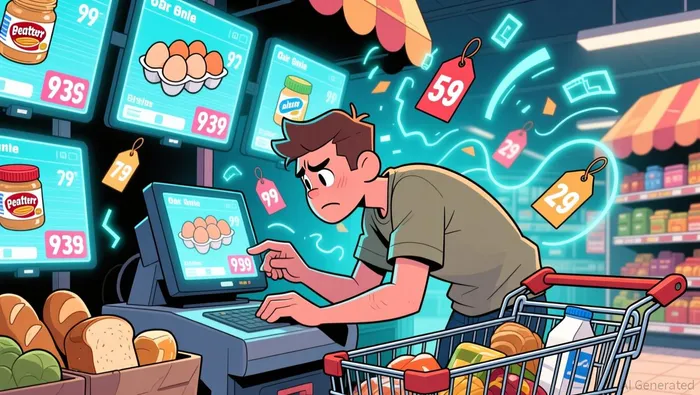 Despite dismissing the issue as a "hoax," Trump's own policies have reportedly cost the average American family $2,250 in 2025 spending power when accounting for inflation, wages, and tariffs. This comes as the Federal Reserve is set to make another key decision on interest rates, with some analysts predicting a 25-basis-point cut.
Internationally, China's trade resilience continues to be a key factor in global markets. Despite external challenges, the country's foreign trade in goods has remained strong in the first 11 months of 2025. As geopolitical tensions remain high, China's ability to maintain economic growth will likely remain a focal point for global investors.
What it means for investors — Market implications and trends
For retail investors, these headlines highlight three main themes: pricing transparency in e-commerce, trade policy volatility, and the evolving role of artificial intelligence in global markets. The grocery price discrepancies, while frustrating for consumers, could eventually lead to more regulatory oversight — a change that could impact how online retailers operate and price their products. If transparency rules emerge, companies like Instacart and Amazon may need to adjust their pricing strategies, potentially affecting their profit margins.
The Trump-Nvidia-China deal also raises questions about how trade policies will continue to influence tech stocks. While the H200 chip may represent a short-term win for NvidiaNVDA--, long-term gains may depend on how China chooses to use or limit these products. Meanwhile, the U.S. semiconductor industry — and the broader tech sector — will likely remain under the microscope as domestic manufacturing initiatives ramp up according to the latest analysis.
Lastly, the Federal Reserve's upcoming rate decision is a key event for investors to watch. A rate cut, even if modest, could signal a shift in the Fed's strategy to manage inflation while supporting economic growth. Given Trump's public pressure on Fed Chair Jerome Powell to cut rates more aggressively, the central bank's decisions will likely remain politically charged.
A forward-looking conclusion — Staying informed in a shifting landscape
Investors today need to look beyond the daily headlines and understand the broader forces at play. From grocery pricing to AI exports to trade policy, the interconnected nature of modern markets means that seemingly small decisions can have large, lasting impacts. As the economy moves into the final stretch of 2025, staying informed — and thinking ahead — will be key to navigating the twists and turns ahead.





Comentarios
Aún no hay comentarios